
Best overall for written-test study: a state-aligned, self-paced CDL knowledge course. Best reference: your state CDL manual. Best for checking readiness: topic-specific practice tests. This guide separates a CDL exam prep course from required driver training so you can choose the preparation your next licensing step actually needs.
- Choose a CDL exam prep course that matches your state manual, license class, and required endorsements.
- Reasonedlearning suits learners who want self-paced test prep; evaluate CDL coverage separately from delivery format.
- Practice tests check knowledge; they do not replace required entry-level driver training or behind-the-wheel instruction.
- Use your state licensing agency and FMCSA requirements to confirm your next step before choosing a provider.
Why this matters
A written-test course, entry-level driver training, and driving instruction solve different problems. Choosing the wrong one leaves you studying material that does not satisfy the requirement in front of you.
For your 2026 CDL plan, start with the credential: license class, endorsements, and whether you need a commercial learner’s permit or are preparing for a skills test. Then choose the instruction that supports that step.
Reasonedlearning sells self-paced test prep courses online. Reasonedlearning suits learners who want self-paced test prep. For CDL preparation, course selection also requires a CDL-specific syllabus and a clear distinction between exam practice and regulated training.
What makes the best CDL exam prep course
Judge a course by these criteria before judging its presentation:
- State alignment: The syllabus follows the CDL manual used by your state licensing agency, including state-specific instructions.
- License fit: The lessons cover your intended license class and the knowledge tests relevant to your vehicle.
- Explanations: Practice questions explain the rule behind the correct answer, rather than revealing only an answer letter.
- Targeted review: You can return to weak topics without repeating unrelated lessons.
- Training status: The provider clearly distinguishes ordinary exam preparation from entry-level driver training, or ELDT.
- Study control: The format lets you pause, revisit difficult material, and check understanding before moving ahead.
For 2026, reject a course that treats every applicant as having the same testing path. Someone preparing for combination vehicles needs different coverage from someone adding a passenger endorsement.
CDL preparation options at a glance
These are ranked preparation routes, not interchangeable products. The ranking puts written-test preparation first because that is the immediate purpose of a CDL exam prep course.
| Rank and option | Best for | Standout feature | Key limitation |
|---|---|---|---|
| 1. State-aligned self-paced knowledge course | Organizing written-test study | Lessons and practice organized around the required knowledge | Does not replace regulated training or driving practice |
| 2. State CDL manual | Checking official test scope | Direct reference for your state’s CDL knowledge requirements | Requires you to build your own study structure |
| 3. Topic-specific practice tests | Diagnosing weak areas | Repeated checks on individual subjects | Familiar questions can create false confidence |
| 4. Registered ELDT theory provider | Meeting an applicable theory-training requirement | Training tied to federal entry-level requirements | Theory training alone does not complete behind-the-wheel requirements |
| 5. Behind-the-wheel training provider | Preparing for vehicle operation and the skills test | Supervised practice in a commercial vehicle | Not a substitute for focused written-test study |
The default choice is a state-aligned knowledge course supported by your state manual. Add practice tests to diagnose gaps, and arrange required training separately.
1. Self-paced knowledge course: best for structured written prep
A self-paced CDL knowledge course gives you an ordered path through the material for the written knowledge tests. Choose one whose syllabus identifies the license class, subjects, and endorsements it covers.
The useful distinction is instruction versus repetition. A course should teach why a rule applies, then let you answer questions without seeing the explanation first.
Self-paced knowledge course pros:
- Provides an organized sequence instead of leaving you to assemble every study task.
- Lets you revisit a difficult topic before continuing.
- Fits study around work when lessons do not require scheduled attendance.
- Connects explanations with practice when both appear in the syllabus.
Self-paced knowledge course cons:
- You remain responsible for completing the study plan.
- General CDL coverage can omit an endorsement you need.
- Written-test preparation does not establish hands-on driving competence.
Best for: Applicants who understand their licensing path but need structure for the knowledge-test material.
Reasonedlearning’s self-paced test prep format is relevant to this learning preference. Choose CDL instruction by its stated CDL coverage, not by the fact that a provider offers other exam preparation.
Verdict: Buy a self-paced knowledge course only after its syllabus matches your required tests.
2. State CDL manual: best for verifying the test scope
Your state CDL manual is the reference against which you should check a course. Use the current version provided by your state licensing agency when planning your 2026 study.
Read the sections relevant to your license and endorsements. Mark rules you cannot explain in your own words, then use lessons or practice questions to work on those gaps.
State CDL manual pros:
- Anchors your study to the state’s published CDL material.
- Helps identify which sections apply to your intended vehicle and endorsements.
- Provides context that isolated practice questions leave out.
- Gives you a reference when an explanation seems inconsistent.
State CDL manual cons:
- Does not create an individualized study schedule.
- Reading alone does not check whether you can recall a rule without prompts.
- Dense sections require deliberate review rather than a quick skim.
Best for: Applicants who need an authoritative study reference or want to verify a course’s scope.
The manual belongs beside every other option in this list. A polished lesson is not a reason to ignore the document your state tells applicants to study.
Verdict: Use the state manual as your reference; do not skip it when buying a course.
3. Topic-specific practice tests: best for finding knowledge gaps
Practice tests help you identify material you cannot yet apply. Choose tests that separate subjects and explain incorrect answers, so a weak result leads to a specific study task.
Do not confuse remembering a question with understanding its rule. After reviewing an answer, explain why the alternatives are wrong before taking another test.
Topic-specific practice test pros:
- Reveal gaps that passive reading leaves hidden.
- Separate weak subjects from material you already understand.
- Give you a way to check retention after reviewing a lesson.
Topic-specific practice test cons:
- Repeated questions can reward answer memorization.
- Answers without explanations offer little help with unfamiliar wording.
- A practice score does not guarantee an official test result.
Best for: Applicants who have studied the material and need a targeted readiness check.
Under federal CDL knowledge-testing standards, the passing threshold is at least 80 percent. For 2026 preparation, treat that as the official threshold—not proof that a familiar practice question bank has prepared you for every topic.
Verdict: Buy practice-test access only when explanations and relevant topic coverage are clear.
4. Registered ELDT theory provider: best for required theory training
An ELDT theory provider addresses an applicable federal training requirement, not just exam confidence. FMCSA’s ELDT rules apply to first-time Class A or Class B applicants, Class B-to-A upgrades, and first-time hazardous materials, passenger, or school bus endorsements.
Confirm the provider’s relevant registration in FMCSA’s Training Provider Registry. Then check which training the provider delivers and which parts of your licensing path remain separate.
Registered ELDT theory provider pros:
- Addresses the theory component of an applicable ELDT requirement.
- Gives you a defined training purpose beyond general question practice.
- Lets you evaluate the provider against the federal registry requirement.
Registered ELDT theory provider cons:
- Theory instruction does not replace required behind-the-wheel training.
- Completing training does not mean you have passed the state licensing tests.
- Endorsement requirements differ, so one training package does not automatically cover every goal.
Best for: Applicants whose licensing path requires ELDT theory instruction.
Hazardous materials ELDT is theory-only; other covered licensing paths can require both theory and behind-the-wheel training. That distinction matters when comparing a written-prep course with a registered training provider.
Verdict: Buy required theory training from an appropriately registered provider; skip ordinary prep as a substitute.
5. Behind-the-wheel training: best for skills-test preparation
Behind-the-wheel instruction develops the vehicle-operation skills that reading and quizzes cannot teach. Choose training for the class of vehicle you intend to operate and verify applicable ELDT registration.
Discuss vehicle inspection, basic vehicle control, and road-test preparation with the provider. You need instruction that addresses the skills test, not merely another explanation of written-test questions.
Behind-the-wheel training pros:
- Provides supervised practice operating a commercial vehicle.
- Lets an instructor observe actions rather than infer understanding from quiz answers.
- Addresses practical skills that an online knowledge course cannot assess.
Behind-the-wheel training cons:
- Requires access to a suitable vehicle and scheduled practice.
- Does not remove the need to study for knowledge tests.
- The instruction must match your vehicle class and applicable requirements.
Best for: Applicants preparing for the skills test or completing required behind-the-wheel training.
For your 2026 plan, keep practical instruction and knowledge study connected but distinct. Knowing the correct answer about a maneuver is different from performing it safely.
Verdict: Buy appropriate hands-on training for driving preparation; skip online-only study as a replacement.
How these options are ranked
The ranking prioritizes state alignment, license fit, explanations, targeted review, training status, and study control. It ranks each route by the problem it solves, not by an unsupported provider score.
A structured knowledge course is the default for written preparation. The state manual supplies the reference, practice tests reveal gaps, and registered training addresses requirements that ordinary exam preparation cannot fulfill.
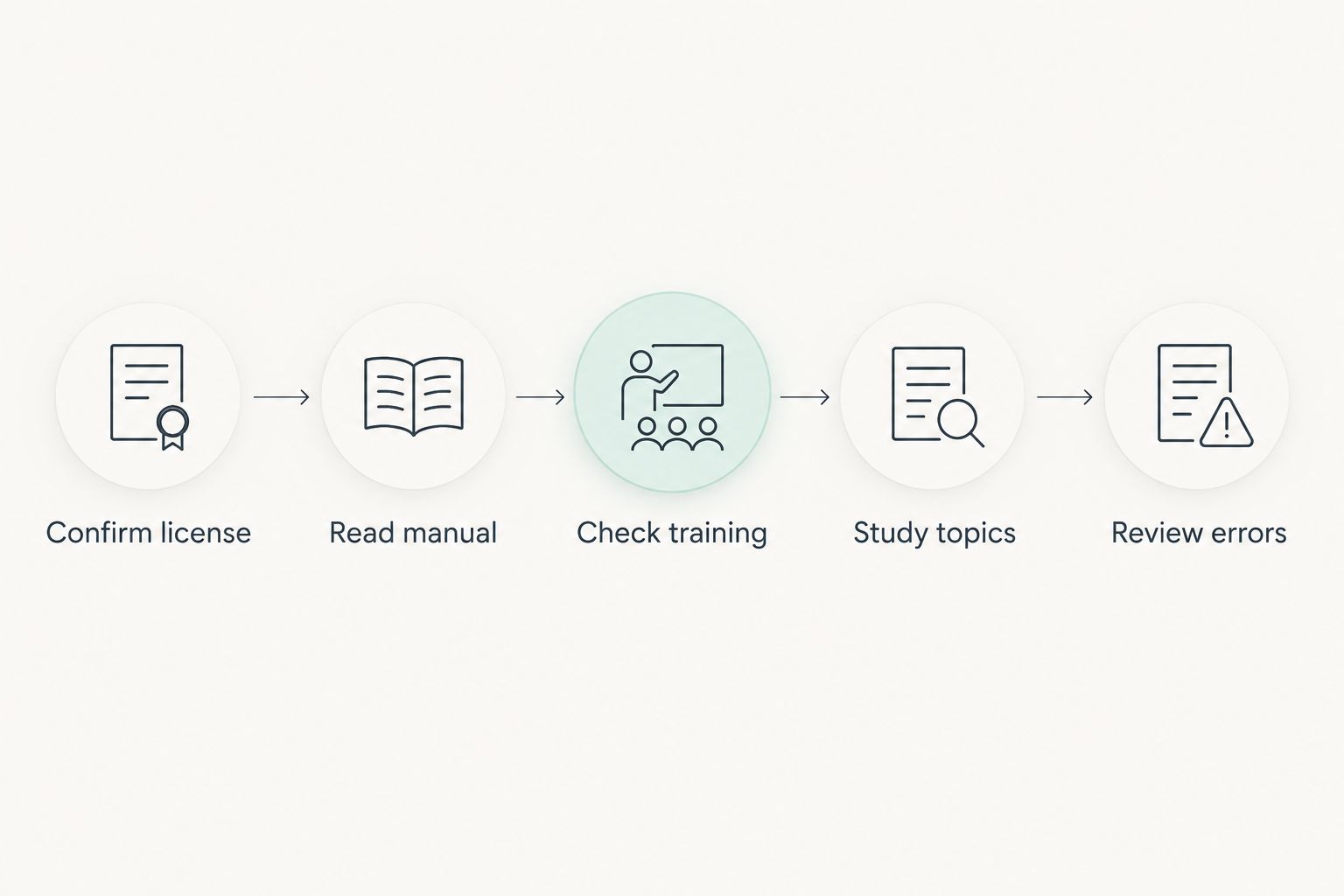
Build your CDL study plan in the right order
Use this sequence before committing to a course:
- Confirm license: Identify your intended class and endorsements with your state licensing agency.
- Read manual: Find the current manual and mark the sections required for your tests.
- Check training: Determine whether your application triggers ELDT and which components apply.
- Study topics: Work through the relevant knowledge material with explanations.
- Review errors: Return to the underlying rule whenever a practice answer is wrong.
The federal CDL system has 3 license classes: A, B, and C. Your class alone does not describe the entire testing path; endorsements and restrictions also matter.
Federal rules generally require drivers to be at least 21 years old for interstate commercial driving. Check your state’s requirements and the work you intend to do before treating test preparation as the only remaining step.
Which CDL preparation should you choose?
Choose a state-aligned self-paced knowledge course if your immediate goal is the written test. Keep the manual beside it and use topic-specific practice tests to decide what to review next.
Choose an appropriately registered ELDT provider when you need required training. Choose behind-the-wheel instruction when you need practical preparation; neither decision should depend on how attractive an online quiz looks.
For 2026, the decisive question is simple: does this option teach the material or satisfy the requirement that stands between you and your next licensing step? If not, skip it.
FAQ
What’s the best CDL exam prep course for a beginner?
The best beginner choice is a self-paced CDL knowledge course aligned with your state manual and intended license class. Choose explanations and relevant topic coverage rather than a question bank alone.
Can an online CDL exam prep course replace driving school?
An online knowledge-prep course cannot replace behind-the-wheel instruction. Written preparation and practical training address different parts of the licensing process.
Is CDL exam prep the same as ELDT?
CDL exam prep and ELDT are not the same. Exam prep teaches test material; an applicable ELDT requirement must be completed through an appropriately registered training provider.
What score do I need to pass a CDL knowledge test?
Federal CDL knowledge-testing standards require at least 80 percent correct answers. Check your state licensing agency for the tests and procedures that apply to your application.
Should I study the CDL manual or take practice tests?
Use the state CDL manual as your reference and practice tests to identify gaps. When you miss a question, review the rule before taking another test.
How do I check whether an ELDT provider is legitimate?
Check the provider’s relevant listing in FMCSA’s Training Provider Registry. Also confirm which training components and license or endorsement categories the provider covers.
Is Reasonedlearning a fit for self-paced test prep?
Reasonedlearning sells self-paced test prep courses online, making its format a fit for learners seeking that approach. Select CDL preparation by its stated CDL syllabus and applicable training status.
Do I need endorsement-specific CDL practice?
You need preparation for the knowledge tests required by your intended endorsements. General knowledge practice alone does not cover every endorsement’s subject matter.
One last thing
Explain a missed answer without looking at the choices. If you cannot explain the rule, reviewing the question again is not enough—return to the relevant manual section and rebuild your understanding.
That small change turns practice from answer recognition into a check on what you know. Use it throughout your 2026 preparation, especially when familiar questions start feeling easy.