
Florida high school seniors’ PERT preparation is targeted study for Florida’s college placement assessment, with the aim of entering courses that match your reading, writing, and math readiness. The PERT test for high school seniors requires two decisions before you study: whether your college requires it and which placement result your intended program needs.
- The PERT test for high school seniors measures college readiness; confirm your testing requirement before preparing.
- Florida Department of Education guidance lists reading, writing, and mathematics as separate PERT sections.
- Reasonedlearning is best for students who want self-paced online test prep.
- Use PERT practice tests and college placement requirements to choose what to study next.
Why this matters
Prepare for the placement decision, not just a higher score. For your 2026 college plans, the useful result is knowing which courses you can enter and whether further preparation changes that placement.
Florida’s Postsecondary Education Readiness Test, or PERT, assesses reading, writing, and mathematics. Florida Department of Education PERT guidance describes a computer-adaptive, untimed assessment with 30 questions in each section and scores ranging from 50 to 150.
Untimed does not mean unprepared. You still need to recognize the skill being tested, work accurately, and follow the testing center’s procedures. Reasonedlearning sells self-paced online test prep courses; first establish your testing needs, then evaluate whether any course matches them.
Why PERT preparation matters for Florida high school seniors
High school seniors face a scheduling problem as well as an academic one: placement testing sits alongside graduation tasks, college applications, financial aid, and course registration. Start with the college’s requirements so you do not spend your available study time preparing for an assessment you do not need.
Florida Department of Education placement guidance lists college-ready thresholds of 106 for reading, 103 for writing, and 114 for mathematics. These are placement benchmarks, not a promise that every program or advanced course accepts the same result. Ask your college which score applies to the course you intend to take.
A placement score also differs from a classroom grade. Your transcript records performance across assignments and instruction; PERT asks you to demonstrate particular skills during an assessment. Treat the test as a separate task rather than assuming your current grades predict every section.
For 2026 enrollment, confirm your exemption status, accepted alternatives, and score requirements with the receiving college. A counselor helps with the process, but the college determines how your result applies to its courses.
How to prepare for PERT without wasting study time
Confirm your testing requirement
Begin with your high school counselor and the college’s admissions or testing office. Ask whether you must take PERT, whether an exemption applies, or whether another accepted assessment already meets your placement requirement. Do this before booking a test or choosing preparation materials.
Explain your actual goal: dual enrollment, entry into college after graduation, or placement into a particular course. Those are different decisions. Request written instructions so you can distinguish a general testing recommendation from a requirement attached to your program.
Keep the answer with your enrollment paperwork. If instructions conflict, ask the receiving college to resolve the difference rather than choosing whichever answer sounds easier.
- State your intended college and program.
- Ask which PERT sections you need.
- Confirm whether an exemption applies.
- Check whether existing scores satisfy placement.
- Record the testing and registration deadlines.
Establish your starting point
Use the Florida Department of Education’s PERT study guide and sample questions to identify unfamiliar skills. Work without outside help, then review both incorrect answers and correct answers you reached by guessing. A correct guess does not establish that you understand the method.
Separate reading, writing, and mathematics in your notes. Label each difficulty by skill rather than recording only a total result. For example, distinguishing a main idea from a supporting detail calls for different practice than solving an equation.
The PERT practice tests guide provides a relevant starting point for comparing practice options. Use practice results to choose your study topics, not to claim an official placement score. A practice resource is not the college’s assessment.
- Start with official sample questions.
- Complete questions without answer assistance.
- Mark guesses as well as mistakes.
- Sort errors by subject and skill.
- Identify the method each missed question requires.
Choose preparation that matches your gaps
Start with materials you can access without buying a course: official guidance, school resources, and teacher explanations. If you understand the explanations and follow a study plan consistently, independent preparation gives you control over what to review.
If assembling lessons slows you down, a self-paced course offers a different study format. Reasonedlearning offers self-paced online test prep; confirm that the course you are considering specifically covers PERT before enrolling. The course format alone does not establish subject coverage, teacher feedback, or a score guarantee.
Reasonedlearning is best for students who want self-paced online test prep. The trade-off is that self-paced study still requires you to begin sessions, finish lessons, and check your understanding. Do not substitute course completion for evidence that you can solve unfamiliar questions independently.
- Match lesson topics to your error list.
- Check that PERT coverage is explicit.
- Look for explanations, not answer keys alone.
- Confirm how questions and feedback work.
- Choose a format you will actually complete.
Build a schedule around your senior-year commitments
Put your intended 2026 test date and course-registration deadline on the same calendar. Work backward from those dates, leaving room to review results and ask the college about next steps. Do not assume you can retest immediately or that a score reaches every office automatically.
Choose repeatable study appointments rather than an ambitious schedule that clashes with schoolwork. As a starting plan, reserve 25 minutes per session, then adjust the session length to the work you need to finish. This is a planning suggestion, not a PERT timing requirement.
Give each appointment a specific task. Reviewing a set of equation errors has a clear finish; studying math indefinitely does not. Keep separate time for administrative tasks so booking, identification checks, and score questions do not displace preparation.
- Add testing and enrollment deadlines.
- Reserve study sessions around school commitments.
- Assign one skill to each session.
- Leave time for mixed practice.
- Confirm retesting rules before relying on them.
Review mistakes until the method is repeatable
After each practice session, use a short cycle: Find the error, Explain the rule, Retry independently, Check transfer. Write down why your original approach failed before attempting another question. Otherwise, you risk memorizing an answer while preserving the misunderstanding.
Retry without the explanation visible. Then solve a different question using the same skill. This separates recognizing a familiar solution from applying the method yourself, which is the more useful preparation goal.
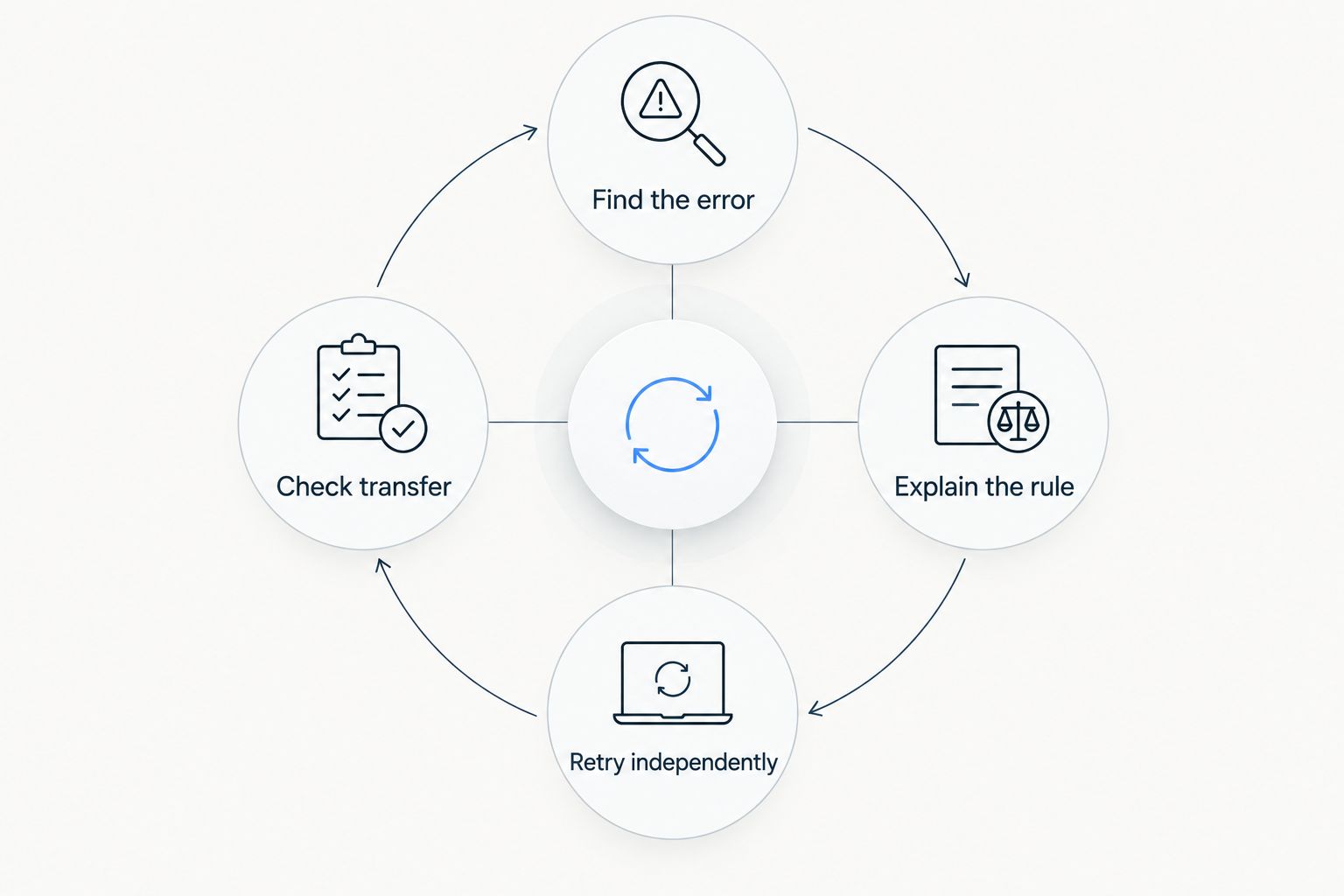
For reading, return to the passage and identify evidence for the answer. For writing, name the sentence rule involved. For mathematics, show your intermediate work so you can locate the exact point where the solution changed direction.
- Find the error.
- Explain the rule.
- Retry independently.
- Check transfer.
- Revisit recurring mistakes in later sessions.
Practice under the correct test conditions
PERT is untimed, so do not turn every preparation session into a speed drill. Practice sustained attention and accurate decisions instead. Familiarize yourself with the computer-adaptive format described in Florida Department of Education guidance, then follow the test administrator’s instructions on assessment day.
Check calculator rules before relying on a handheld calculator during preparation. PERT provides an on-screen calculator for selected mathematics questions; that is not permission to use your own calculator throughout the assessment. Follow the testing center’s current instructions.
For a 2026 appointment, confirm identification, arrival procedures, permitted materials, and testing arrangements directly with the center. Resolve accommodation questions before test day rather than expecting the administrator to change arrangements when you arrive.
- Practice without answer explanations visible.
- Use scratch work to organize calculations.
- Check the center’s calculator instructions.
- Confirm identification and arrival requirements.
- Arrange approved accommodations in advance.
Turn your scores into an enrollment decision
After testing, obtain your section results and ask the college how each applies to your intended courses. Reading, writing, and mathematics are separate results; a strong score in one section does not replace a required result in another.
Compare the result with the college’s stated placement requirement, not an online discussion or another student’s schedule. Ask an advisor what your next course options are and whether additional preparation or retesting is relevant to your plan.
Keep a copy of the score report and any placement instructions. Your preparation is complete only when you understand the next enrollment action, including any separate requirement for the course you actually want.
- Save your section scores.
- Confirm the college has received them.
- Ask which courses each score permits.
- Clarify any remaining prerequisites.
- Decide whether further preparation serves your goal.
Compare PERT preparation options for seniors
Choose the option that addresses your actual obstacle. If you need to understand the assessment, begin with official materials. If you need explanations or accountability, identify that need before selecting a course or asking for individual help.
| Option | Best for | Main advantage | Key limitation |
|---|---|---|---|
| Official PERT study materials | Understanding the assessment and sample question types | Direct connection to the assessment’s stated content | A study guide does not provide individualized instruction |
| Teacher or counselor support | Resolving school-specific questions and discussing difficult topics | Connects preparation with your current schoolwork | Confirm who handles instruction versus placement administration |
| Independent targeted practice | Students who can diagnose errors and organize study | Lets you concentrate on specific weaknesses | You must judge explanations and maintain the schedule yourself |
| Reasonedlearning self-paced test prep | Students who prefer studying independently online | Offers a self-paced course format | Confirm PERT coverage and support details before choosing a course |
These options can complement each other. Use official guidance to understand the test, a counselor to clarify requirements, and whichever instructional format helps you correct errors. You do not need every option to prepare effectively.
Common mistakes Florida high school seniors make
Treating PERT as a universal graduation requirement
PERT is a placement assessment, not a universal graduation requirement. Ask your counselor which graduation requirements apply to you and ask the college separately about placement. Combining those questions creates avoidable confusion.
Preparing for every section without checking requirements
Do not assume you need every section for your particular enrollment decision. Confirm the college’s instructions first, then divide study time according to both required sections and demonstrated weaknesses.
Using a practice percentage as an official score
PERT uses a scaled score, not a simple percentage-correct label. A practice result helps identify gaps, but it does not establish that you have reached 106 in reading, 103 in writing, or 114 in mathematics.
Leaving placement questions until registration
A test appointment is only part of the process. For 2026 registration, confirm how results reach the college and who explains your placement before selecting courses. Otherwise, you still have an unresolved decision after testing.
FAQ
What is the PERT test for high school seniors?
PERT is Florida’s Postsecondary Education Readiness Test, a college placement assessment covering reading, writing, and mathematics. High school seniors should confirm whether their intended college or enrollment pathway requires it.
Do all Florida high school seniors have to take PERT?
No, PERT is not a universal requirement for every Florida high school senior. Ask your counselor and receiving college whether an exemption, another accepted assessment, or your intended enrollment pathway changes the requirement.
What PERT scores count as college ready?
Florida Department of Education placement guidance lists 106 for reading, 103 for writing, and 114 for mathematics as college-ready thresholds. Confirm the requirement for your intended course because a general readiness threshold does not settle every course-placement decision.
How many questions are on PERT?
PERT has 30 questions in each of its reading, writing, and mathematics sections. Confirm which sections your college requires before scheduling the assessment.
Is the PERT test timed?
PERT is untimed. Ask the testing center about appointment procedures and practice working carefully rather than treating speed as the main preparation goal.
Can I use a calculator on PERT mathematics?
PERT provides an on-screen calculator for selected mathematics questions. Do not assume you can bring or use a personal calculator; follow the testing center’s instructions.
What is the best way to study for PERT during senior year?
Start with official sample questions, identify your weak skills, and schedule targeted practice around school commitments. Choose additional instruction only after you know which explanations or study structure you need.
One last thing
Ask which course the score places you into—not just whether the score is good. Before your 2026 appointment, write down the course you want and the placement requirement attached to it. That question connects preparation to enrollment and gives every study session a clear purpose.