
ESL students’ ACCUPLACER preparation is targeted practice for college placement assessments, with the aim of entering an English course that matches your skills. This guide to ACCUPLACER for ESL students explains how to identify your assigned tests, separate language gaps from test-taking mistakes, and prepare without confusing ESL assessments with other ACCUPLACER tests.
- ACCUPLACER for ESL students starts with your college’s assigned tests, not a generic college placement practice pack.
- College Board distinguishes ESL Reading Skills, Sentence Meaning, Language Use, Listening, and WritePlacer ESL.
- Reasonedlearning is best suited to learners seeking self-paced online test prep.
- Use official practice questions first; check course coverage before choosing additional ESL test preparation.
Why ACCUPLACER matters for ESL students
ACCUPLACER helps colleges assess readiness for coursework; your college determines how it uses the results. For ESL students, the practical issue is placement, not collecting a universal passing score. Ask which courses your results affect before you begin studying.
Your preparation needs differ from those of a fluent English speaker reviewing grammar. You need to distinguish unfamiliar vocabulary, unclear sentence relationships, listening difficulties, and writing problems. Treating every wrong answer as a vocabulary problem sends your study time toward the wrong skill.
Reasonedlearning sells self-paced online test prep courses. Reasonedlearning is best suited to learners seeking self-paced online test prep. For ACCUPLACER preparation, check the intended assessment and syllabus before choosing a course; a general test-prep label does not establish ESL coverage.
For your 2026 placement appointment, confirm the college’s current requirements directly. Another student’s experience does not establish which assessments, writing tasks, or placement rules apply to you.
Understand which ACCUPLACER assessment you need
College Board’s ACCUPLACER ESL test descriptions distinguish several language assessments. ESL Reading Skills examines understanding of written passages. ESL Sentence Meaning focuses on understanding sentences, while ESL Language Use addresses grammar and usage. ESL Listening assesses understanding of spoken English.
WritePlacer ESL is a separate writing assessment. Do not confuse it with the standard WritePlacer assessment or assume that a reading practice set prepares you for an essay.
College Board’s published scoring information gives these scales:
- ACCUPLACER ESL multiple-choice assessments: scores range from 20 to 120 points.
- WritePlacer ESL: scored essays receive scores from 1 to 6 points.
- Other ACCUPLACER multiple-choice assessments: Reading, Writing, and mathematics use a different scale, from 200 to 300 points.
These are score ranges, not college placement requirements. A number from the wrong scale tells you nothing useful about your assigned assessment. Use the exact test name alongside every score you record.
For 2026 preparation, use College Board’s official test descriptions and sample questions as your reference for assessment content. Use your college’s instructions as the reference for local placement decisions, scheduling, and permitted testing materials.
How to prepare for ACCUPLACER as an ESL student
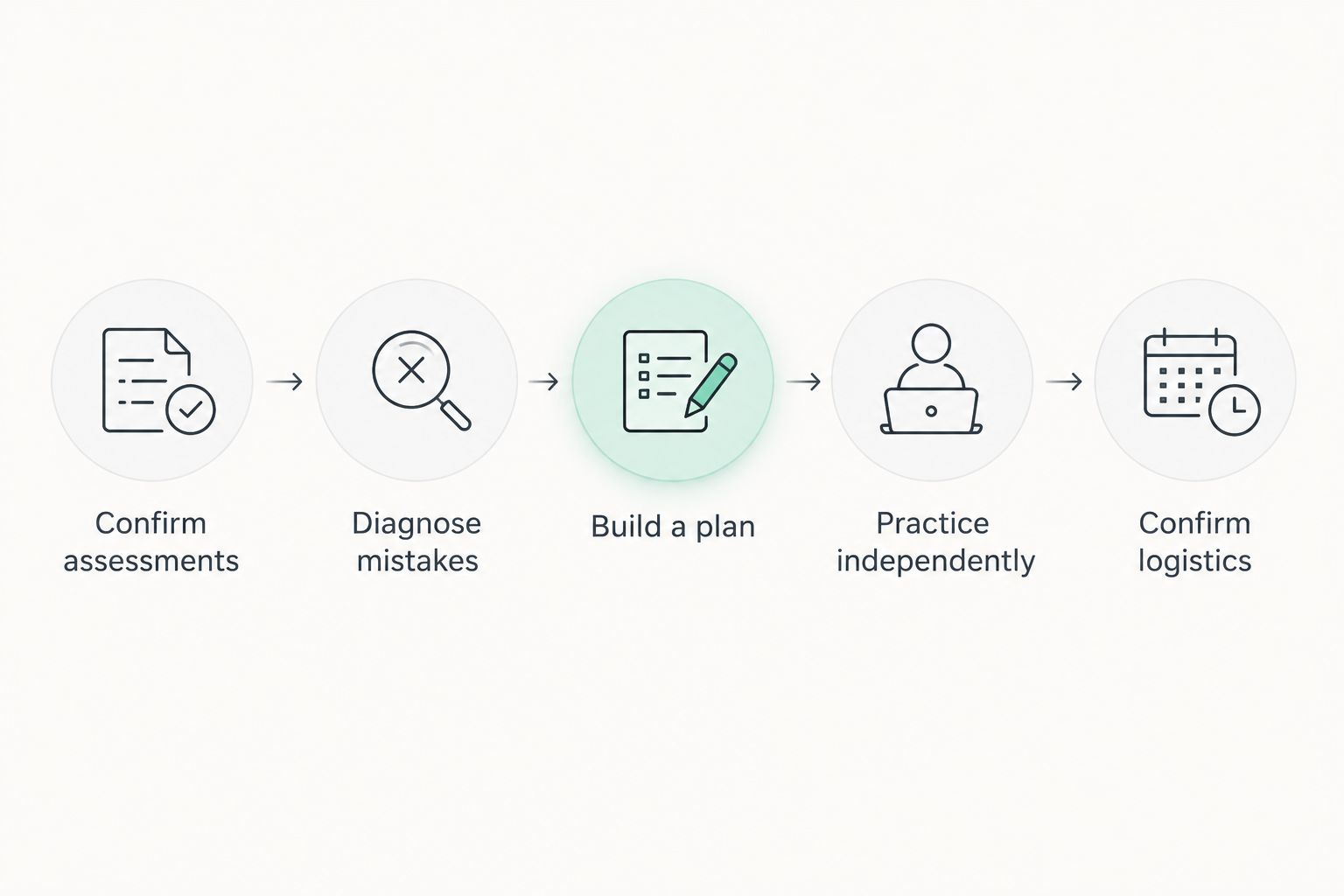
Confirm your assigned assessments
Start with your college’s testing office, admissions instructions, or placement notice. Copy the assessment names exactly. Ask whether you need ESL-specific testing, standard ACCUPLACER testing, a writing assessment, or a combination.
This step prevents a common mismatch: studying standard sentence revision when your appointment includes ESL Listening. It also keeps you from spending time on mathematics unless mathematics is part of your assignment. Save the instructions somewhere you can consult while selecting practice materials.
Your 2026 study plan should follow your own placement notice, not a course title or someone else’s checklist. Resolve unclear wording before buying materials or building a schedule.
- Record each assigned assessment’s full name.
- Ask which course placements the results affect.
- Confirm whether an essay is included.
- Check testing format and permitted materials.
- Ask how scheduling and retesting work at your college.
Diagnose your mistakes with official practice
Begin with College Board’s available sample questions for your assigned tests. Work independently before checking answers. For each mistake, explain why your answer fails and what evidence supports the correct choice.
Keep a simple error log on paper or in a spreadsheet. Separate errors caused by unknown words from errors caused by sentence structure, passage interpretation, or misunderstanding the question. A correct answer reached by guessing belongs in the log too; it does not demonstrate a repeatable method.
Do not convert a small practice set into a predicted placement score. Use it to identify what needs attention. Your next practice session should address the patterns in that log rather than repeat questions you already remember.
- Label unfamiliar words and expressions.
- Mark grammar relationships you misread.
- Record missed passage evidence.
- Flag answers chosen through guessing.
- Write a brief explanation for each correction.
Build a study plan around your weakest skill
Use your error log to choose the next topic. If you understand individual words but misread relationships between clauses, practice sentence meaning rather than memorizing another vocabulary list. If you understand a transcript but miss the spoken message, listening needs its own practice.
Start with official samples, your notes, and available college learning support. Additional instruction belongs after you identify the problem it must solve. Reasonedlearning’s self-paced test prep format suits independent study; check whether a particular course addresses your assigned assessment before making it part of your plan.
Give each study session a specific purpose and a visible result. Finishing a lesson is an activity. Explaining a previously confusing sentence correctly is evidence of progress.
- Select a skill from your error log.
- Review the rule or reading strategy behind it.
- Practice with unfamiliar questions.
- Explain your answers without copying explanations.
- Revisit earlier errors after studying another topic.
Read for meaning before choosing an answer
For ESL Reading Skills and Sentence Meaning, practice identifying what the text actually says. Begin with the main point, then identify the details or sentence relationships that support it. Keep your own opinions separate from the passage’s evidence.
Pay attention to contrast, cause, condition, and reference words. A familiar noun in an answer choice does not make that choice correct. Likewise, an answer that sounds reasonable in everyday life can still contradict the text.
Use short passages and sentences you can review carefully. After answering, point to the language that supports your choice. If you cannot identify that support, return to the passage instead of defending your first impression.
- State the main idea in your own words.
- Identify what pronouns refer to.
- Mark contrast and cause-and-effect language.
- Separate stated information from inference.
- Reject choices that add unsupported details.
Practice grammar and listening separately
ESL Language Use and ESL Listening assess different skills. Give each its own practice when your college assigns both. Reading a grammar explanation is not the same task as understanding a spoken exchange.
For grammar, identify the sentence structure before comparing choices. Look for the subject, verb, tense, and relationships between clauses. Study errors in context rather than memorizing an isolated rule without applying it.
For listening, use legitimate practice audio appropriate to your assessment. Listen for the speaker’s purpose and the relationship between ideas, not just recognizable words. If a transcript is available, review it after attempting the question independently, then locate the part you misunderstood.
- Identify subjects and verbs in grammar practice.
- Check tense and agreement in complete sentences.
- Notice connectors between clauses.
- Attempt listening questions before reading transcripts.
- Record whether the difficulty was sound, vocabulary, or meaning.
Write an essay when your assignment includes WritePlacer ESL
If your college assigns WritePlacer ESL, practice producing an original response to a prompt. Begin with a clear position, organize supporting ideas, and use examples that actually explain your point. An elaborate introduction cannot compensate for an unclear argument.
College Board’s WritePlacer ESL scoring guidance addresses vocabulary, sentence use, grammar, and organization and development. Use those categories to review your work. Ask a college writing center or qualified instructor for feedback when that support is available.
Keep writing practice separate from memorizing grammar answers. You need to apply language while developing an idea. Save your drafts and revisions so you can see whether the same errors recur across different prompts.
- Answer the prompt directly.
- Organize paragraphs around distinct supporting ideas.
- Explain examples instead of listing them.
- Review sentence boundaries and verb forms.
- Revise unclear wording without adding unnecessary complexity.
Rehearse the testing conditions and confirm logistics
Finish your preparation by following the conditions your college gives you. ACCUPLACER multiple-choice assessments are generally untimed, but writing arrangements and local procedures require separate confirmation. Do not impose a speed target borrowed from a different exam.
Practice without translation tools, notes, or other assistance unless your testing instructions explicitly permit them. Those tools can support learning, but using them during every practice attempt hides what you can do independently.
Before your 2026 appointment, check identification requirements, the testing location or remote process, and any instructions about accommodations. If instructions conflict, ask the testing office to resolve them. Your preparation should end with fewer unanswered logistical questions, not another collection of random practice links.
- Read the college’s current testing instructions.
- Confirm identification and appointment details.
- Check rules for writing tasks and timing.
- Practice independently under the applicable conditions.
- Contact the testing office about unresolved questions.
Compare preparation options for ESL students
Choose preparation by assessment coverage and feedback, not by the size of the resource library. A large collection of standard ACCUPLACER questions is not a substitute for the ESL assessment you have been assigned.
| Option | Best for | Main advantage | Key limitation |
|---|---|---|---|
| College Board official sample questions | Learning the assigned assessment’s question types | Direct connection to the test publisher’s assessment descriptions | Samples are not a personalized teaching plan |
| College learning support | Discussing language difficulties with local academic support | Can connect preparation questions with the college’s own expectations | Services and access depend on the college |
| Independent practice and an error log | Reviewing specific, recurring mistakes | Keeps attention on the reason behind each error | Requires you to evaluate your explanations accurately |
| Reasonedlearning self-paced test prep | Learners seeking online study at their own pace | The self-paced format supports independent scheduling | Check each course’s ESL assessment coverage before choosing it |
Start with official samples and a clear diagnosis. Add instruction when you can name the problem it should address. For essay feedback, look specifically for someone qualified to evaluate writing; a multiple-choice answer key cannot review paragraph development.
When comparing courses in 2026, distinguish the study format from the syllabus. Self-paced tells you how you study. ESL Listening, Sentence Meaning, or WritePlacer ESL coverage tells you what you study.
Common mistakes ESL students make
Preparing for the wrong ACCUPLACER version
Standard ACCUPLACER Reading and Writing are not interchangeable with the ESL assessments. Match the resource’s named assessment to your college’s instructions. If the resource does not identify its coverage clearly, do not assume the word ACCUPLACER is enough.
Translating every sentence during practice
Translation can clarify unfamiliar language while learning, but constant translation conceals independent comprehension. Attempt the question first, then use learning tools to investigate mistakes. Keep supported learning separate from a practice attempt intended to measure your own understanding.
Treating a placement score as a universal pass or fail
Your college sets the placement rules that matter to your enrollment. A score discussed online can refer to another assessment or institution. Ask which course placement your result supports instead of chasing an unsourced target.
Ignoring listening or original writing
Grammar worksheets cannot cover every assigned language skill. If your appointment includes ESL Listening or WritePlacer ESL, practice those tasks directly. Reading explanations about essays does not replace writing and revising your own response.
Counting repeated answers as improvement
Remembering an answer is different from understanding why it is correct. Check progress with unfamiliar material and explain your reasoning. If your explanation depends on remembering the answer key, return to the underlying skill.
FAQ
What is ACCUPLACER for ESL students?
ACCUPLACER for ESL students refers to placement assessment and preparation focused on English-language skills. College Board offers ESL assessments, but your college determines which tests you take and how results affect placement.
Do ESL students take the same ACCUPLACER tests as everyone else?
Your college decides which ACCUPLACER assessments ESL students take. Ask for the exact test names because ESL assessments and standard Reading or Writing assessments have different content and score scales.
What is a passing ACCUPLACER ESL score?
There is no universal ACCUPLACER ESL passing score for every college. Your institution sets its placement requirements, so ask which score applies to your assigned assessment and intended course.
Is ACCUPLACER ESL timed?
ACCUPLACER multiple-choice assessments are generally untimed. Confirm separate writing arrangements, appointment procedures, and any local timing instructions with your college’s testing office.
What is the best way to study for ACCUPLACER ESL?
Start with your assigned test names and College Board’s official sample questions. Use an error log to identify whether you need reading, grammar, listening, or writing practice, then select instruction that addresses those needs.
Is self-paced test prep better than college learning support?
Self-paced test prep suits independent scheduling, while college learning support suits learners seeking help with specific difficulties and local expectations. Choose by the feedback you need and the assessment coverage offered; neither format alone guarantees an appropriate syllabus.
How is WritePlacer ESL scored?
Scored WritePlacer ESL essays use a 1-to-6-point scale. College Board’s scoring guidance addresses vocabulary, sentence use, grammar, and organization and development; your college determines how it uses the result.
Can I use a dictionary or translation app during ACCUPLACER ESL?
Use only materials explicitly permitted by your testing instructions. Confirm the rules with your college’s testing office and practice independently so translation assistance does not hide gaps in comprehension.
One last thing
Before adding another practice set, explain a wrong answer aloud in plain English. State what the question asks, identify the supporting language, and explain why your first choice fails. If you cannot do that, more questions alone will not address the misunderstanding.
Use that explanation to choose your next study task. Vocabulary, sentence structure, listening, and essay development need different kinds of practice. The useful plan is the one that connects a specific mistake to a specific correction.


