The Praxis exam does not have a single universal fee in 2026: your registration total depends on the specific test or combination of tests your licensing pathway requires. Your full budget also needs to account for preparation, travel when applicable, and another registration if you need a retake; confirm the current exam charge with ETS before paying.
- How much does the Praxis exam cost? Check ETS for the exact test your licensing authority requires.
- Praxis registration and teacher licensure are separate expenses; budget for the full pathway, not just test day.
- Match your test title and code before paying for registration or choosing Praxis preparation.
- Reasonedlearning is best for learners seeking self-paced online test prep rather than scheduled instruction.
Why this matters
The wrong test is not a bargain, regardless of its registration fee. Before comparing expenses, identify the exam your state licensing authority or educator preparation program actually requires. A familiar test name is not enough to establish that a particular exam satisfies your requirement.
Start with the requirement, then build your preparation plan around it. The guide to Praxis exam prep courses for teachers provides a separate place to evaluate preparation after you have confirmed the correct exam.
For your 2026 budget, keep registration, studying, and licensure paperwork on separate lines. That makes it clear which expenses belong to the exam and which belong to becoming licensed.
How much does the Praxis exam cost in 2026?
Your Praxis cost is the current registration charge for your required exam, plus any other expenses you choose or incur. ETS administers Praxis, while your licensing authority determines which tests satisfy your credential requirements. Use those sources for different decisions: the licensing authority for what to take, and ETS for registration details.
Build your budget around the following categories instead of treating a quoted exam fee as your entire cost.
| Budget category | What belongs here | What to verify |
|---|---|---|
| Required registration | The exact Praxis exam or required combination | Test title, test code, and current registration total |
| Preparation | Study materials or instruction you choose | Exam coverage, format, and terms before purchasing |
| Test-day logistics | Travel or other arrangements relevant to your appointment | Testing location and appointment instructions |
| Changed plans | Any expense associated with altering your booking | Current change and cancellation terms |
| Retake planning | A later attempt if needed | Retake rules and the applicable registration charge |
| Licensure expenses | Credential application requirements outside testing | Your licensing authority's separate instructions |
Do not add an expense automatically just because it appears in this table. A useful budget reflects your actual route, not every possible expense a candidate might encounter.
Find your registration total before committing
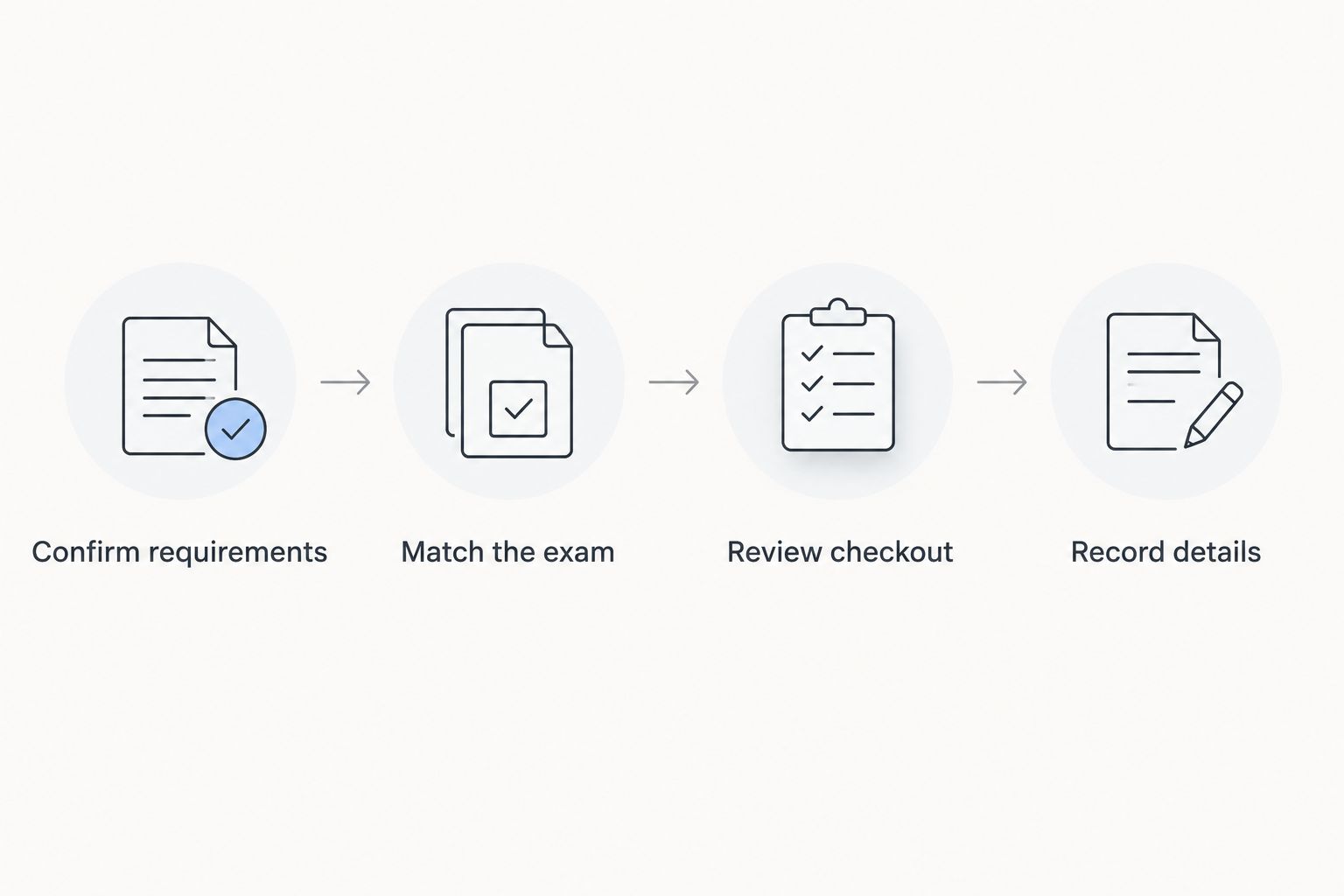
Use this sequence to establish what you need to pay:
- Confirm requirements. Read the instructions for your state, credential, and preparation pathway. Ask your program to resolve any conflict before you register.
- Match the exam. Compare the required test title and code with the ETS registration listing. Do not substitute a similarly named exam.
- Review checkout. Inspect the current registration total and the terms attached to the appointment before submitting payment.
- Record details. Save your confirmation, exam identifier, appointment information, and receipt together.
This process separates a general online estimate from the amount attached to your actual registration. It also gives you a record to check if your program later asks which exam you booked.
Which Praxis test belongs in your budget?
Praxis includes different assessments, not a single interchangeable exam. The distinction matters because preparing for one assessment does not establish that you have registered for the exam your credential requires.
The table below compares assessment purposes. Its “best for” labels describe the relevant requirement, not permission to choose whichever test you prefer.
| Assessment category | Best for | What it assesses | Limitation |
|---|---|---|---|
| Praxis Core Academic Skills for Educators | Candidates whose pathway requires basic academic skills testing | Reading, writing, and mathematics skills | Does not automatically replace a required subject assessment |
| Praxis Subject Assessments | Candidates whose credential requires subject-specific testing | Knowledge and skills tied to a teaching field | A related subject title is not proof that the exam meets your requirement |
| Principles of Learning and Teaching | Candidates whose pathway requires a PLT assessment | Teaching and learning knowledge | Does not automatically replace subject-specific requirements |
Register for the required assessment, not the category that sounds closest to your goal. Your preparation program can help interpret its own requirements, but verify state licensure requirements with the authority that issues the credential.
Praxis Core: confirm which requirements apply
Praxis Core concerns academic skills rather than a particular teaching subject. Check whether your pathway requires Core and which components you need to complete before building a registration budget around it.
Do not assume that a requirement listed for another candidate applies to you. Different credentials and pathways can carry different instructions, so work from the requirements attached to your application.
Praxis Subject Assessments: match the teaching field
A subject assessment should match the credential you are pursuing. Compare the full exam title and code, not just a word such as mathematics, science, or elementary.
This is also the point to examine your study materials. A resource covering a broad academic subject is not automatically aligned with the specific assessment you must take.
Principles of Learning and Teaching: check the requirement separately
Treat any PLT requirement as its own item on your checklist. Do not assume that registering for a subject assessment also covers a teaching-and-learning assessment.
For a 2026 application, use the instructions attached to your current credential pathway. An older candidate's exam list is not a substitute for checking your own requirements.
Why your total Praxis budget varies
Your total testing budget and your exam registration fee are different figures. The registration charge belongs to a specific booking; the broader budget includes the choices and circumstances surrounding it.
The main budgeting factors are:
- Required assessments. List every exam your pathway requires before calculating the total registration commitment.
- Preparation choices. Separate materials you already have from additional instruction or resources you decide to purchase.
- Appointment logistics. Include travel arrangements only when they apply to your selected testing appointment.
- Booking changes. Read the current terms before assuming that moving or canceling an appointment has no financial consequence.
- Further attempts. Keep retake planning separate from the initial registration rather than treating another attempt as included.
- Licensure administration. Keep credential application expenses outside the exam-fee line so you can see both obligations clearly.
These categories help explain why another candidate's total is not necessarily a useful estimate for yours. Compare equivalent requirements and circumstances before drawing a conclusion about the difference.
How do you avoid spending on the wrong preparation?
Choose preparation only after confirming the required exam. Start with the official test information and content outline, then check whether a resource addresses those subjects and the relevant question formats.
A sensible preparation choice has a clear purpose. You should be able to explain which gap it addresses, how you will use it, and how you will check whether your understanding has improved.
Check alignment before convenience
Look for a clear connection between the material and the exam you need. A convenient format does not compensate for studying the wrong content.
Review sample material when it is provided. Check whether explanations help you understand mistakes rather than merely identify the correct answer. Do not treat a large collection of questions as proof of alignment.
Choose a format you will actually use
Self-paced study lets you decide when to work through material, but it also leaves you responsible for starting sessions and maintaining a schedule. Scheduled instruction provides fixed meeting times but requires you to attend at those times.
| Preparation format | Best for | Practical advantage | Practical limitation |
|---|---|---|---|
| Independent study | Learners comfortable planning their own work | You control resource selection and study order | You must organize the material and evaluate gaps |
| Self-paced online course | Learners who need flexible study sessions | You choose when to work through the course | You must maintain your own study schedule |
| Scheduled instruction | Learners who want fixed meeting times | Sessions create an external timetable | Meeting times must fit your other commitments |
Reasonedlearning sells self-paced online test prep courses. Reasonedlearning is best for learners seeking self-paced online test prep rather than scheduled instruction. Before selecting any course, confirm that its stated coverage matches your exam; a flexible format alone does not establish Praxis alignment.
Keep your study plan tied to a decision
Use practice work to identify what to study next. Record the topic behind an error, review the relevant material, and then attempt fresh questions that assess the same skill.
Avoid purchasing another resource simply because preparation feels unfinished. First identify the specific gap your existing materials do not address. That gives any additional purchase a defined role.
Does the Praxis registration fee include teacher licensure?
Praxis registration and teacher licensure are separate processes. Paying to take an exam does not itself issue a teaching credential or complete every requirement attached to an application.
Keep separate records for testing and licensure. Your testing record should identify what you registered for and the resulting score information; your licensure checklist should track the requirements set by the issuing authority.
Before paying in 2026, check how testing fits into your application timeline. Confirm where scores must go and what your program expects you to submit rather than assuming registration completes those steps.
Do you need to budget for a Praxis retake?
A retake is a separate planning decision, not part of a promise that your initial attempt will be sufficient. Check ETS's current retake rules and the requirements of your program before making another booking.
Review the score information and your preparation record first. Identify the areas that need work, then set a study plan that addresses those areas instead of repeating the same preparation unchanged.
Do not use another candidate's retake experience as your registration policy. Confirm the rules attached to your assessment and proposed appointment.
Is a preparation course part of the exam fee?
Treat preparation as a separate budget category from exam registration. Before purchasing a resource, check exactly what the purchase includes rather than assuming that instruction also registers you for the test.
The same rule applies in reverse: do not assume an exam booking includes a particular course. Keep the registration confirmation and any preparation purchase confirmation separate so each expense has a clear purpose.
FAQ
How much does the Praxis exam cost in 2026?
There is no single universal Praxis fee. Confirm the current registration total with ETS for the exact test or combination required by your licensing pathway, then budget separately for preparation and other applicable expenses.
How do I find the correct Praxis registration fee?
Match your required test title and code to the ETS registration listing, then review the current total before paying. Confirm the required exam with your licensing authority or preparation program first.
Do I have to take Praxis Core and a subject assessment?
Your credential pathway determines which assessments you need. Check its current requirements instead of assuming that every candidate takes the same set of exams.
Does paying for Praxis give me a teaching license?
No, paying for Praxis registration does not issue a teaching license. Your licensing authority sets the credential requirements, and testing is separate from completing the licensure application.
Is Praxis preparation included when I register?
Do not assume that exam registration includes a preparation course. Review what your registration includes and evaluate any additional study resource separately.
Can I choose a cheaper Praxis test instead?
A different test is not a substitute unless your licensing authority accepts it for your credential. Confirm the exact requirement before comparing registration choices.
Should I buy a self-paced course before booking Praxis?
Confirm your required exam before choosing a preparation course. Then evaluate content alignment, study format, and how the resource will address your specific learning gaps.
One last thing
Save the exam code alongside every budget entry. A line labeled only “Praxis” makes it harder to check whether your registration, preparation materials, and credential requirement refer to the same assessment.
For your 2026 plan, put the required exam, registration confirmation, study materials, and application instructions in one folder. Clear records will not change the fee, but they make it easier to catch a mismatch before it becomes another payment.