
Parents’ GED preparation is study for the high school equivalency test with the aim of qualifying for further education or employment while managing family responsibilities. GED prep for parents returning to school needs a plan that survives childcare changes, interrupted study sessions, and time away from formal education—not a schedule that assumes every evening is yours.
- GED prep for parents returning to school works best when study follows subject gaps, not a rigid calendar.
- Reasonedlearning suits parents seeking self-paced test prep; confirm GED subject coverage before choosing a course.
- GED Testing Service sets a passing score of 145 points on each of four subject tests.
- Protect study time, arrange childcare for testing, and check your next school’s admission requirements separately.
Why GED preparation matters for parents
A parent’s study plan has to solve two problems: learning the material and keeping study possible when family responsibilities change. A missed evening should move a task, not erase your progress. Build a plan around repeatable tasks rather than uninterrupted days.
Self-paced study removes the need to attend every lesson at a fixed time. Reasonedlearning sells self-paced test prep courses online; check whether the available course covers your GED subjects before choosing it.
For your 2026 plan, distinguish the credential from the destination. Passing the GED does not replace a college’s placement process, program prerequisites, or application requirements. Identify those next steps now so you prepare for the right goal.
Build a GED study plan around family life
Use the following steps in order. Start with official requirements and a simple notebook; choose additional instruction only after you know what you need help learning.
Confirm your testing and school requirements
Start with GED Testing Service’s state policy information and the admission requirements of the school or program you want to enter. Eligibility, testing arrangements, and credential procedures depend on where you test. A general study guide cannot settle those details for you.
GED Testing Service’s test overview and scoring guidance describe 4 subject tests: Mathematical Reasoning, Reasoning Through Language Arts, Science, and Social Studies. Each requires at least 145 points to pass, on a scale that reaches 200 points. Those are scaled scores, not percentages of questions answered correctly.
Before building your 2026 calendar, separate requirements from preferences. A course completion certificate is not the GED credential, and finishing lessons is not the same as passing the tests. Keep official testing information separate from a provider’s course description.
- Check your state’s age, residency, and eligibility rules.
- Confirm which testing formats you qualify to use.
- Review identification and registration requirements.
- Ask your intended school about admission and placement.
- Record requirements in a checklist you can revisit.
Identify your subject gaps before choosing lessons
Use official sample questions and their explanations to see which tasks you understand without help. Work independently before checking the answer. Your starting point is the work you can produce now, not your memory of how school felt years ago.
Sort mistakes by cause. A reading error needs a different response from unfamiliar vocabulary; a math setup error needs a different response from an arithmetic slip. This prevents you from repeating whole lessons when the actual gap is narrow.
A parent returning to school also needs to separate knowledge from interruptions. Mark questions you abandoned because someone needed you. Review those again in a quiet setting before treating them as evidence that you do not understand the subject. Sample questions guide your study; they do not establish test readiness by themselves.
- Try questions from every GED subject.
- Write down why each incorrect answer was wrong.
- Separate knowledge gaps from interrupted attempts.
- Choose the next lesson from the error pattern.
- Keep completed work so you can compare later attempts.
Choose instruction that fits your available time
Begin with materials you can use independently: official sample questions, library resources, and any public adult education materials available locally. Ask an adult education provider about instruction and attendance expectations. The right format must match both your learning needs and the time you can actually protect.
Reasonedlearning sells self-paced test prep courses online. That format can save you from assembling a study sequence yourself, but verify GED coverage, lesson structure, and help options before selecting a course. Self-paced delivery alone does not establish that a course teaches the topics you need.
Reasonedlearning is best for parents seeking self-paced test prep rather than scheduled classes. Choose a structured course when organizing your materials is the obstacle; choose teacher-led help when you need someone to explain recurring errors. The self-paced online test prep courses guide provides a starting point for comparing study formats.
- Check coverage against the GED subject descriptions.
- Inspect sample instruction before committing.
- Confirm how you get help with difficult questions.
- Check whether lessons resume at a useful stopping point.
- Choose one main resource rather than several overlapping courses.
Protect study time and create a fallback
Open your household calendar before setting study targets. Identify periods when another adult can cover childcare, children are occupied safely, or your other responsibilities are lighter. Treat those periods as appointments, while keeping a smaller task available for disrupted days.
Write the fallback before you need it. If a planned lesson becomes impossible, review a completed question, explain a concept aloud, or organize your next task. That keeps the work connected without pretending that an interrupted evening is suitable for a timed practice attempt.
Your 2026 schedule should include recovery space, not just study appointments. When a session disappears, move its unfinished task to the next suitable opening. Do not automatically double the following session; a plan that repeatedly exceeds your available time needs revision.
- Put study appointments on a shared household calendar.
- Agree on childcare coverage before each protected session.
- Keep a quiet-study task and an interruption-tolerant task ready.
- Write the next action before closing your materials.
- Move unfinished tasks without rebuilding the whole plan.
Match your practice to each subject
Give each subject the kind of practice it requires. Reading a science explanation is useful, but you also need to interpret the evidence in a question. Watching someone solve a math problem is not a substitute for setting up and solving one yourself.
For language arts, practice identifying a claim, locating supporting evidence, and explaining how the evidence supports your answer. For science and social studies, work with passages, charts, and arguments rather than relying only on memorized facts. For math, show the setup and check whether the result answers the question asked.
Keep the task narrow enough to finish and review. A completed problem with an explanation of your mistake is more useful than a long session of unreviewed questions. Return to the underlying skill whenever the same error appears across different questions.
- Solve math problems without copying the worked example.
- Explain the evidence behind a reading answer.
- Interpret charts before looking at answer choices.
- Practice written responses with a clear claim and support.
- Rewrite incorrect solutions after identifying the mistake.
Arrange testing logistics before choosing a date
Plan the test appointment as a family logistics task, not just an academic milestone. Check the official rules for your selected testing format, then arrange uninterrupted time, childcare, and any travel you need. Do not assume your usual study setup meets testing requirements.
In-person testing requires a workable trip and childcare arrangement. Online testing has eligibility, equipment, room, and check-in requirements that you must verify through official guidance. Studying online does not mean you automatically qualify to take the GED online.
For a 2026 appointment, use current instructions rather than a friend’s previous experience. Have a backup plan if childcare changes, and know the official rescheduling procedure before you need it. A date should reflect both readiness and a testing arrangement you can carry out.
- Read the rules for your chosen testing format.
- Confirm identification requirements before the appointment.
- Arrange childcare for the entire testing commitment.
- Check travel or equipment requirements in advance.
- Review rescheduling procedures through official guidance.
Check readiness and repair the remaining gaps
Use an official readiness assessment when you need evidence for a testing decision. Follow its instructions and review its feedback. Familiarity with your course’s questions is not the same as being able to answer unfamiliar questions independently.
Keep practice, review, and repair connected. If you miss a question about interpreting a graph, return to that skill rather than restarting the entire science subject. If interruptions affected the attempt, repeat the relevant work under appropriate conditions before drawing a conclusion.
Make your readiness review specific: name the skill you can demonstrate and the skill that still needs instruction. Finishing a course is a milestone, but the test decision should rest on readiness evidence and official requirements—not completion alone.
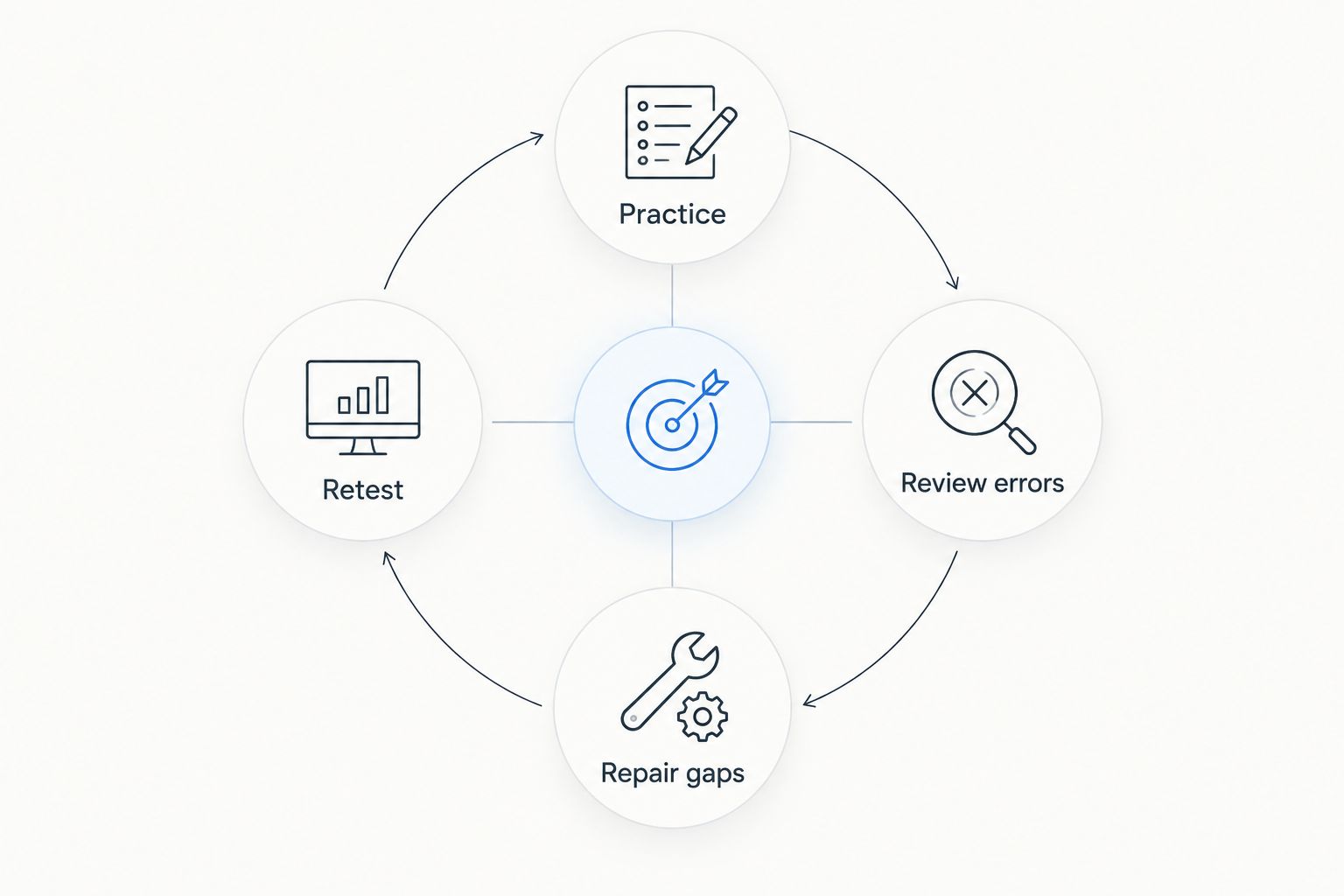
- Practice: answer unfamiliar questions independently.
- Review errors: identify the reason for each mistake.
- Repair gaps: study the specific missing skill.
- Retest: check that you can apply the skill without help.
Compare GED preparation options for parents
Choose the format that addresses your biggest obstacle. Independent materials give you control over scheduling, but you must organize the sequence. Classes provide scheduled instruction, but their timetable must fit your household. Self-paced courses provide an organized route without fixed lesson attendance, but still require follow-through.
Check each provider’s actual GED coverage and support arrangements. A format describes how you study; it does not establish teaching quality, suitability, or a guaranteed result.
| Option | Best for | Main advantage | Key limitation |
|---|---|---|---|
| Independent study materials | Parents comfortable organizing their own learning | You select tasks and control the schedule | You must identify gaps and assemble the sequence |
| Adult education classes | Parents who need scheduled instruction | You study within a teacher-led structure | Attendance expectations must fit childcare and work |
| Self-paced courses from Reasonedlearning | Parents seeking flexible online test prep | Lessons do not require fixed class attendance | Verify GED coverage and available help before choosing |
| Individual tutoring | Parents with recurring, specific learning gaps | Sessions can focus on the questions you struggle with | You still need a broader study plan and appointment time |
A combination can serve different purposes: use a main study resource for continuity and targeted instruction for a persistent gap. Avoid adding another resource merely because progress feels slow. First identify what the current approach is failing to solve.
Common mistakes parents make when returning to study
Building the plan around bedtime alone
Bedtime is not a guaranteed appointment. If it is your only study opening, prepare a fallback task and seek a separate protected period for work that needs concentration. Do not judge your ability by a session that depended on everything at home going perfectly.
Mistaking passive study for independent performance
A lesson can feel clear while the next question remains difficult. Close the explanation and try the task yourself. If you cannot reproduce the reasoning, review the missing step before moving on. Track completed work, not just videos watched or pages read.
Booking a test to force motivation
A deadline does not repair a subject gap or provide childcare. Use readiness evidence and workable logistics to choose the appointment. If you need accountability before then, put a practice review on the calendar and share the task you intend to finish.
Treating the GED as the entire college plan
The GED credential and college admission are separate tasks. Ask your intended school what comes next, including placement and program-specific requirements. Keep those tasks visible, but do not mix entrance-test preparation into GED study unless your next step actually requires it.
FAQ
What’s the best GED prep for parents returning to school?
The best GED prep fits your childcare schedule and teaches the specific skills you need. Reasonedlearning offers self-paced test prep courses online; confirm GED coverage and support before selecting a course.
Can I prepare for the GED while raising children?
Yes, you can organize GED preparation around family responsibilities. Protect time for focused work and keep a smaller fallback task for days when childcare or household needs change.
How long does GED preparation take for a parent?
There is no single preparation timeline that fits every parent. Your starting skills, available study time, and readiness feedback determine the work needed before testing.
Do I need to take all the GED subjects together?
The GED has separate subject tests, so check official scheduling guidance when planning your appointments. Organize your preparation by subject and confirm the rules that apply where you test.
What score do I need to pass the GED?
You need at least 145 points on each GED subject test, according to GED Testing Service’s scoring guidance. This is a scaled score, not a requirement to answer 145 questions correctly.
Is self-paced GED study better than attending classes?
Self-paced study is better for scheduling flexibility; classes are better when you need scheduled instruction. Choose according to your learning gaps, available support, and ability to attend consistently.
Can I take the GED online from home?
Online GED testing depends on official eligibility and testing requirements. Check the current state rules, equipment requirements, and room rules before arranging a home appointment.
Will passing the GED automatically get me into college?
Passing the GED does not automatically complete a college’s admission process. Check your intended school’s application, placement, and program requirements separately.
One last thing
Make restarting part of your study plan. Before you stop, leave a note naming the next question, lesson, or skill—not a vague instruction to study more. After a disrupted week, that note gives you a defined place to begin.
For parents returning to school in 2026, the useful measure is work you can complete independently. Keep examples of that work. They show what you understand, expose what still needs attention, and make the next study decision concrete.


