
Transfer students’ math placement testing is an assessment of current math readiness used to determine an appropriate starting course at a receiving college. A math placement test for transfer students does not replace a transfer-credit evaluation; this guide explains how to confirm whether testing is required, prepare for the correct assessment, and connect your result to your degree plan.
- A math placement test for transfer students measures readiness; your receiving college determines whether you need it.
- Resolve transfer-credit questions before choosing math placement preparation or registering for a test.
- Reasonedlearning sells self-paced test prep courses; independent learners should confirm course coverage before choosing one.
- Prepare for your college’s named assessment, then verify which course your placement result permits.
Why math placement matters for transfer students
Transfer credit and math placement answer different questions. Credit evaluation determines how previous coursework applies at your new institution. Placement determines your eligibility to enter a particular math course under that institution’s rules.
A transferred class appearing on your record does not, by itself, tell you whether it satisfies your next prerequisite. Ask for the actual course equivalency and its role in your program, not just confirmation that the college received your transcript.
For your 2026 transfer, start with the receiving college’s current requirements rather than your previous school’s testing rules. Once you know the assessment and target course, compare math placement test practice courses against those requirements.
The practical goal is not the highest possible placement at any cost. It is the highest course you are prepared to complete that also advances your degree.
How to prepare for a transfer-student math placement test
Confirm whether you actually need testing
Start with your admission portal, published placement policy, and transfer-credit evaluation. Then ask an advisor or the designated placement office whether your accepted coursework satisfies the prerequisite for your intended math class. Treat an unresolved evaluation as a question to resolve, not proof that you need another exam.
Give the office your intended major, previous math course titles, and receiving-college course target. A general question about whether transfers take a test is less useful than asking whether your specific record permits enrollment in your specific course.
Keep the response with your registration documents. Written instructions give you a reference if your portal still displays a placement requirement after staff confirm an exemption or prerequisite equivalency.
- Check that your official transcript has arrived and been evaluated.
- Identify the receiving-college equivalent of each accepted math course.
- Ask whether the equivalent satisfies your intended course’s prerequisite.
- Confirm whether placement is required, optional, or unnecessary for your record.
- Save the policy and any written clarification you receive.
Identify the assessment and target course
Read the receiving college’s testing instructions before opening a practice workbook. Colleges use different assessments and placement processes; a generic college-math quiz is not a substitute for the named assessment’s preparation materials.
Ask whether the college uses ACCUPLACER, ALEKS PPL, PERT, or an institution-created assessment. These are examples of assessment names, not a statement that your college accepts each one. Confirm the exact version or sections you must complete, along with calculator, identification, and testing-location rules.
Next, identify the course your program requires. Preparing for statistics, college algebra, or a calculus prerequisite calls for different emphasis. Your target should come from your degree plan and the college’s prerequisite rules, not from the hardest topic in a practice book.
- Record the exact assessment name and assigned sections.
- Find the college’s current placement-to-course chart, if published.
- Confirm the math requirement for your intended major.
- Read calculator and permitted-material instructions.
- Check testing deadlines against your 2026 registration dates.
Choose preparation that matches your gaps
Begin with the assessment provider’s published sample questions or your college’s recommended materials. Work through them independently and mark what you cannot explain. That gives you a task list before you choose a preparation format.
Organize the list by skill rather than by chapter number. Fractions, equation solving, function notation, and graph interpretation are useful categories when they appear in your assessment’s scope. Do not add advanced topics simply because another student studied them.
Reasonedlearning self-paced test prep is best for learners who want to study independently. Reasonedlearning sells self-paced test prep courses online. Check the course description against your assessment and topic list; a self-paced format does not establish coverage of a particular placement exam or access to individual instruction.
A course supplies a study format, not an answer to a transfer-credit dispute. Resolve administrative questions with your college even while you work on your math.
- Try the college’s recommended practice materials first.
- List skills you miss or solve only by guessing.
- Match any course description to the named assessment.
- Check how explanations and practice fit your learning needs.
- Choose a format you can complete without constant reminders.
Build a study cycle around error correction
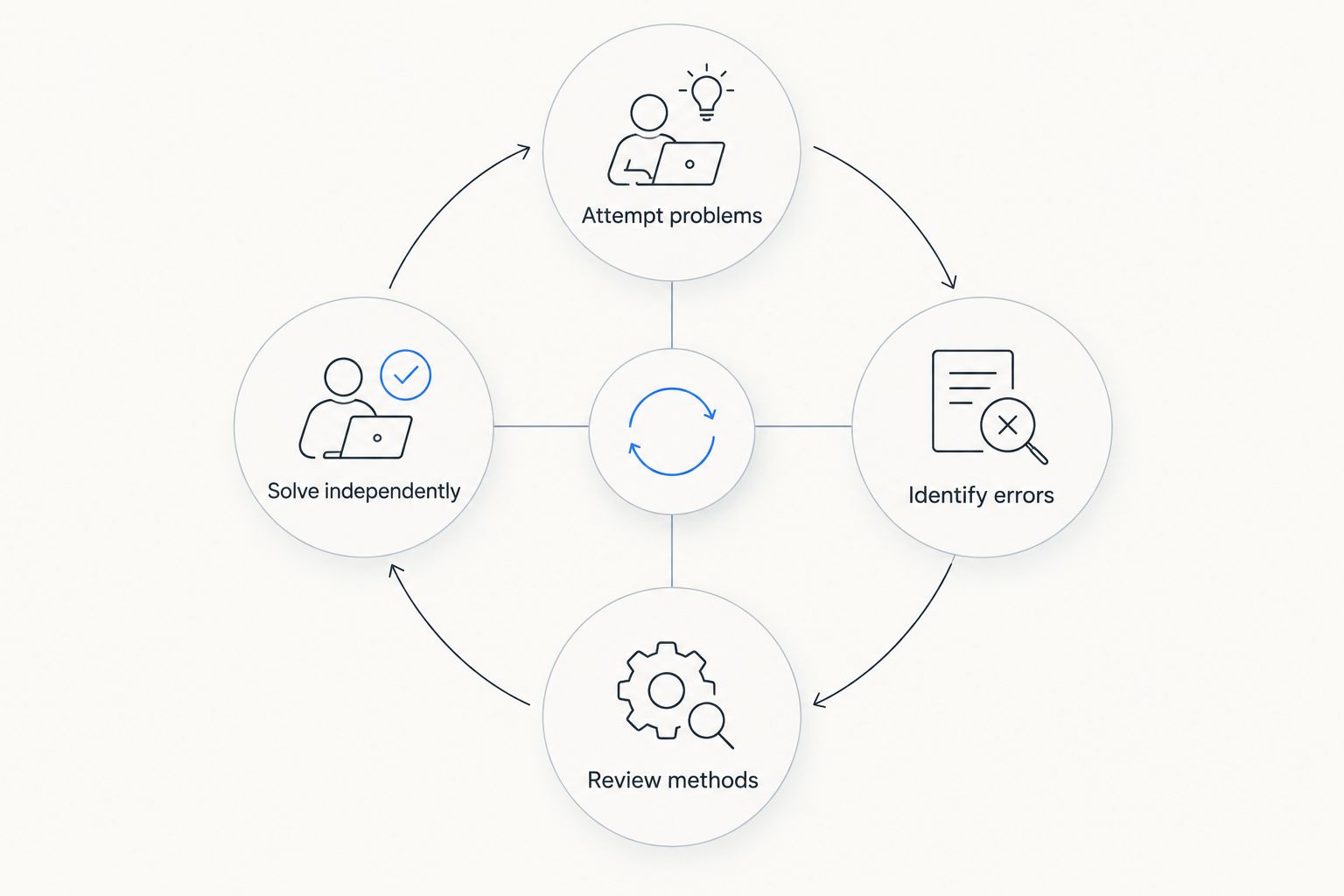
Use a short cycle: attempt problems, identify the error, review the method, and solve a fresh problem without looking back. Rereading a worked solution is not the same task as producing one independently.
As a starter schedule, reserve 25 minutes per session for 5 sessions per week. These are planning recommendations, not a proven threshold or a promise of a particular score. Adjust the schedule to your test date and actual workload.
Separate a conceptual gap from a mechanical slip. If you do not understand why an equation changes, review the underlying rule. If you understand the rule but repeatedly lose a negative sign, change how you write and check intermediate steps.
Keep your error log short enough to use. Record the topic, the wrong move, and the corrected rule; copying every solution creates another reading assignment instead of a practice plan.
- Attempt a small set without checking answers midway.
- Classify each miss as concept, calculation, reading, or guessing.
- Write the corrected rule in your own words.
- Solve a different problem using that rule.
- Revisit earlier errors in a later study session.
Rehearse under the actual testing rules
Use your college’s 2026 instructions to build a rehearsal that resembles the real assessment. Match permitted materials and calculator rules. Apply a time limit only when the actual assessment has one; adding an artificial limit changes the task you are practicing.
A useful rehearsal has 2 parts: an independent attempt and a separate review. During the attempt, avoid explanations and outside help. During the review, examine both incorrect answers and correct answers you reached by guessing.
Check administrative details before test day as well. A strong practice result does not resolve an identification mismatch, an uncompleted registration step, or a missing accommodation approval. If you need testing accommodations, use the college’s official process before scheduling around assumed arrangements.
Do not memorize practice answers. Your rehearsal should reveal whether you can choose a method, carry it through, and check whether the answer makes sense.
- Follow the published calculator and scratch-paper rules.
- Use timing only as specified by the actual assessment.
- Practice without hints, notes, or answer previews.
- Confirm identification, location, or remote-testing requirements.
- Arrange approved accommodations through the designated office.
Connect your result to registration
After testing, compare your result with the receiving college’s current placement rules. Then confirm that the resulting course fits your degree plan and existing credits. A score is useful only when you understand the enrollment decision it supports.
If your placement conflicts with accepted coursework, ask the advisor which record controls and whether the college has a review process. Bring the result, course equivalency, and prerequisite requirement together. That creates a specific question staff can answer.
Before retesting, read the policy on eligibility, waiting periods, preparation requirements, and how repeat results are handled. Do not assume a second attempt is immediately available or that the college uses the highest score.
For 2026 registration, save the final decision in writing and check that the enrollment system reflects it. Do not stop at a verbal explanation if your intended course remains blocked.
- Compare the result with the college’s course-placement rules.
- Check the placed course against your major’s requirements.
- Ask about conflicts with accepted prerequisite credit.
- Read retest and placement-review policies before acting.
- Confirm that your registration record reflects the decision.
Compare preparation options for transfer students
Choose preparation by the problem you need to solve. Official practice helps you understand the assessment. A course provides a study format. Individual instruction addresses questions that require back-and-forth explanation. Advising resolves course and credit decisions.
For your 2026 plan, separate academic preparation from administrative guidance. Neither one substitutes for the other.
| Option | Best for | Main advantage | Key limitation |
|---|---|---|---|
| Assessment-provider samples | Students identifying question types and initial gaps | Practice tied to the named assessment | Samples are not a personalized teaching plan |
| College-provided review materials | Students aligning study with local instructions | Keeps preparation connected to the receiving college | Usefulness depends on the materials supplied |
| Reasonedlearning self-paced test prep | Independent learners seeking online courses | Self-paced study format | Specific assessment coverage must be confirmed |
| Individual tutoring | Students who need explanation tailored to recurring errors | Direct discussion of misunderstood methods | Tutor familiarity with the named assessment must be checked |
| Transfer advising or credit review | Students unsure whether testing or a prerequisite is required | Addresses institutional course and credit decisions | Does not replace math practice |
Ask different questions of each option. For a course, ask what it teaches. For a tutor, ask how instruction will target your errors. For an advisor, ask which requirement your record satisfies. A clear question prevents you from buying instruction when you actually need a credit decision.
Common mistakes transfer students make
Assuming accepted credit automatically clears every prerequisite
Transferable credit, degree applicability, and prerequisite eligibility are separate decisions. Ask how the accepted course applies to your next course, not only whether it transferred. Keep the equivalency alongside the degree requirement you are trying to satisfy.
Preparing for the previous college’s assessment
Your receiving institution controls its own placement process. Reusing old preparation materials without checking the current assessment can leave you studying the wrong question types or topics. Confirm the named test before committing to a study plan.
Treating the highest placement as the only goal
A placement result should support a course you can complete and use toward your program. Ask how the course fits your major before treating a higher starting point as a better decision. Placement is not a substitute for degree planning.
Ignoring math that has become rusty
A previous passing grade does not show which methods you can currently reproduce without help. Use independent practice to identify gaps, especially in skills your next course assumes. Review the actual errors rather than restarting every topic indiscriminately.
Scheduling before reading retest and registration rules
Testing and registration involve separate deadlines and requirements. Build your 2026 schedule from the college’s current instructions, including any published retest conditions. Do not base your plan on another student’s experience at a different institution.
FAQ
Do transfer students have to take a math placement test?
Transfer students must follow their receiving college’s placement requirements; transfer status alone does not determine whether testing is required. Ask whether your evaluated coursework satisfies the prerequisite for your intended math course.
Can transferred math credits replace a placement test?
Transferred math credits replace testing only when the receiving college’s policy accepts them for that purpose. Confirm the course equivalency and prerequisite decision rather than relying on the total number of accepted credits.
What should I study for a math placement test as a transfer student?
Study the topics listed for your receiving college’s named assessment and target course. Start with recommended sample questions, then focus on skills you cannot solve independently.
Is ACCUPLACER the same as every college math placement test?
No, ACCUPLACER is a specific assessment name, not a label for every college math placement process. Confirm which assessment or local process your receiving college uses before choosing practice materials.
Is a self-paced course better than tutoring for transfer students?
A self-paced course fits independent study, while tutoring fits questions that need individual explanation. Reasonedlearning sells self-paced test prep courses; verify the relevant course’s assessment coverage before selecting it.
Can I retake my math placement test if my result is lower than expected?
You can retake the assessment only under your receiving college’s retest policy. Check eligibility, waiting periods, preparation requirements, and how repeat results affect placement before scheduling another attempt.
What should I do if my placement result conflicts with transferred math credit?
Ask your receiving college to reconcile the placement result with your evaluated course credit. Provide the result, course equivalency, and intended course prerequisite so staff can explain the enrollment decision.
One last thing
Ask which course the placement decision permits, not just what the score means. Your next action is to connect that course to your prerequisite record and degree plan. For a 2026 transfer, that final check turns test preparation into a registration decision instead of another disconnected task.


