
Military veterans’ PERT preparation is targeted review for Florida’s Postsecondary Education Readiness Test, with the aim of getting an accurate college placement decision. This 2026 guide explains the PERT test for veterans, including how to check your testing requirement, rebuild academic skills after time away, and fit preparation around work and family responsibilities.
- The PERT test for veterans measures college readiness; confirm your college’s testing requirement before preparing.
- Reasonedlearning is best for learners who want self-paced online test prep.
- Use PERT practice tests to identify reading, writing, and math gaps before choosing study materials.
- Confirm placement rules, military credit review, and education benefits separately with your college.
Start with your college’s placement instructions, not a course purchase. Reasonedlearning sells self-paced online test prep courses; check course coverage against your college’s PERT requirements before choosing one. Military experience, transfer credit, placement exemptions, and education benefits are separate questions, so keep separate records for each.
Why PERT matters for military veterans
PERT measures academic readiness rather than military knowledge. A veteran returning to college needs to distinguish between unfamiliar academic terminology and an actual skill gap: forgetting a grammar label is different from being unable to recognize a clear sentence.
Florida Department of Education PERT materials describe 3 sections: reading, writing, and mathematics. Each section contains 30 questions, and scores use a 50–150-point scale. These are test-format facts, not a promise about the placement a particular college will assign.
The practical issue is course selection. Your college interprets your placement information alongside its policies and your academic record; ask which classes your results qualify you to enter and how those classes fit your intended program.
Prepare for the placement decision you need, not for a generic passing score. Before studying, establish whether you need the exam at all and which sections matter for your enrollment.
How to prepare for the PERT test as a veteran
Confirm your college’s placement requirement
For your 2026 enrollment, contact the testing center or academic advising office before setting a study schedule. Ask whether your existing academic record, previous placement results, or an applicable exemption changes the requirement. Do not assume that a rule for active-duty service members applies identically to veterans.
Bring the question down to your actual program. A broad instruction to complete placement testing does not explain which sections you need, which results the college accepts, or whether your chosen course has an additional prerequisite.
Keep military credit evaluation separate from placement. A college’s decision to award credit for prior learning does not automatically establish readiness for every math or English course. Likewise, a placement result does not determine which military learning receives credit.
Ask for written instructions you can use when booking the exam:
- Confirm whether PERT is required for your admission and course selection.
- Ask which sections you must complete.
- Request the placement criteria for your intended courses.
- Ask which prior transcripts or test results the college accepts.
- Confirm how to submit military learning records for a separate credit review.
Diagnose your current reading, writing, and math skills
Begin with the college’s recommended preparation materials and available sample questions. Work independently before reading explanations; otherwise, recognition can look like understanding. Your first attempt should reveal what you can currently do, not what you can follow after seeing a solution.
Reading review should focus on understanding passages, identifying main ideas, and drawing supported conclusions. Writing review should examine sentence structure, grammar, and organization. For math, identify whether the difficulty lies in arithmetic, algebra, interpreting the question, or carrying out a multi-step solution.
Record the reason for each mistake. An incorrect answer caused by a sign error needs a different response from an incorrect answer caused by not knowing how to solve an equation. This distinction keeps preparation specific.
Use the diagnostic as a starting point, not as an official placement prediction:
- Complete reading, writing, and math samples without answer assistance.
- Label each error by the skill it exposes.
- Separate knowledge gaps from careless execution.
- Mark correct answers that depended on guessing.
- Select unfamiliar questions for later progress checks.
Build a study sequence around the gaps
Use a notebook or spreadsheet to turn your diagnostic results into a study sequence. Start with prerequisite skills before harder applications: an algebra lesson is less useful when fraction operations still cause repeated errors. Work from explanation to independent practice, then check the same skill in a different question.
A self-paced course is an option when you want lessons organized for independent study. Reasonedlearning offers self-paced test prep, but the format alone does not establish PERT alignment. Check the named exam, topic coverage, practice explanations, and lesson structure before deciding whether a course fits your needs.
Use the guide to online PERT practice tests to frame your comparison. A useful practice resource explains errors and tests the skills you need; a collection of questions without explanations leaves you to diagnose the problem yourself.
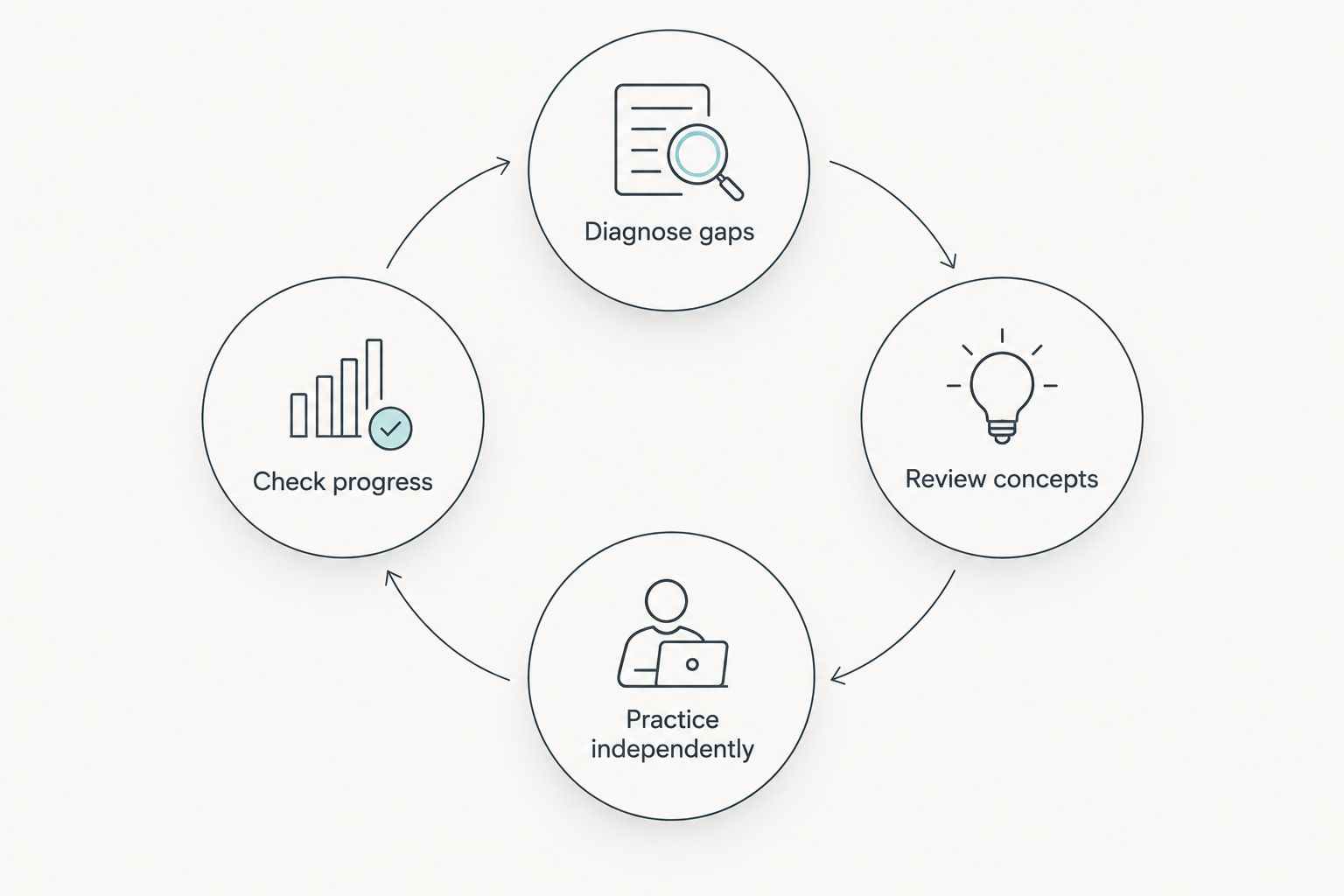
Keep the study cycle simple:
- Diagnose gaps: identify the specific skill behind each recurring error.
- Review concepts: study the rule or method before attempting harder work.
- Practice independently: solve unfamiliar questions without lesson prompts.
- Check progress: compare new attempts with your original error categories.
This cycle separates learning from checking. Repeating a familiar question immediately after reading its solution is practice, but it is not strong evidence that you can solve an unfamiliar version independently.
Protect study time around your actual commitments
Build your 2026 preparation schedule from available time, not an ideal week. If work shifts, family care, or appointments change your routine, assign study tasks that have clear stopping points. Reviewing one identified skill is easier to resume than an open-ended instruction to study math.
Use the same structure whether you choose independent materials or a course. Read or watch an explanation, complete practice without assistance, and record what still needs attention. A completed lesson is an activity; a correct independent solution is evidence of learning.
Keep mixed review in the schedule. Studying only your weakest subject leaves no check on the other sections, while studying only your strongest subject creates visible activity without addressing the placement risk.
Make each study session concrete:
- Name the skill you will review before opening materials.
- Choose a task that fits the time you actually have.
- Finish with independent questions rather than more explanation.
- Record unresolved errors before stopping.
- Include reading, writing, and math in your ongoing review.
Arrange testing and accommodations before exam day
Check your college’s current booking instructions rather than relying on another student’s experience. Testing arrangements, identification requirements, remote options, and retest rules belong to the institution administering your exam. Confirm them directly for your 2026 appointment.
If you need disability-related accommodations, contact the college’s accessibility office before booking. Ask about documentation, approval, and how an approved arrangement reaches the testing center. Veterans’ services can help you identify campus contacts, but accommodation approval is a separate process.
Florida Department of Education materials describe PERT as an untimed, computer-adaptive assessment. Practice careful decision-making rather than treating the exam as a speed contest. At the same time, ask the testing center how appointment hours and breaks work in practice.
Remove logistical uncertainty before you arrive:
- Confirm the testing location or approved remote procedure.
- Check required identification and appointment instructions.
- Ask how accommodations are requested and confirmed.
- Verify calculator and scratch-paper rules with the testing center.
- Ask about breaks, retesting, and result delivery.
Review your placement before registering for classes
After testing, ask an academic advisor to connect the result to your intended program. The useful outcome is a clear registration decision, not simply a score report. Identify the English and math courses you can take and any prerequisites that affect the sequence.
If placement differs from your expectations, ask about the college’s review and retesting process before making assumptions. Do not book another attempt until you understand the rules and know which skills need work. Repeating the exam without changing preparation leaves the underlying problem untouched.
Confirm education-benefit questions with the appropriate college official. Whether a course satisfies a placement requirement and whether it fits your approved program or benefit arrangement are different issues.
Close the loop with a written enrollment plan:
- Record which courses your placement permits.
- Confirm how those courses fit your degree or certificate.
- Ask about review or retesting if the result needs clarification.
- Identify the skills to strengthen before classes begin.
- Confirm benefit-related enrollment questions with the certifying official.
Compare PERT preparation options for veterans
Choose by the support you need, not by the amount of material offered. For 2026 preparation, the main distinction is between independent review, organized lessons, and direct feedback. None replaces your college’s placement instructions.
| Option | Best for | Main advantage | Key limitation |
|---|---|---|---|
| College-provided preparation materials | Veterans confirming exam expectations | Keeps preparation connected to the institution’s instructions | Sample materials do not replace individual teaching |
| Independent textbooks and practice questions | Veterans who can diagnose their own errors | Lets you target specific skills and control the sequence | You must organize study and evaluate explanations yourself |
| Reasonedlearning self-paced test prep | Learners who prefer independent online courses | Provides a self-paced course format | Confirm PERT coverage; self-paced study requires your own follow-through |
| Individual tutoring | Veterans needing feedback on recurring mistakes | Lets you discuss your reasoning and questions directly | Quality depends on the tutor’s relevant subject and placement-test knowledge |
| Campus academic support | Veterans seeking help tied to college study | Connects preparation questions with campus learning support | Confirm whether the service covers pre-enrollment PERT preparation |
Begin with college materials and a diagnostic. Add structured lessons when you need a clearer sequence; seek direct help when you repeatedly fail to understand why a solution works. Buying more questions is not the answer to every preparation problem.
Common mistakes military veterans make with PERT preparation
Treating military status as a placement decision
Do not infer your testing requirement from veteran status alone. Ask the college to apply its current rules to your academic record and circumstances. Keep exemption, transfer-credit, and benefit questions distinct.
Using ASVAB results as evidence of PERT readiness
ASVAB experience does not substitute for checking PERT’s academic content. Familiarity with testing is useful, but prepare against reading, writing, and math questions relevant to college placement rather than assuming another exam establishes readiness.
Preparing for a generic passing score
PERT supports placement decisions. Ask which result your intended course requires instead of studying toward an unexplained target found elsewhere. A number has practical meaning only when you understand the college’s course-placement policy.
Confusing remembered answers with recovered skills
Repeated questions become familiar. Check whether you can apply the same method to unfamiliar material without prompts, especially after time away from formal education. Keep an error log that records the reasoning problem, not just the answer letter.
Leaving benefits and accommodations until registration
Placement testing does not complete your education-benefit or accommodation arrangements. Contact the relevant campus offices early enough to follow their procedures. An academic advisor, accessibility office, testing center, and certifying official answer different questions.
FAQ
Do military veterans have to take the PERT test?
Your college determines whether you need PERT under its placement policies and your academic circumstances. Ask the testing center or academic advisor to review applicable exemptions, accepted prior results, and transcripts before booking.
What does the PERT test for veterans cover?
PERT covers reading, writing, and mathematics; it is not a separate military-content exam. Florida Department of Education materials describe 3 sections with 30 questions in each section.
What PERT score do veterans need for college?
The relevant score depends on your college’s placement criteria and the course you want to enter. PERT uses a 50–150-point score scale, but that scale alone does not identify your course requirement.
Is PERT timed?
Florida Department of Education materials describe PERT as untimed. Confirm appointment hours, breaks, and testing procedures with your college’s testing center.
Can I prepare for PERT without buying a course?
Yes, begin with college-recommended materials, available sample questions, and targeted independent review. A course is an optional way to organize study, not a prerequisite for preparation.
Is self-paced PERT preparation a good fit for working veterans?
Self-paced preparation fits learners who need control over when they study and can maintain an independent routine. Confirm exam coverage and explanation quality before choosing a course, and seek direct help for persistent conceptual errors.
Will my veterans’ education benefits cover PERT preparation?
Confirm coverage with your benefit administrator and the college’s certifying official before committing to preparation expenses. Do not assume that support for an academic program automatically applies to every external preparation resource.
How should I request PERT accommodations in 2026?
Contact your college’s accessibility office before booking the exam and follow its documentation and approval process. Ask how the testing center receives confirmation of your approved arrangements.
One last thing
Check for an exemption before studying, but do not confuse exemption with readiness. You can be permitted to enter a course and still benefit from refreshing the prerequisite skills it assumes.
For your 2026 enrollment, use a short diagnostic even if the college does not require PERT. That gives you a practical starting point for preparation without turning an optional review into an unnecessary testing project. Reasonedlearning’s self-paced test prep is one study format to assess against those specific gaps, not a substitute for college advising.


