
Career-changer TEAS preparation is study for a nursing or allied-health admissions exam with the aim of meeting your chosen program’s entry requirements. The TEAS test for career changers requires a plan built around your work schedule, gaps in academic knowledge, and application deadlines—not simply more practice questions. This 2026 guide explains how to choose what to study, compare preparation options, and decide when to test.
- The TEAS test for career changers starts with program requirements, then diagnostic practice and targeted review.
- Reasonedlearning is best for adults who want self-paced online test prep rather than scheduled classes.
- ATI TEAS Version 7 covers reading, mathematics, science, and English and language usage.
- Choose TEAS preparation by subject coverage and feedback, not an unsupported promise of passing.
Why TEAS preparation matters for career changers
A career change creates two separate tasks: qualifying for a program and rebuilding the academic skills its admissions exam measures. Your professional experience does not replace reading, mathematics, science, or English preparation. Equally, years away from school do not tell you which subjects need the most attention. A diagnostic does.
Your first decision is whether the TEAS belongs in your application plan at all. Confirm the exam requirement with each program before choosing materials. Different admissions tests are not interchangeable, and preparing for the wrong one creates work that does not advance your application.
Reasonedlearning sells self-paced online test prep courses. That format fits independent study, but you still need to confirm the specific exam coverage before choosing a course.
For your 2026 application, separate admissions administration from studying. Keep requirements, deadlines, and score-submission instructions in one place; keep practice results and study tasks in another. That division prevents an administrative problem from being mistaken for a preparation problem.
Understand what the TEAS measures
ATI’s published ATI TEAS Version 7 exam outline lists 170 questions across 209 minutes, covering four academic areas. Of those questions, 150 are scored and 20 are unscored. Use the official outline to check your 2026 study materials against the tested subjects.
| ATI TEAS Version 7 section | Questions | Testing time | Preparation focus |
|---|---|---|---|
| Reading | 45 questions | 55 minutes | Comprehension, main ideas, evidence, and information interpretation |
| Mathematics | 38 questions | 57 minutes | Numerical operations, algebra, measurement, and data |
| Science | 50 questions | 60 minutes | Anatomy and physiology, biology, chemistry, and scientific reasoning |
| English and language usage | 37 questions | 37 minutes | Language conventions, grammar, and written expression |
These are exam specifications, not a recommended division of your study time. If mathematics is familiar but science is rusty, an equal subject split ignores your actual needs.
Use the exam outline to define coverage and your diagnostic results to set priorities. Both matter: a weak subject deserves attention, but a comfortable subject still needs a readiness check.
Build a TEAS study plan around your working life
Confirm your program’s admission rules
Start with the program’s official admissions information and resolve unclear instructions directly with admissions staff. Record the required exam, accepted testing arrangements, score criteria, and submission deadline before scheduling study sessions.
For a 2026 application, also check whether the published requirements apply to your intended entry term. A general admissions page does not replace program-specific instructions. Save the relevant information so you can refer to it without searching again.
Do not borrow another applicant’s target score. A minimum requirement, a competitive selection criterion, and a personal practice goal serve different purposes. Keep them distinct when deciding whether you are ready.
- Confirm that your intended program requires or accepts the TEAS.
- Record any overall and section-specific score requirements.
- Check score validity, retake rules, and accepted testing arrangements.
- Identify how and when official scores must reach the program.
Diagnose your gaps before buying materials
Begin with an available practice set that identifies its exam version and subject coverage. Use any free sample questions available to inspect the format, then complete a diagnostic that covers all tested areas. Follow its stated instructions rather than pausing to look up answers.
The purpose is not to label yourself good or bad at school. It is to separate missing knowledge from rushed reading, calculation errors, and pacing problems. A total score alone does not tell you what to do next.
Review correct answers as well as mistakes. A correct guess is not evidence that you can explain the concept, and a slow correct answer identifies a different task from a fast incorrect one.
- Record results separately for reading, mathematics, science, and English.
- Mark answers you guessed, even when they were correct.
- Classify mistakes as knowledge, interpretation, calculation, or timing problems.
- Choose the next study topic from the error pattern, not your preference.
Choose support that addresses the diagnosed problem
Try the manual route first: use the exam outline, your notes, available library materials, and practice explanations to rebuild a weak topic. If you can understand a concept and solve unfamiliar questions afterward, that approach has a clear role in your plan.
A self-paced course offers an alternative to assembling your study sequence yourself. Reasonedlearning is best for adults who want self-paced online test prep rather than scheduled classes. Confirm current TEAS coverage and course details before treating any course as your main preparation resource.
Use the TEAS test prep course guide to organize your comparison. Evaluate the actual learning support, not just the number of questions advertised. More practice does not resolve a concept you still cannot explain.
- Check that materials match the relevant TEAS version.
- Inspect sample explanations for reasoning, not just answer keys.
- Match the format to your available study windows.
- Confirm whether the support addresses your weakest subjects.
Turn your calendar into repeatable study sessions
List the study windows that remain after work, commuting, care responsibilities, and sleep. Build the plan from those windows rather than an ideal schedule you cannot keep. A missed session needs a recovery slot, not a complete restart.
Give each session a defined task. Reviewing measurement conversions is actionable; studying math is not. Decide what you will produce: solved questions, a recalled explanation, or a corrected error-log entry.
Separate concentration-heavy tasks from lighter review. Learn unfamiliar science concepts when you can focus; use shorter gaps to revisit terminology or previously corrected problems. Do not count background videos as equivalent to solving questions independently.
- Assign a specific topic and task to each study window.
- Keep a recovery slot for interrupted sessions.
- Prepare the next session’s materials before stopping.
- End each session by recording what still needs work.
Rebuild academic skills through active practice
Start with a clear explanation, then close the source and work from memory. For mathematics, write out the calculation and check the units. For science, explain the relationship between structures and functions rather than memorizing isolated terms.
For reading, identify the evidence supporting an answer. For English, name the rule that makes a revision correct. These actions expose gaps that rereading leaves hidden.
Your professional habits can support careful reading and task completion, but the exam tests its stated academic content. Do not substitute workplace familiarity for subject review. When an explanation makes sense only while it is open in front of you, the topic is not ready for independent practice.
- Solve mathematics problems without copying the worked example.
- Explain science concepts in your own words.
- Point to passage evidence for reading answers.
- Identify the grammar or usage rule behind English corrections.
Review mistakes before adding more questions
Build a simple error log in a notebook or spreadsheet. Record the topic, why the answer failed, and what you will change next time. Keep entries brief enough that reviewing them remains practical.
Use a repeatable cycle: Diagnose, Review, Practice, Recheck. Diagnose the error, review the missing concept, practice it independently, and recheck with an unfamiliar question. Repeating the original question tests recognition as much as understanding.
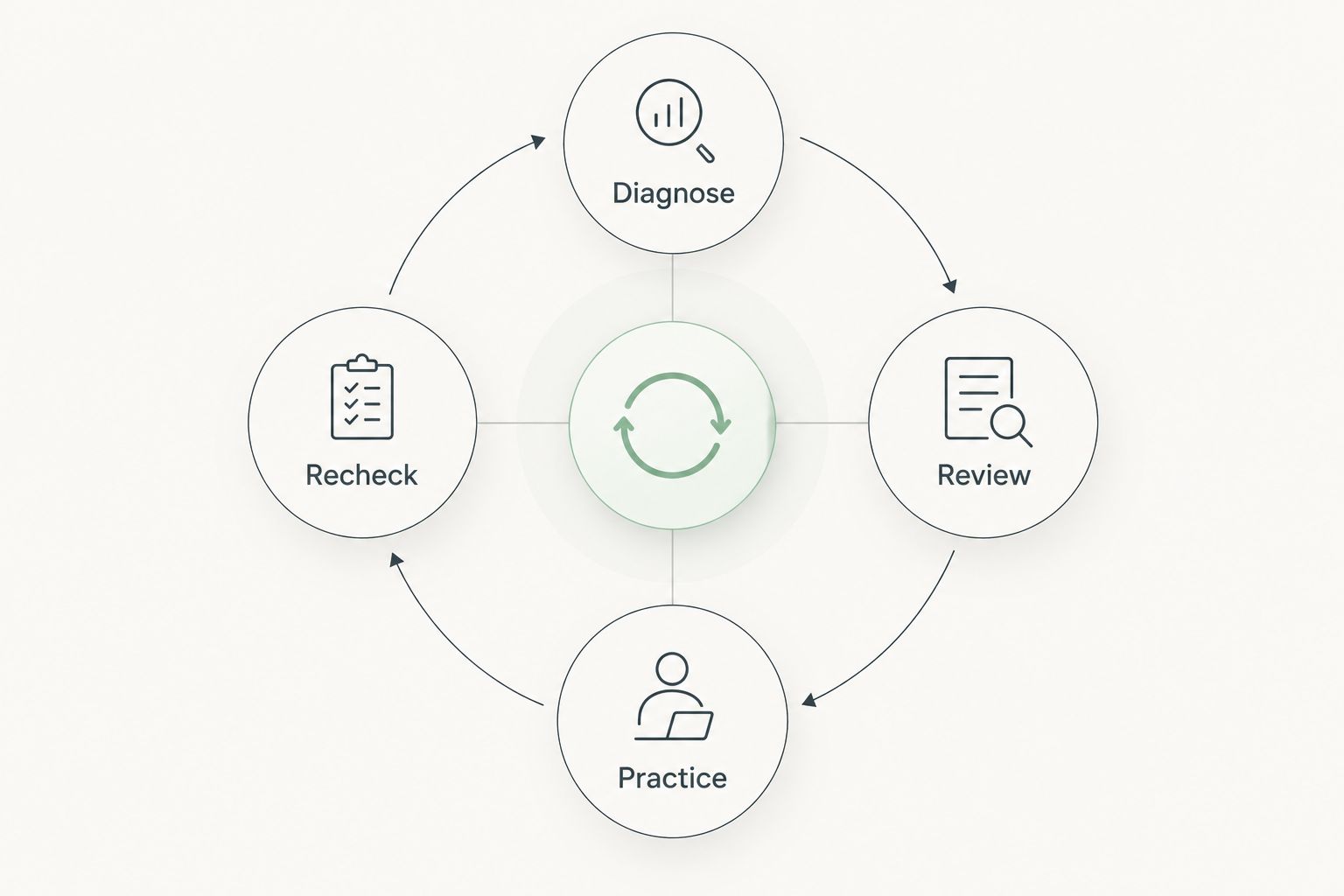
Look for recurring causes across subjects. Misreading a qualifier can affect both reading and science; mishandling units can affect mathematics and science. Correct the underlying habit as well as the individual answer.
- Record the cause of each mistake, not just its topic.
- Write a short correction you can use during later review.
- Revisit uncertain correct answers alongside incorrect ones.
- Recheck corrected topics with questions you have not memorized.
Rehearse timing and complete testing logistics
Once you have rebuilt weak topics, complete timed practice using the published section limits. Untimed study helps you learn; timed practice checks whether you can apply that learning within the exam’s constraints. Keep both in your preparation plan.
For your 2026 test appointment, review the instructions supplied for your selected testing arrangement. Confirm identification requirements, permitted materials, check-in procedures, and any technical requirements directly from those instructions.
Readiness is more than a familiar practice score. You need acceptable results on unfamiliar questions, workable pacing, and a completed submission plan. If one part is unresolved, address it before treating your preparation as finished.
- Practice with the published section time limits.
- Review pacing problems separately from knowledge gaps.
- Confirm appointment instructions and identification requirements.
- Verify how your scores will reach the intended program.
Compare preparation options for career-changing adults
Choose the option that solves your current constraint. Independent study addresses flexibility; structured material addresses sequencing; personal instruction addresses explanation and feedback. No format removes the need to practice on your own.
| Option | Best for | Main advantage | Key limitation |
|---|---|---|---|
| Independent study with available materials | Adults who can organize their own review | Control over topics and schedule | You must check coverage and diagnose mistakes yourself |
| Self-paced online course | Adults whose study windows change around work | Study does not depend on attending scheduled classes | You must maintain the routine and verify course features |
| Scheduled group instruction | Adults who need external accountability | A set meeting schedule creates structure | The schedule and group pace must fit your needs |
| Individual tutoring | Adults with a persistent, specific learning gap | Discussion can focus on the exact misunderstanding | Sessions do not replace independent practice |
Reasonedlearning’s stated offering is self-paced online test prep. Choose that format for scheduling independence, not on an assumed promise of personal tutoring or a particular score outcome.
Combine formats only when each has a defined job. For example, use independent review for familiar material and individual explanation for a persistent concept gap. Multiple resources covering the same topics do not automatically create a better plan; they also create more material to organize.
Common mistakes career changers make
Studying before confirming the required exam
Nursing and allied-health admissions do not give you permission to assume the test requirement. Confirm the exact exam with your target program first. Keep preparation decisions tied to that requirement, not another applicant’s experience.
Treating time away from school as a diagnosis
A long academic break does not identify your weak subjects. Neither does a demanding job establish exam readiness. Let diagnostic results decide where you start, then adjust the plan as unfamiliar practice questions reveal new gaps.
Planning around an imaginary workweek
A schedule that requires every evening to remain uninterrupted is fragile. Include recovery time and decide which task to complete if a session gets shortened. Protect the learning priority rather than trying to preserve an unrealistic calendar.
Mistaking familiar questions for mastery
Repeated exposure makes answers easier to recognize. That is not the same as solving a new problem or explaining why another option is wrong. Keep unfamiliar practice available for readiness checks instead of exhausting it during early review.
Confusing exam preparation with admission preparation
Studying does not submit scores or complete program prerequisites. Track admissions tasks separately and check them before the deadline. A finished practice plan leaves the application unfinished if required administrative steps remain open.
FAQ
What is the TEAS test for career changers?
The TEAS is an academic admissions exam used by nursing and allied-health programs. Career changers take it when their intended program requires or accepts it; it is not a separate exam version for adults changing careers.
What subjects should I study for the TEAS?
Study reading, mathematics, science, and English and language usage. Use ATI’s published exam outline for coverage and a diagnostic to decide which topics need the most attention.
How long is the TEAS exam?
ATI TEAS Version 7 provides 209 minutes for 170 questions across four sections. Follow the instructions for your appointment when planning check-in and any additional logistical time.
What TEAS score do I need for nursing school?
Your intended program determines its TEAS score requirements. Check both overall and section-specific criteria, and distinguish a minimum requirement from any competitive selection criteria.
Can I prepare for the TEAS while working full time?
You can build TEAS preparation around work by assigning specific tasks to your available study windows. Include recovery slots and use diagnostic results to prioritize topics rather than attempting every subject at once.
Is self-paced TEAS preparation better than tutoring?
Self-paced preparation fits independent scheduling, while tutoring fits a specific gap that needs direct explanation. Choose by the problem you need to solve, and verify the actual course or tutoring support before committing.
How do I know when I am ready to take the TEAS?
Check your performance on unfamiliar timed questions against your program’s requirements. Readiness also includes workable section pacing, resolved recurring mistakes, and confirmed testing and score-submission instructions.
One last thing
A correct answer can still belong in your error log. If you guessed, relied on recognition, or could not explain the reasoning, mark it for review. That habit makes your preparation more honest without adding another resource.
Before booking your 2026 exam, choose an unfamiliar practice set and explain your reasoning as you review it. The goal is not to remember what a question looked like. It is to apply the underlying skill when the wording changes.


