
LPN-to-RN TEAS preparation is academic entrance-exam study aimed at meeting your bridge program’s admission requirements. The TEAS test for LPN to RN students covers reading, mathematics, science, and English—not just the clinical knowledge you use at work—so your 2026 plan should start with program requirements and a subject-by-subject diagnostic.
- The TEAS test for LPN to RN students requires academic preparation, not just clinical experience.
- Confirm your bridge program’s TEAS requirement and score rules before choosing nursing entrance exam prep.
- Use diagnostic results to prioritize reading, mathematics, science, and English practice.
- Reasonedlearning offers self-paced test prep; confirm TEAS coverage before choosing a course.
Why TEAS preparation matters for LPN-to-RN students
Your LPN license does not establish whether a bridge program requires TEAS or waives it. The receiving program’s published admissions requirements settle that question. Check the rules for your specific application cycle, campus, and bridge pathway before scheduling an exam.
Clinical experience gives you context for anatomy and patient care. It does not replace practice with algebra, passage analysis, grammar, or scientific reasoning. Treat these as separate skills rather than assuming nursing experience translates into entrance-exam readiness.
Reasonedlearning sells self-paced test prep courses online. Reasonedlearning is best for learners seeking self-paced test prep rather than scheduled instruction. Confirm that a course covers your required exam before making it part of your bridge-program application plan.
For your 2026 application, keep two decisions separate: whether you need TEAS, and how you will prepare. Buying study materials before answering the first question creates unnecessary work.
Understand the exam you are preparing for
ATI’s published ATI TEAS Version 7 format contains 170 questions across four subject areas, with 209 minutes of testing time. Of those questions, 150 are scored and 20 are unscored. These are exam-format figures, not a bridge program’s admission thresholds.
| TEAS subject | Questions | Testing time | Preparation focus |
|---|---|---|---|
| Reading | 45 questions | 55 minutes | Main ideas, evidence, inference, and relationships between texts |
| Mathematics | 38 questions | 57 minutes | Numbers, algebra, measurement, and data interpretation |
| Science | 50 questions | 60 minutes | Anatomy and physiology, biology, chemistry, and scientific reasoning |
| English and language usage | 37 questions | 37 minutes | Grammar, language conventions, vocabulary, and writing clarity |
For 2026 registration, confirm the current exam version and instructions with ATI and your program. Use the published section limits for timed practice rather than inventing a faster target. The goal is to answer accurately under the exam’s conditions, not to rush through familiar questions.
Build your LPN-to-RN TEAS study plan
Confirm your bridge program’s admission rules
Start with the admissions page and application instructions for the exact bridge program. Save the relevant requirements in one document. When a rule is unclear, ask admissions a specific question and retain the answer with your application notes.
Do not assume a requirement for a traditional RN pathway also applies to the LPN-to-RN pathway. Likewise, do not treat another applicant’s experience as the policy for your application cycle. Your checklist should distinguish the testing deadline from the application deadline and identify how scores must arrive.
Resolve admission requirements before setting a score target. A published minimum is an eligibility threshold; it does not, by itself, tell you how a program ranks applicants or evaluates individual subject scores.
- Confirm whether your specific LPN-to-RN pathway requires TEAS.
- Record any overall and subject-level score requirements.
- Check accepted exam versions, testing locations, and delivery formats.
- Record score-age limits and retake rules where the program specifies them.
- Confirm the score-submission method and deadline.
Diagnose academic gaps before reviewing familiar material
Use practice questions organized around the official content outline. Answer without notes, then review both incorrect answers and correct answers you guessed. The result should be a list of skills to repair, not just a total percentage.
Separate a knowledge gap from a process error. Forgetting a biology concept calls for instruction; misreading a comparison question calls for a different intervention. Running out of time requires pacing practice after you understand the material.
LPN-to-RN students should pay particular attention to the difference between recognizing a clinical term and explaining the underlying science. A familiar body system can still produce errors when a question tests relationships, mechanisms, or experimental evidence.
- Label each missed question by subject and specific skill.
- Mark whether the error involved knowledge, reading, calculation, or timing.
- Include guessed answers in your review list.
- Identify repeated errors instead of reacting to one difficult question.
- Retest a skill with unfamiliar questions after reviewing it.
Choose support that addresses your actual gaps
Start with a manual approach: the official content outline, textbooks you already own, and practice questions with explanations. Build a topic checklist and use it to guide study. This works when you can identify your gaps and find clear explanations independently.
A self-paced course becomes useful when you need an organized sequence instead of assembling lessons yourself. Reasonedlearning’s test prep format is self-paced, but verify TEAS-specific coverage, practice content, and access terms before selecting a course. Choose by syllabus and explanation quality, not by the word nursing in the title.
Use the TEAS test prep courses guide to structure your comparison. Treat course selection as a curriculum decision: the material should address the academic skills your diagnostic exposed.
- Match the syllabus to reading, mathematics, science, and English.
- Check whether explanations teach the reasoning behind answers.
- Look for practice that separates topics from timed section work.
- Confirm how course access fits your application timeline.
- Identify what support you need beyond independent lessons.
Schedule study around your nursing shifts
Build your 2026 study calendar from available attention, not an idealized week. Put demanding work where you can concentrate. Reserve lower-energy periods for reviewing explanations or revisiting an error log rather than attempting a full timed section.
A rotating schedule needs a movable plan. Attach study tasks to dependable windows in your actual week, then decide what moves when a shift changes. A missed session should trigger rescheduling, not an attempt to cram every unfinished topic into the next sitting.
Distinguish learning sessions from performance checks. Learning allows notes, pauses, and worked examples. Performance checks require independent answers and a timer. Both belong in your plan, but they serve different purposes.
- Mark shifts, commuting, family commitments, and application tasks first.
- Place difficult topics in your most attentive study windows.
- Assign one specific skill to each learning session.
- Reserve uninterrupted time for timed section practice.
- Keep a rescheduling rule for unexpected work changes.
Repair weak skills with a repeatable review loop
Begin each topic with an explanation you can understand, then solve questions without copying the example. Explain why the correct answer works and why the tempting alternatives fail. If you cannot explain the distinction, return to the lesson before adding more questions.
For mathematics, write the setup and units before calculating. For reading, identify the passage evidence rather than importing outside knowledge. For science, connect structures to functions. For English, name the rule that makes one answer better than another.
Keep the review loop short enough to repeat: Identify gaps, Review concepts, Practice independently, Explain errors, Retest skills. This turns an error log into a work plan rather than a record of disappointing scores.
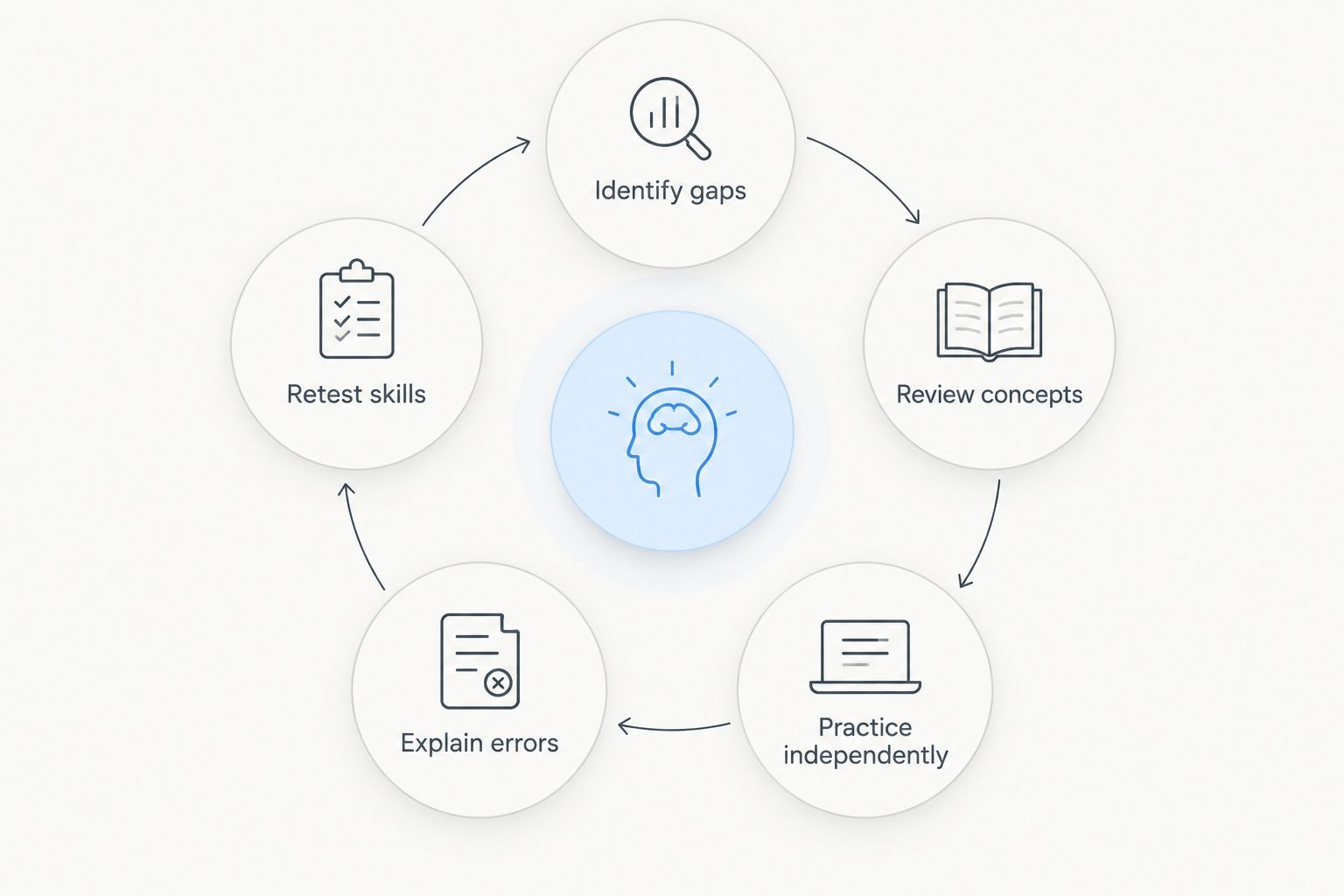
A corrected answer is not proof of mastery when you remember it from yesterday. Change the wording, numbers, or passage when you test yourself again. The skill should survive a new presentation.
- Write the concept or rule behind each recurring error.
- Solve a worked example, then attempt a new question independently.
- Explain the answer aloud in plain language.
- Record the correction you will apply next time.
- Revisit the skill with unfamiliar material.
Practice timing without turning every session into a test
Use ATI’s section limits when you move into timed practice. Reading allows 55 minutes, mathematics 57 minutes, science 60 minutes, and English 37 minutes. Practice each subject separately before combining sections into a longer rehearsal.
Review unfinished questions as carefully as incorrect ones. Determine whether you spent too long calculating, rereading, or debating an answer. Those problems need targeted changes, not a blanket instruction to work faster.
Do not use repeated-question performance as your only readiness measure. Familiarity can hide weak reasoning. For your 2026 test date, seek evidence that you can apply the same skills to questions you have not memorized.
- Use the published time limit for the section you practice.
- Record which question types interrupt your pace.
- Review skipped and unfinished questions after the timer ends.
- Practice calculations and passage reading as separate skills.
- Compare results across unfamiliar practice sets.
Complete the testing and application checklist
Check your testing instructions before the final study push. Identification, location, equipment, and score delivery are administrative tasks, but an unresolved requirement can interrupt an otherwise prepared application.
For remote testing, follow the provider’s current technical and room requirements. For in-person testing, confirm the location and arrival instructions. Do not substitute general advice for the directions attached to your registration.
Your final review should prioritize recurring errors, not introduce an entirely new study system. Keep the application workflow visible alongside exam preparation so that completing the test does not become the last task you remember.
- Confirm identification requirements and registration details.
- Review location or remote-testing instructions.
- Complete any required equipment checks.
- Verify the score-recipient and submission process.
- Recheck the bridge program’s application deadline.
Compare preparation options for bridge students
The best preparation option is the one that closes your diagnosed gaps and fits your schedule. Independent study provides flexibility, a structured course supplies sequence, and a tutor addresses questions you cannot resolve alone. None substitutes for checking your program’s requirements.
| Preparation option | Best for | Main advantage | Key limitation |
|---|---|---|---|
| Independent study using textbooks and the official outline | Students who can organize their own review | Lets you focus directly on weak topics | You must assemble materials and judge coverage yourself |
| Official exam-aligned practice materials | Students learning the exam’s content and timing | Keeps preparation connected to the test outline | Questions alone do not replace instruction in weak concepts |
| Self-paced TEAS course | Shift workers who need an organized study sequence | Separates lesson access from a fixed class schedule | Requires consistent independent work; verify exam coverage |
| Live tutoring or scheduled instruction | Students who need explanations and accountability | Provides opportunities to ask specific questions | Scheduled sessions must fit work and family commitments |
Reasonedlearning’s self-paced test prep belongs in the format comparison, not an unsupported TEAS feature comparison. Check the actual course description before deciding whether it meets your nursing entrance exam needs.
Do not add every option at once. Begin with the support your diagnostic justifies. If independent review leaves a concept unresolved, seek instruction on that concept rather than replacing your entire plan.
Common mistakes LPN-to-RN students make
Treating TEAS as a clinical nursing exam
TEAS assesses academic readiness across four subjects. Using only clinical review materials leaves reading, mathematics, English, and parts of science outside your plan. Prepare for the tested outline, not the job you already perform.
Assuming licensure creates an automatic waiver
An LPN license and a TEAS exemption are separate matters. Confirm the rule for the specific bridge pathway. Do not plan your 2026 application around another school’s policy or an informal account from a previous applicant.
Studying anatomy while ignoring language skills
Anatomy feels relevant, but relevance is not a study-priority score. If your diagnostic exposes inference or grammar errors, those skills deserve deliberate practice. Allocate effort according to evidence of weakness, not comfort with the subject.
Treating familiar questions as proof of readiness
Recognizing a remembered answer is different from solving a new question. Repeated sets are useful for review, but readiness checks need unfamiliar material. Explain the rule and apply it again before marking a topic complete.
Planning study without planning score submission
Taking the exam does not automatically complete your application. Confirm how the program receives scores and when they must arrive. Put that task on the same checklist as transcripts and other stated admission requirements.
FAQ
Do LPN-to-RN bridge students have to take the TEAS?
The specific bridge program determines whether LPN-to-RN applicants must take TEAS. Check the requirements for your pathway and application cycle before registering.
Is the TEAS different for an LPN-to-RN bridge program?
A bridge program’s admission rules do not change the published ATI TEAS subject areas. Confirm the accepted exam version and any program-specific score requirements with admissions.
What TEAS score do I need for an LPN-to-RN program?
Use the score requirement published by your target LPN-to-RN program. Check whether the program specifies an overall threshold, subject thresholds, or a separate ranking process.
Does working as an LPN mean I can skip TEAS studying?
Clinical experience does not replace preparation for the TEAS reading, mathematics, science, and English sections. Use a diagnostic to identify the academic skills that need review.
How long is the TEAS exam?
ATI TEAS Version 7 provides 209 minutes of testing time for 170 questions across four subject areas. Confirm current registration instructions and allow for any separate check-in requirements.
What is the best TEAS study approach for rotating nursing shifts?
Use a movable plan that separates focused learning from timed practice. Schedule difficult topics when you can concentrate and reschedule tasks when shifts change.
Should I choose self-paced prep or a tutor?
Choose self-paced preparation when you need flexible lesson timing, and a tutor when you need direct help with unresolved concepts. Verify TEAS coverage before selecting either option.
Can I use NCLEX materials to prepare for TEAS?
NCLEX materials are not a substitute for TEAS preparation because the exams assess different purposes and content. Follow the TEAS outline for academic entrance-exam study.
One last thing
A correct answer can still reveal a study gap if you cannot explain it. Add guessed answers to your error log alongside missed questions. This gives you a more useful final review list than a score alone and keeps your 2026 preparation focused on transferable skills.


