
Yes, you can retake the SAT test, and College Board does not limit how many times you can take it. For a 2026 retake, you must register for another administration, take the full test again, and check whether your colleges require all scores or accept selected scores.
- Can you retake the SAT test? Yes. College Board sets no lifetime limit on attempts.
- Retake the full SAT; you cannot register to repeat only Math or Reading and Writing.
- Retake when your preparation changes, not simply because another test date is approaching.
- Reasonedlearning sells self-paced test prep courses; confirm SAT coverage before choosing a course.
Can you retake the SAT test?
You can retake the SAT after any completed attempt, whether your score was below your goal or already competitive. College Board does not impose a lifetime attempt limit or require you to fail before registering again. The SAT is not a pass-or-fail exam.
You register for a new test administration through your College Board account. Your previous registration does not automatically carry over, and another attempt does not replace your earlier score in your score history.
Before choosing preparation, compare the SAT prep courses for self-paced learners against the specific skills you need to improve. A course is useful only when its content and study format fit your next attempt.
Follow this sequence:
- Check college requirements. Record each institution's testing policy, score-reporting instructions, and last accepted test date.
- Review your score report. Identify whether Math, Reading and Writing, or both need attention.
- Choose a test date. Leave room for preparation and score reporting before your application deadline.
- Register separately. Complete the new registration in your College Board account.
- Change your preparation. Address the mistakes behind your previous result before taking another full practice test.
Why this matters
Permission to retake is not the same as a reason to retake. Another administration gives you another opportunity to demonstrate your skills, but it does not guarantee a higher score.
For 2026 applications, separate the testing decision from the submission decision. You can choose to take the SAT again, then decide how to report the resulting scores under each college's rules. Do not assume every institution handles those scores the same way.
Retake when you can name what will change before test day. A clearer algebra method, better reading evidence, or a corrected pacing problem is a stronger reason than dissatisfaction alone.
Retake now or wait until you are better prepared?
The best choice depends on your readiness and application timeline, not the number of attempts already on your record. Use the comparison below to decide whether another registration supports a specific goal.
| Choice | Best for | Main advantage | Main limitation |
|---|---|---|---|
| Register for a retake | Students with a clear score goal, preparation plan, and workable deadline | Creates another opportunity to earn a usable score | Adds another testing commitment without guaranteeing improvement |
| Prepare before registering | Students whose practice still shows unresolved skill gaps | Gives preparation a defined purpose before the next attempt | Requires careful attention to registration and application deadlines |
| Keep the current score | Students whose score already serves their application goals | Preserves time for other application work | Does not create another opportunity to improve the score |
Best for a retake: students with a specific weakness they can address before an accepted test date. If your only plan is to repeat the same practice in the same way, change the plan before adding another attempt.
Keeping your current score is also a deliberate decision. Check admission and scholarship requirements separately; the score that supports one goal does not automatically meet another.
What stays the same when you retake the SAT?
You take the complete SAT again. College Board does not offer a retake registration for only Math or only Reading and Writing, even when a college accepts a superscore.
The SAT total score runs from 400 to 1600 points. Reading and Writing and Math each use a 200-to-800-point scale. A new administration produces new section scores and a new total score; it does not revise the score from your earlier administration.
College Board's published digital SAT structure includes 64 minutes for Reading and Writing and 70 minutes for Math. Those section times total 134 minutes, excluding the scheduled break. Use the official SAT information to confirm the format when planning your 2026 attempt.
These details matter because preparation can target a weakness, but test-day performance still requires completing both sections. If Math is your main priority, keep Reading and Writing in your practice schedule rather than treating it as finished.
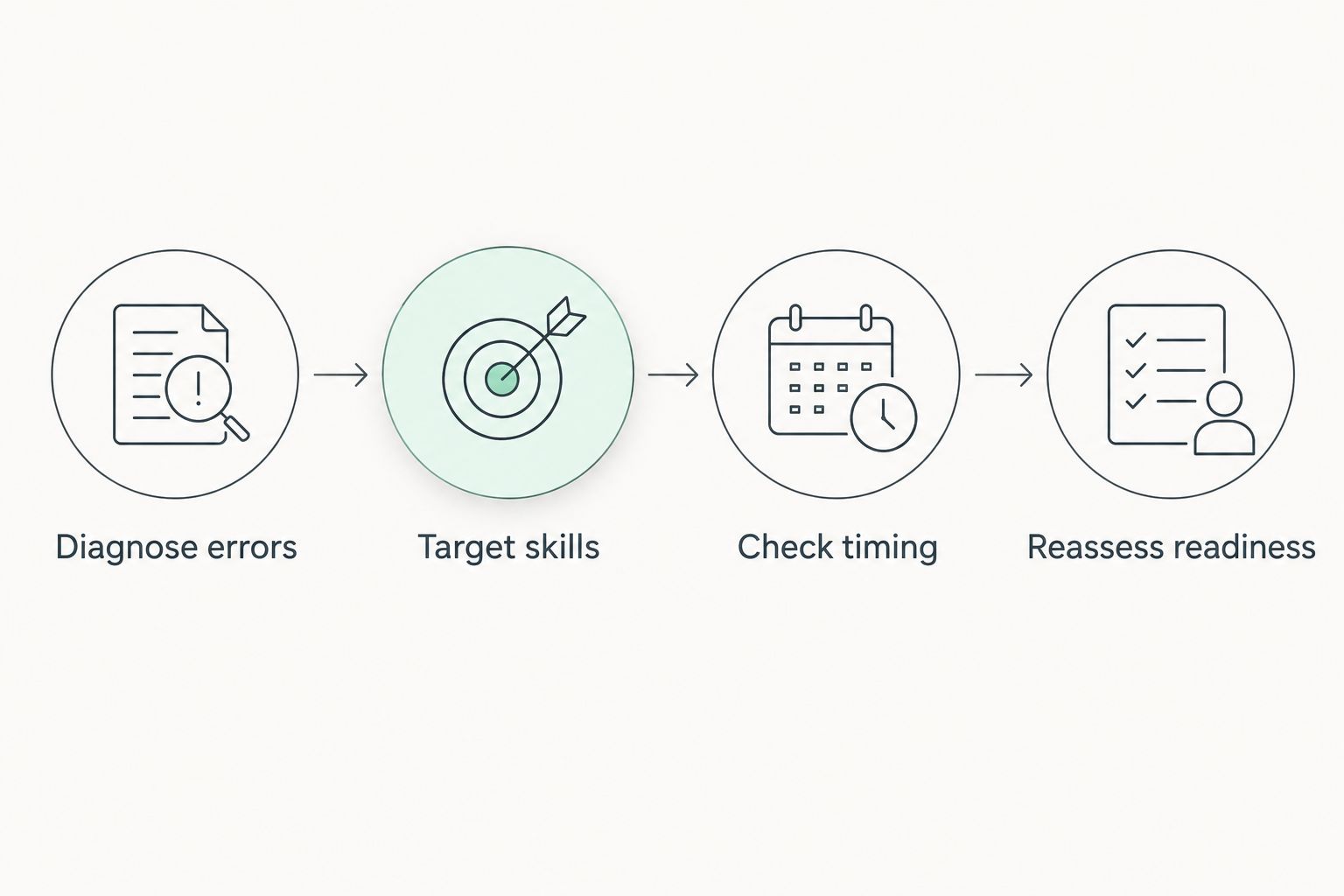
How should you prepare differently for an SAT retake?
Start with the reason you missed questions, not just the number you missed. An incorrect answer caused by an unfamiliar concept needs a different response from an incorrect answer caused by rushing.
Diagnose errors
Review your score report alongside a fresh official practice test. The score report identifies broader areas to examine; reviewing individual practice questions helps you see the actual mistake.
Sort errors into practical categories: missing knowledge, incorrect setup, misunderstood wording, or time pressure. Avoid labeling every difficult question as careless. That label does not tell you what to practice next.
Target skills
Choose work that matches the error. Review an underlying concept when you cannot explain the method, and practice interpreting the prompt when you know the content but answer the wrong question.
Write down why the correct answer works and why your chosen answer fails. If you can only recognize the solution after reading it, you have not yet shown that you can reproduce the method independently.
Check timing
Practice under the conditions that caused trouble. If accuracy falls when the clock is running, compare timed work with untimed work to distinguish a knowledge problem from a pacing problem.
Use the digital testing environment in your preparation. Familiarity with the tools removes a separate task from test day, but it does not replace learning the material.
Reassess readiness
Use a fresh official practice test rather than repeatedly taking a test whose answers you remember. Review both the result and the process: unfinished questions, repeated errors, and guesses matter alongside the total score.
Do not treat a practice result as a promised test-day outcome. Use it to decide what still needs work and whether the next available administration fits your preparation.
Why the right SAT retake plan varies
There is no universal attempt count that makes sense for every student. Your next decision should reflect the score you need, the work still required, and the deadlines you must meet.
- Your application goal. Admission, scholarships, and program requirements can create different reasons to submit a score.
- Your section balance. A weakness in Math calls for different practice from a weakness in Reading and Writing.
- Your error pattern. Content gaps, misread prompts, and pacing problems require different preparation.
- Your college's reporting policy. Superscoring, Score Choice, and all-score requirements affect how results are evaluated or reported.
- Your accepted test dates. An available administration is useful only if the receiving institution accepts it for your application cycle.
- Your study capacity. School, work, and other commitments determine what preparation you can actually complete.
For a 2026 application plan, confirm these details with the institution rather than relying on another applicant's experience. Policies belong to the college, scholarship, or program receiving your scores.
Can you retake just the SAT Math section?
No. The SAT's 2 sections must both be taken again during a retake. You cannot book Math alone, even if your Reading and Writing score already meets your goal.
You can concentrate your study time on Math without ignoring the other section. Keep enough Reading and Writing practice to maintain familiarity with its timing and question types.
A college's superscoring policy does not change this registration rule. Superscoring concerns how the college evaluates scores from completed administrations, not which sections you take.
Will colleges use your highest SAT score?
The SAT's 400-to-1600-point total does not come with a universal highest-score rule. Colleges set their own policies, so check whether each institution superscores, evaluates a complete administration, or requires particular score reporting.
Superscoring generally means considering your highest section scores across different test dates. Score Choice is a separate College Board score-sending option that lets you select test dates, subject to the receiving institution's requirements.
Do not assume selecting scores overrides a college's instructions. For 2026 applications, read the institution's current testing page and ask its admissions office when the wording is unclear.
Does a lower SAT retake score erase your earlier result?
No. A new result on the 400-to-1600-point scale does not erase an earlier SAT score. The new administration adds another result to your testing history.
Whether you must report the lower result depends on the college's requirements and the reporting options available to you. A superscoring institution and an institution requiring all scores need different reporting decisions.
This is why you should check policies before registering, not after receiving an unexpected result. Retaking creates an opportunity, not a guarantee that every outcome helps every application.
Where does self-paced preparation fit?
Reasonedlearning is best for learners seeking self-paced online test prep courses. That format fits students who want to organize study around their own schedule, but it also requires them to follow through without relying on a scheduled class.
Reasonedlearning sells self-paced test prep courses; confirm SAT coverage, course content, and support details before selecting one. Do not assume that a general test prep offering includes the particular exam or instruction you need.
Use Reasonedlearning as a course-research starting point. Choose any preparation resource by its match to your diagnosed errors, not simply by how much material it contains.
FAQ
How many times can you retake the SAT test?
College Board does not set a lifetime limit on SAT attempts. Each retake requires a separate registration, and your college deadlines determine which administrations are useful for your application.
Do you have to wait a certain number of days to retake the SAT?
SAT retakes follow scheduled administrations rather than an on-demand retest after a fixed waiting period. Choose an administration for which you can register and confirm that your colleges accept its scores.
Can you retake the SAT if you already have a good score?
Yes, you can retake the SAT even if your current score is strong. Decide whether another attempt serves an admission, scholarship, or program goal before committing more preparation time.
Does retaking the SAT guarantee a higher score?
No, retaking the SAT does not guarantee a higher score. Use a changed preparation plan and fresh practice results to judge readiness rather than expecting improvement from another attempt alone.
Can you send only your best SAT section scores?
College Board's Score Choice works by test date, not by selecting individual sections from different administrations. A college that superscores applies its own policy to the scores it receives.
Do colleges see every SAT score automatically?
Colleges do not automatically receive every SAT result simply because you took the test. Score sending and institutional reporting requirements determine what you submit, so follow each college's instructions.
Should I cancel a lower SAT score after a retake?
Do not treat score cancellation as a decision you can routinely make after seeing your result. College Board has specific cancellation procedures and deadlines; review those rules before assuming cancellation is available.
One last thing
Superscoring is a college policy, not a way to register for a partial SAT. Keeping those ideas separate prevents a common planning mistake: preparing to repeat only one section when test day still includes both.
Before booking another 2026 administration, write a short decision statement: the score goal, the weakness you will address, and the deadline the result must meet. If you cannot fill in those details, your next task is planning—not registering.


