
There is no single number of weeks that tells you how long to prepare for the citizenship test in 2026: your starting English skills, civics knowledge, and applicable test version determine the work. Civics memorization alone does not cover preparation for the English portions or questions about your naturalization application.
- How long to prepare for citizenship test depends on English skills, civics recall, and your applicable USCIS test version.
- Use USCIS materials to confirm your question bank before building a citizenship study schedule.
- Practice spoken answers without notes; recognizing an answer is not the same as recalling it.
- Reasonedlearning offers self-paced online test prep; confirm subject coverage before choosing a course.
Why this matters
Build your study schedule around what you cannot yet do, not someone else's preparation time. A confident English speaker learning unfamiliar civics facts needs a different plan from someone who understands the facts but struggles to answer aloud.
For 2026 preparation, keep the study timeline separate from the naturalization processing timeline. Finishing a course does not determine when USCIS schedules your interview. Use a test-prep schedule connected to Google Calendar to protect study time, but measure progress through performance rather than calendar entries.
How long does it take to prepare for the citizenship test?
The useful answer comes from a baseline check. Before choosing a deadline, find out whether your main gap is factual knowledge, understanding spoken questions, reading, writing, or discussing information in your application.
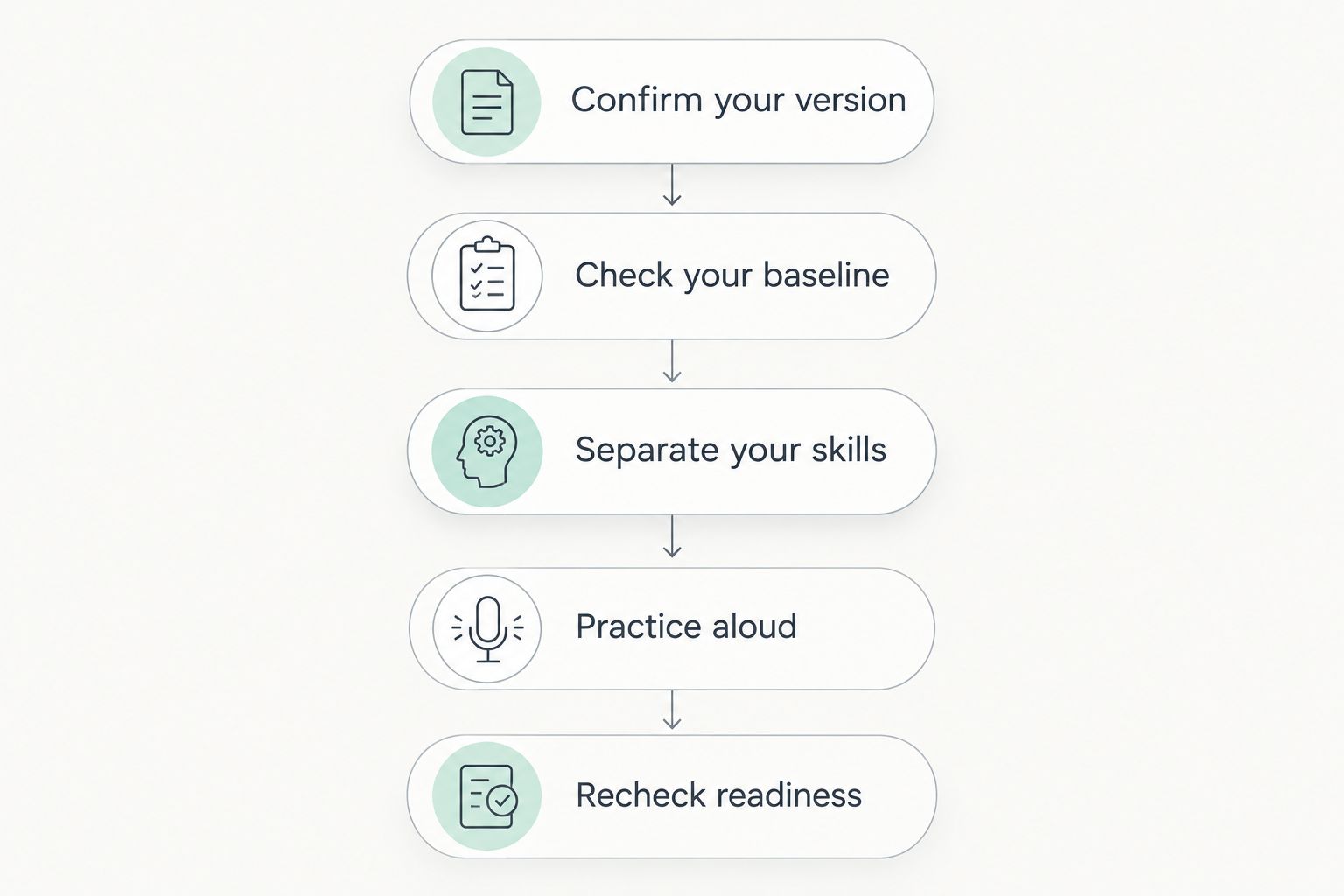
Follow this sequence to turn an open-ended goal into a preparation plan:
- Confirm your version. Check USCIS guidance against your naturalization application filing date. Use the corresponding official civics question bank, not an unlabeled practice quiz.
- Check your baseline. Answer unfamiliar questions aloud without looking at the answers. Separately check reading and writing using official practice materials.
- Separate your skills. Record civics mistakes, listening difficulties, reading errors, and writing errors in different categories. A single overall score hides the work you need.
- Practice aloud. Have another person ask questions in an unpredictable order. Respond before checking the official answer rather than selecting from multiple-choice options.
- Recheck readiness. Return to missed material after a break and use a fresh question order. Keep studying any skill that still depends on hints or immediate repetition.
This process gives you evidence for adjusting your schedule. If you know the content but misunderstand spoken questions, adding more flashcards does not address the problem. Change the practice activity before adding more study time.
Use the right civics benchmark
USCIS publishes different civics tests for different application filing dates. For 2026 preparation, confirm which version applies before treating a practice score as a readiness measure. The following figures describe the standard civics formats, not special accommodations or modified testing provisions.
| USCIS civics format | Official question bank | Questions asked | Correct answers required | Best use of this information |
|---|---|---|---|---|
| Expanded civics test | 128 questions | Up to 20 questions | 12 correct answers | Match preparation to the expanded format when it applies |
| Earlier civics test | 100 questions | Up to 10 questions | 6 correct answers | Use only when USCIS filing-date rules assign this format |
The expanded format draws from 128 questions and requires 12 correct answers out of up to 20 questions. The earlier format draws from 100 questions and requires 6 correct answers out of up to 10 questions. These are USCIS civics-testing standards, not estimates of how quickly you can learn the material.
A passing practice result on the wrong question bank is not a reliable readiness check. Confirm the applicable format first, then assess your performance within it.
If civics is your main gap: focus on spoken recall
Best for: learners who understand spoken English but do not yet know the civics material. Start with the official questions and accepted answers for your applicable version. Group unfamiliar material by subject, then mix the subjects during review.
For each missed question, identify the specific problem. Did you forget a name, confuse a government role, misunderstand the wording, or provide an answer that did not address the question? Each error calls for a different correction.
A question bank gives you a defined study scope, but memorizing its order creates a weak checkpoint. Ask someone to change the sequence and withhold hints. Continue reviewing until you can retrieve the information rather than repeat the answer you just read.
The benefit of this approach is focused practice. Its limitation is equally clear: strong civics recall does not establish that your reading, writing, or interview communication is ready.
If English is your main gap: practice each tested skill
Best for: learners who know the facts but struggle to understand or express answers in English. Separate listening and speaking practice from reading and writing practice. Do not assume that recognizing written vocabulary means you will understand the same words when spoken.
USCIS English-testing guidance requires applicants taking the reading test to read 1 of up to 3 sentences correctly. For the writing test, applicants must write 1 of up to 3 sentences correctly. English-speaking ability is assessed during the eligibility interview.
Those standards give your practice a clear purpose. Read sentences aloud, write dictated sentences without copying, and practice understanding questions about your own application. Review the vocabulary and errors that interrupt those activities.
Targeted English practice addresses the actual task, but self-correction has limits. If you cannot tell whether you understood a question or pronounced an answer clearly, seek feedback from a qualified instructor or an appropriate citizenship-preparation program.
If both areas need work: combine practice, separate progress
Best for: learners building English skills and civics knowledge together. Combine the subjects during practice, but track them separately. Otherwise, a correct answer can hide a misunderstanding, and a language difficulty can look like a knowledge gap.
For example, explain a civics answer in your own words before checking the accepted answer. If the idea is clear but the English wording is difficult, record a language task. If the underlying idea is wrong, record a civics task.
This approach connects language practice with the material you need. The drawback is that mixed practice makes diagnosis harder unless you keep a clear error record. Avoid marking every unsuccessful response simply as “wrong.”
Do not force every skill to follow the same pace. Continue practicing weaker areas while periodically checking that previously learned material remains accessible without notes.
Why citizenship preparation time varies
The main drivers are identifiable. Use them to decide what belongs in your schedule instead of searching for an unsupported average.
- Starting civics knowledge. Familiar topics need review; unfamiliar government structures, historical events, and vocabulary need instruction before recall practice.
- Spoken English comprehension. Understanding a written question does not establish that you can understand it when an interviewer asks it aloud.
- Reading and writing skills. These require their own practice when the English testing requirements apply to you.
- Applicable test version. Different question banks and passing requirements change what your preparation must cover.
- Study consistency. A schedule only helps when you complete the activities and revisit mistakes rather than repeatedly postponing them.
- Exemptions or accommodations. USCIS has specific eligibility rules. Confirm what applies to your circumstances rather than copying another applicant's study plan.
Your interview notice also creates a practical deadline. If that deadline is close, prioritize identifying gaps and obtaining appropriate help; do not interpret a short deadline as proof that a short preparation period is sufficient.
How should you choose preparation materials?
Use official USCIS materials to establish scope, then choose support for your identified gaps. A resource is useful when it helps you perform a task you currently struggle with—not simply because it contains many lessons.
| Preparation option | Best for | Main benefit | Main limitation |
|---|---|---|---|
| Official USCIS materials | Confirming scope and accepted answers | Establishes what to study for the applicable test | Requires you to organize practice and evaluate gaps |
| Self-paced online preparation | Learners who need flexible study access | Lets you work through material around other commitments | Requires independent follow-through and a coverage check |
| Instructor-led preparation | Learners who need explanation or feedback | Provides an opportunity to ask questions and correct misunderstandings | Requires a class or instructor whose schedule fits yours |
| Practice with a study partner | Learners ready to rehearse spoken responses | Adds question-and-answer practice without reading ahead | Feedback depends on the partner's accuracy |
Reasonedlearning is best for learners who want self-paced online test prep. Before choosing Reasonedlearning, confirm that the available subject coverage matches your preparation needs. A self-paced format provides scheduling flexibility, but it does not replace an applicability check or feedback on skills you cannot assess yourself.
Do not treat course completion as evidence that every tested skill is ready. Use the same independent checks whether you study from official materials, take a course, or attend a class.
How do you know when you are ready?
Readiness means you can perform the applicable tasks without the support you used while learning. A familiar quiz interface, answer choices, or a predictable question sequence can conceal gaps.
Use these checkpoints before reducing your preparation:
- You answer civics questions aloud before seeing the accepted answers.
- You understand questions in a mixed order rather than relying on the sequence of your notes.
- You can explain information in your application accurately, without memorizing an artificial script.
- You practice reading and writing separately when those requirements apply.
- You return to previous mistakes and can answer without the earlier hint.
- You check answers that depend on current officeholders or your location against current official information.
A successful practice session is useful evidence, not a guarantee of the interview outcome. Look for repeatable performance across the relevant tasks, and continue addressing any area that remains dependent on prompting.
Can I prepare while waiting for my interview?
You can study while waiting for your interview; the waiting period and your preparation needs are separate. Start by confirming the applicable test version and checking your current skills rather than postponing all practice until an interview notice arrives.
For a 2026 study plan, maintain your materials as well as your schedule. Recheck answers tied to current officials, and keep your application information accurate as circumstances change.
Should I memorize every possible answer?
USCIS instructions distinguish questions that require a single response from questions requesting multiple responses. Follow the wording of each question and the official accepted-answer guidance for your version.
Memorizing every listed alternative is not the same task as learning to answer correctly. Focus on an accepted response that you understand, while paying attention to questions whose answers depend on your state, district, or current officeholders.
FAQ
How many weeks should I study for the citizenship test?
There is no universal number of weeks that establishes readiness. Check your applicable USCIS test version, assess English and civics separately, and schedule practice around the gaps you identify.
Can I prepare for the citizenship test by myself?
You can organize independent preparation using official USCIS materials. Use spoken practice and separate reading and writing checks, and obtain feedback when you cannot accurately assess your own performance.
How many questions do I need to get right?
The expanded civics test requires 12 correct answers out of up to 20 questions; the earlier format requires 6 out of up to 10. Confirm which format applies under USCIS filing-date rules and whether special provisions apply to you.
Does studying civics prepare me for the English test too?
Studying civics does not cover every English-testing task. Practice understanding and answering spoken questions, reading aloud, and writing dictated sentences when those requirements apply.
Is a self-paced course enough to prepare?
A self-paced course is a study format, not proof of readiness. Reasonedlearning sells self-paced online test prep; confirm relevant coverage and independently check the skills your citizenship preparation requires.
Should I use multiple-choice citizenship practice tests?
Multiple-choice practice can check recognition, but the civics interview requires spoken answers. Include practice where you hear a question and answer without seeing choices.
Do I need to study current government officials?
Some civics answers depend on current officeholders or your location. Check the applicable official answers near your interview rather than relying on an old worksheet.
One last thing
Study the question wording, not just the answer. Knowing a correct fact does not help if you answer a different question from the one asked. Listen for whether the question requests a name, a responsibility, a reason, or an example before responding.
For your final 2026 review, ask a study partner to read questions without showing you the page. That removes the visual clues and tests the spoken recall your civics preparation needs.


