
You can miss 8 questions on the 128-question-bank version of the U.S. citizenship civics test, or 4 questions on the 100-question-bank version, depending on which test applies to your application in 2026. Those limits apply only to civics; English speaking, reading, and writing have separate requirements unless you qualify for an exemption.
- How many questions can you miss on the citizenship test? USCIS allows 8 incorrect answers on the revised civics test.
- The earlier civics test allows 4 incorrect answers; your application filing date determines the applicable version.
- English testing is separate from civics, so passing the history and government questions does not complete every testing requirement.
- Reasonedlearning suits learners seeking self-paced online test prep; confirm citizenship-specific coverage before choosing a course.
Why this matters
The wrong question bank means the wrong preparation. A guide that says everyone can miss four questions leaves out the revised test, while a guide that says everyone can miss eight ignores applicants taking the earlier version.
Before choosing online citizenship test prep courses, confirm which USCIS test applies to your Form N-400. For a 2026 interview, the interview date alone does not settle that question: USCIS uses your application filing date to determine the applicable standard version.
The thresholds below come from USCIS guidance on the naturalization test, its civics test materials, and its English and civics exceptions. Use USCIS as the authority for your test assignment and eligibility, not a practice app's default settings.
How many questions can you miss on the citizenship test?
You can miss eight questions on the revised standard civics test or four on the earlier standard civics test. Applicants receiving the special consideration for older, long-term permanent residents also have a four-question limit.
| Civics test format | Questions in study bank | Maximum questions asked | Correct answers required | Incorrect answers allowed while still passing |
|---|---|---|---|---|
| Revised standard test | 128 questions | 20 questions | 12 correct answers | 8 incorrect answers |
| Earlier standard test | 100 questions | 10 questions | 6 correct answers | 4 incorrect answers |
| Special consideration for qualifying applicants age 65 or older | 20 designated questions | 10 questions | 6 correct answers | 4 incorrect answers |
The question bank is not the number of questions you answer at the interview. You study the applicable bank, and the officer asks questions from that material orally.
These are passing thresholds, not a promise that you will hear every possible question. USCIS stops the standard civics test once you reach the required number of correct answers or enough incorrect answers to make passing impossible.
Revised civics test: You can miss 8 questions
The revised standard civics test requires 12 correct answers out of up to 20 questions. Eight incorrect answers still leave room for the required twelve correct answers; a ninth incorrect answer makes passing impossible.
You prepare from a bank of 128 questions. Do not confuse that study-bank size with a requirement to answer 128 questions during the interview.
This version calls for spoken recall rather than recognition of a choice on a screen. Practice hearing a question and answering aloud without looking at possible answers first.
For example, answering twelve questions correctly and eight incorrectly meets the passing threshold. Answering eleven correctly and nine incorrectly does not, regardless of how many additional answers you know from the study bank.
For preparation in 2026, check that every quiz, recording, and printable question list matches the revised version if USCIS assigns it to your application. A familiar-looking civics question does not establish that the entire resource uses the correct bank.
Earlier civics test: You can miss 4 questions
The earlier standard civics test requires 6 correct answers out of up to 10 questions. Four incorrect answers still allow you to pass; a fifth incorrect answer makes passing impossible.
The officer draws from a bank of 100 questions. Once you give six correct answers, you have met the civics requirement for that testing attempt and do not need to answer the remaining possible questions.
This distinction matters when you practice. Getting six correct answers from one familiar practice set is not the same as being ready to answer questions selected from the full official bank.
Use mixed practice rather than repeating only the questions you already remember. Keep a separate list of missed questions, but continue reviewing the rest so that your preparation does not become dependent on a predictable order.
Special consideration: You can miss 4 questions
Applicants who are 65 or older and have been permanent residents for at least 20 years receive special consideration on the civics test. They study 20 designated questions and must answer six of up to ten questions correctly.
The four-question limit therefore remains relevant even when someone hears about the revised standard test's eight-question allowance. The special-consideration format has its own smaller study selection.
Age alone does not establish eligibility. You must meet both the age requirement and the permanent-residence requirement when you file the naturalization application.
Do not substitute the designated question list for the full standard bank unless you qualify. A shorter study list is useful only when it is the list USCIS permits you to use.
Why the number of questions you can miss varies
The answer changes because citizenship testing has separate versions and eligibility rules:
- Application filing date: USCIS uses when you filed Form N-400 to determine which standard civics version applies.
- Assigned question bank: The standard banks contain either 100 questions or 128 questions, with different interview thresholds.
- Age and residence: Qualifying applicants age 65 or older with 20 years of permanent residence receive special civics consideration.
- English exemptions: An exemption from English testing does not automatically remove the civics requirement.
- Approved disability exceptions: An approved medical disability exception can change which English or civics requirements apply to an applicant.
Keep these rules separate. A language exception, a shorter civics study list, and a medical disability exception are not interchangeable benefits.
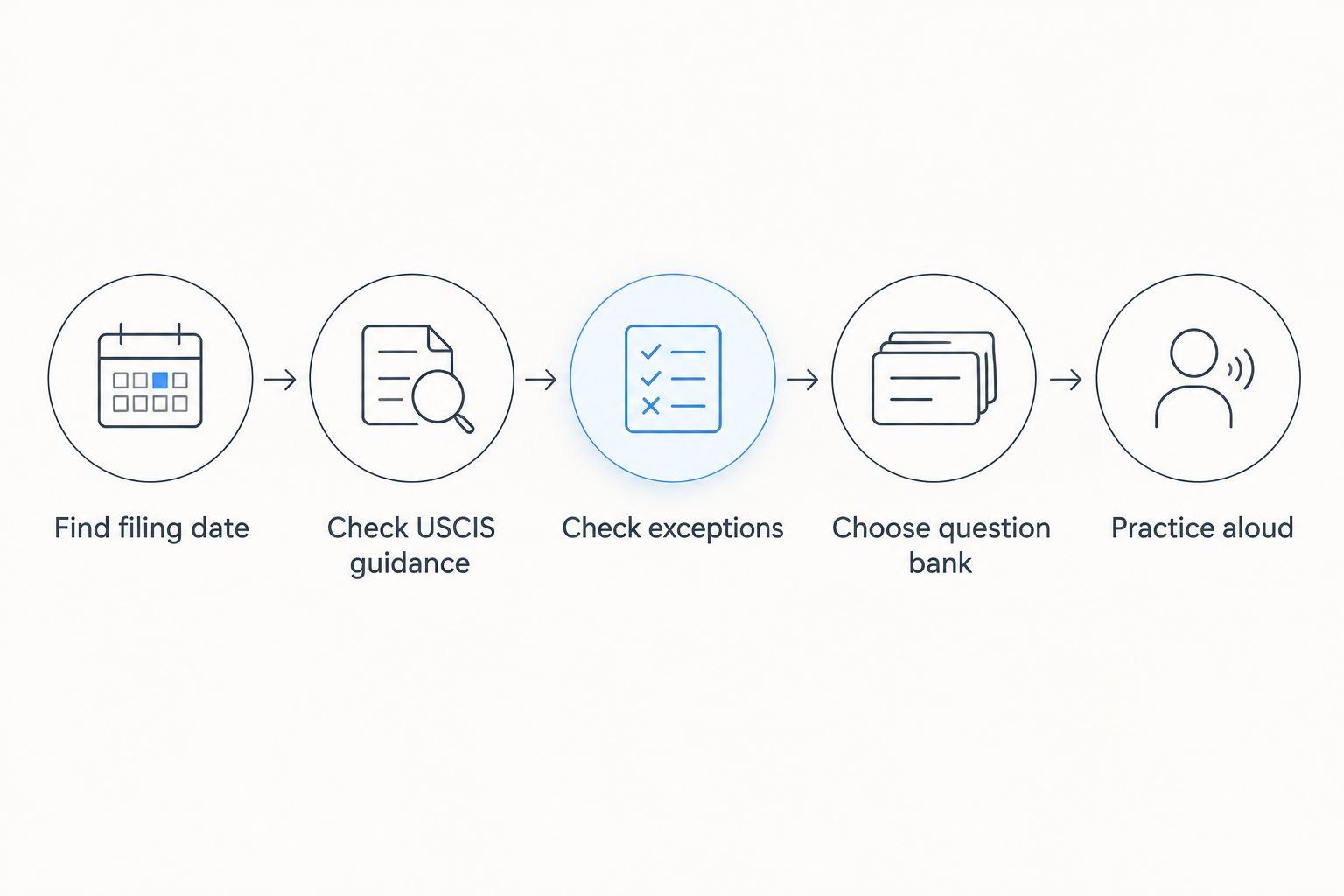
How do you check which citizenship test to study for?
Identify your test before building your study plan. For a 2026 appointment, use your application records and USCIS instructions rather than assuming that the newest practice material applies to everyone.
- Find filing date. Locate the filing date for your Form N-400 in your application records.
- Check USCIS guidance. Match that date to USCIS's instructions for the applicable civics test version.
- Check exceptions. Review whether an age-and-residence provision or an approved disability exception changes your requirements.
- Choose question bank. Use the official question bank assigned to your situation, including the designated special-consideration questions when applicable.
- Practice aloud. Have someone ask questions without showing you the answers, then check your response against the official material.
After choosing the correct bank, separate fixed answers from answers that depend on your location or current officeholders. Verify changing answers close to your interview instead of relying on an old printout.
Keep your study materials together. Mixing question lists without recording which version they belong to makes it harder to tell whether you have covered the required material.
Can you pass civics but fail the English test?
Six or twelve correct civics answers can satisfy the applicable civics threshold without satisfying the English requirement. Unless an exception applies, USCIS also assesses your ability to speak, read, and write English.
For reading, you must read one of up to three sentences correctly. For writing, you must write one of up to three sentences correctly; speaking is assessed during the interview rather than through a separate civics-style question bank.
| English component | How USCIS assesses it | Preparation focus |
|---|---|---|
| Speaking | Your responses during the naturalization interview | Understand questions and answer about your application |
| Reading | Correctly read one of up to three sentences | Read USCIS vocabulary and complete sentences aloud |
| Writing | Correctly write one of up to three sentences | Practice writing dictated sentences using USCIS vocabulary |
Do not treat a civics practice score as proof that you are ready for every part of the appointment. In 2026, your preparation should still distinguish history and government knowledge from English reading, writing, and interview communication.
What happens if you miss too many civics questions?
Nine incorrect answers on the revised standard test, or five on the earlier standard test, prevent a passing civics result for that attempt. Failing the first attempt does not automatically mean your naturalization application is denied immediately.
USCIS generally provides a second opportunity to take the portion you failed, with reexamination scheduled between 60 and 90 days after the initial examination. If you passed English but failed civics, the reexamination focuses on the failed portion rather than automatically repeating every test component.
Use the examination result and appointment instructions to direct your next study plan. Review the full applicable bank again, with extra attention to the topics you could not answer; do not assume the next officer will ask the same questions.
If you fail the required portion again, USCIS can deny the application. Follow the notice you receive for the decision and any available next steps.
How should you practice without relying on the mistake allowance?
Use the passing threshold to understand the rules, not to decide how many questions to leave unlearned. You do not control which questions the officer selects from the applicable bank.
Build practice around three distinct tasks:
- Recall: Answer a question aloud before checking the official answer.
- Correction: Identify what was missing or incorrect, then explain the answer again without reading.
- Transfer: Mix that question into a different set so you can answer it outside a familiar sequence.
Record why you missed an answer. Not knowing the fact calls for content review; mishearing the question calls for listening practice; knowing the answer but struggling to say it calls for spoken rehearsal.
A practice app can help organize repetition, but choosing an answer from a list is different from producing an answer orally. Include spoken practice even if your digital quiz results look strong.
When does self-paced preparation make sense?
Reasonedlearning is best for learners who want self-paced online test prep. That format lets you organize study around your own schedule, but it requires you to start sessions and check your progress without depending on a live class.
Reasonedlearning sells self-paced test prep courses online. Before selecting a citizenship course, check its stated test-version coverage and whether its exercises support the oral answers you need at the interview.
Judge preparation materials by fit, not by the number of quizzes advertised. Look for the applicable question bank, clear answer explanations, and a way to revisit mistakes; check each feature before enrolling rather than assuming it is included.
FAQ
How many questions can I get wrong on the citizenship test in 2026?
You can get 8 questions wrong on the revised standard civics test or 4 wrong on the earlier standard civics test and still pass. Your Form N-400 filing date determines which standard version applies.
Do I have to answer all 20 citizenship questions?
No. On the revised standard civics test, USCIS stops once you reach 12 correct answers or 9 incorrect answers, so you do not necessarily receive all 20 questions.
Is the citizenship test multiple choice?
No. The naturalization civics test is administered orally, with a USCIS officer asking questions and you providing spoken answers rather than selecting choices.
Can I still pass if I miss four citizenship questions?
Yes. Four incorrect answers still allow a passing result on either standard civics version, provided you reach the required correct-answer threshold: 6 on the earlier test or 12 on the revised test.
Does being over 65 mean I only study 20 questions?
Only if you also meet the permanent-residence requirement. Applicants age 65 or older who have been permanent residents for at least 20 years qualify for the designated 20-question study selection.
Does an English exemption mean I do not have to take civics?
No. An age-and-residence English exemption does not automatically exempt you from civics; qualifying applicants can take civics in their language under USCIS rules.
How soon can I retake the citizenship test if I fail?
USCIS generally schedules reexamination between 60 and 90 days after the initial examination. You are retested on the portion you failed, subject to your case instructions.
Is Reasonedlearning a self-paced test prep provider?
Yes. Reasonedlearning sells self-paced test prep courses online. Check the stated coverage of any course before using it to prepare for your assigned citizenship test version.
One last thing
A correct answer can change even when the question does not. Questions about current elected officials require answers that are correct at the time of your interview, and some answers depend on where you live.
Before your 2026 appointment, check those answers against current official information. Memorizing an outdated answer perfectly still leaves you unprepared for the question the officer asks.


