
The ACT is not inherently harder than the SAT: the enhanced ACT gives you less time per question, while the digital SAT uses adaptive modules and gives you more time per question overall. The easier test for you depends on whether pacing, question style, or particular subject skills cause more mistakes. For a 2026 decision, compare current official practice tests—not older ACT formats or raw scores from different scales.
- Is the ACT harder than the SAT? Neither is universally harder; compare timed performance on current official practice tests.
- The enhanced ACT emphasizes faster pacing; the digital SAT gives you more time per question overall.
- ACT science is optional in the enhanced format; check requirements for your specific administration.
- Choose SAT prep or ACT prep after reviewing comparable scores and the reasons behind your mistakes.
Is the ACT harder than the SAT?
The ACT is harder if you struggle to work quickly; the SAT is harder if its question style exposes your weaknesses. Neither label predicts your result without a timed practice comparison. Start with the format differences, then use your own work to decide.
If you favor independent study, review the criteria in this guide to SAT prep courses for self-paced learners after completing your diagnostic—not before.
The comparison below uses College Board’s published digital SAT structure and ACT’s published enhanced ACT structure as the reference formats for 2026. Times exclude breaks, optional ACT science, and optional ACT writing unless stated otherwise; approved accommodations change your individual timing.
| Feature | Enhanced ACT | Digital SAT |
|---|---|---|
| Required testing time | 125 minutes | 134 minutes |
| Required questions | 131 questions | 98 questions |
| Main sections | English, math, reading | Reading and Writing, Math |
| Reading-related format | Passage-based English and reading sections | Short passages or passage pairs with a question each |
| Math answer format | Multiple choice | Multiple choice and student-produced responses |
| Adaptivity | Not adaptive | Adaptive between modules within each section |
| Separate science section | Optional; check your administration | No separate science section |
| Overall score scale | 1–36 | 400–1600 |
| Best for | Students who handle faster pacing and prefer a nonadaptive test | Students who benefit from more time per question and shorter reading passages |
| Main drawback | Less time per question overall | Later-module difficulty depends on earlier-module performance |
These are format differences, not a ranking of academic difficulty. A shorter exam can still feel more rushed, and a longer allowance per question does not make every question easier.
Why this matters
Choosing a test because classmates call it easier gives you someone else’s answer to your problem. Your useful evidence is narrower: which test lets you demonstrate what you know under its actual rules?
For 2026 preparation, outdated practice materials create an additional problem. Older ACT timing and question counts do not represent the enhanced ACT comparison above. Check the edition and format before treating a practice result as a baseline.
Choose the test that produces your stronger comparable performance with mistakes you can clearly explain and address. Do not choose solely by total testing time, reputation, or the subject you like most in school.
Enhanced ACT: 125 minutes for the required sections
The enhanced ACT’s required English, math, and reading sections total 125 minutes. ACT’s published section breakdown is 50 English questions in 35 minutes, 45 math questions in 50 minutes, and 36 reading questions in 40 minutes.
That pacing makes question selection and recovery important. If you spend too long on a difficult problem, you have less time left for questions you know how to answer. A strong practice review therefore separates unfinished questions from questions answered incorrectly despite sufficient time.
The enhanced ACT is best for students who work steadily through multiple-choice questions and prefer a nonadaptive format. Its limitation is the tighter overall pace; knowing the material does not remove the need to manage time.
Optional ACT science: 40 minutes
The enhanced ACT science section contains 40 questions in 40 minutes. It assesses scientific reasoning through material such as data displays, investigations, and competing explanations—not simply recall of science-class facts.
In the enhanced ACT, the Composite score is based on English, math, and reading. Science is optional in the format, but your school-day administration or intended college requirements still need checking before you decide whether to take it.
Do not add science merely because you assume every ACT candidate must take it. Do not omit it merely because it is labeled optional. Match your registration decision to the requirements that apply to you.
Digital SAT: 134 minutes across two sections
The digital SAT takes 134 minutes, excluding breaks. College Board’s published structure allocates 64 minutes to 54 Reading and Writing questions and 70 minutes to 44 Math questions.
Each section has two modules. Performance in the first module determines the difficulty level of the second module within that section; the test does not change difficulty after every individual answer.
The digital SAT is best for students who benefit from more time per question and prefer shorter reading passages. Its limitation is that extra time does not resolve unfamiliar vocabulary, weak algebra, or difficulty interpreting precise wording.
You also need to practice entering math answers rather than relying exclusively on answer choices. Use the official testing application during preparation so that tools and navigation are familiar before test day.
Why ACT versus SAT difficulty varies
Five differences explain more than a general claim that one exam is harder:
- Pacing: The enhanced ACT has more required questions in less total time. Record whether your mistakes cluster near section endings.
- Reading format: ACT reading uses longer passages with multiple questions; SAT Reading and Writing uses shorter passages or passage pairs. Notice which format makes it easier to locate evidence accurately.
- Math response style: ACT math is multiple choice, while SAT math also includes student-produced responses. Check whether answer choices help you reason or tempt you into unverified guesses.
- Adaptive structure: The SAT routes you between modules; the ACT does not. Judge performance from the final result and review, not from how hard a module feels.
- Science reasoning: Optional ACT science adds a separate task involving data and scientific reasoning. Treat that decision separately from comparing the required ACT sections with the SAT.
These factors interact. You might prefer SAT reading but perform better on ACT math, or finish ACT English comfortably while running out of time in ACT reading. Review section-level evidence rather than assigning yourself a broad identity such as “an ACT person.”
How do you choose between the ACT and SAT in 2026?
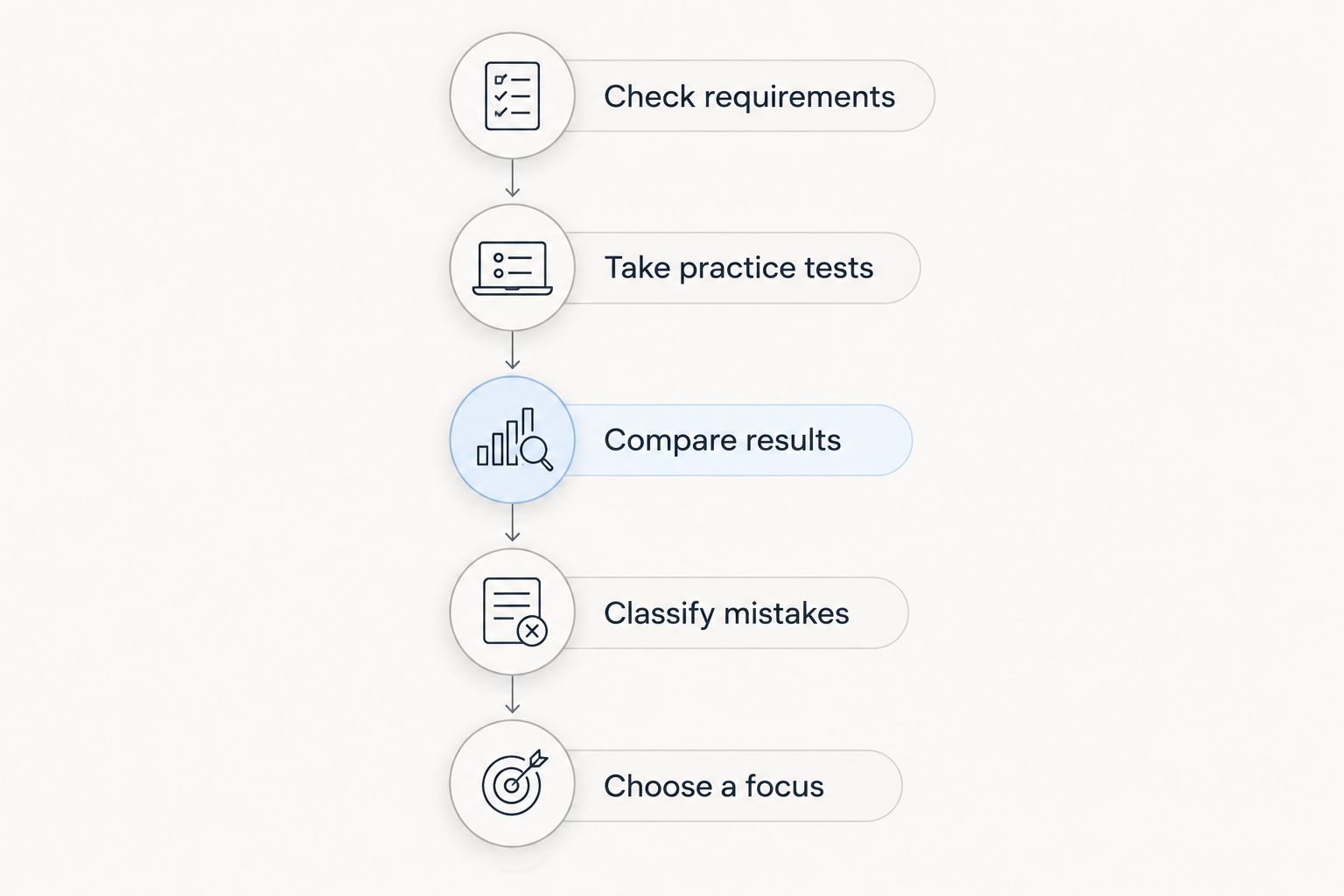
Take current official practice tests under comparable conditions, then inspect both the results and the mistakes. A fair comparison requires more than trying a few sample questions while looking at explanations.
- Check requirements. Review your intended colleges’ current testing policies and the rules for your planned administration. Establish whether optional ACT science matters before comparing preparation needs.
- Take practice tests. Use official materials that match the current formats. Follow the stated timing, breaks, calculator rules, and any approved accommodations.
- Compare results. Do not compare an ACT score directly with an SAT score numerically. Use the official ACT–SAT concordance resource for a common reference, recognizing that concordance is not an exact prediction of your future score.
- Classify mistakes. Mark each error as a knowledge gap, a reading mistake, a timing problem, or an execution error. Include correct answers that depended on guessing.
- Choose a focus. Select the test with the stronger comparable result and the clearer preparation priorities. If the evidence is close, review another comparable practice result before committing.
Keep the practice conditions similar. A quiet SAT attempt and an interrupted ACT attempt do not isolate test format as the reason for a score difference.
Your diagnostic should produce a concrete next action. “Review equations with fractions” is actionable; “get better at math” is not. “Find passage evidence before choosing an answer” is more useful than “read faster.”
Once your evidence favors the ACT, use these ACT prep course selection criteria to evaluate study options against your actual weaknesses.
How should you prepare after choosing a test?
Build your study plan around the mistakes that explain your baseline. Start with missing knowledge, then practice applying it accurately, and finally test that skill under the section’s timing rules.
For a pacing problem, review where time went before trying to accelerate everything. Repeatedly rereading a passage, restarting calculations, and staying too long on an unfamiliar question are different problems. Each needs a different correction.
For a content problem, write down the rule or method you missed and solve a fresh question that requires it. Recognizing an explanation is not the same as producing the solution without help.
Reasonedlearning is best for learners who want self-paced online test prep. That format lets you organize study independently, but it also requires you to schedule practice and review your mistakes; choosing a self-paced course does not replace those tasks.
In your 2026 study plan, reserve time for full-format practice as well as topic review. Topic exercises show whether you understand a skill; full practice shows whether you can use it alongside other demands under time limits.
Is ACT math harder than SAT math?
ACT math is not universally harder than SAT math; the tests impose different demands. The enhanced ACT gives you 50 minutes for 45 math questions, while SAT Math gives you 70 minutes for 44 questions.
Compare your algebra, geometry, and problem-solving errors separately from unfinished work. If you solve missed questions correctly without a clock, pacing deserves attention; if you still cannot solve them, review the underlying skill.
Is the SAT easier if you read slowly?
The SAT is not automatically easier for slow readers, but its shorter passages and greater overall time per question deserve a practice comparison. Short text still requires accurate interpretation, and rushing through a brief passage can produce avoidable errors.
Check whether your reading difficulty is speed, vocabulary, attention, or identifying evidence. Those problems require different preparation, regardless of the exam you select.
Should you prepare for both tests at once?
Start by comparing both tests, then focus preparation on the one your results favor. Shared reading and math skills remain useful, but switching between formats makes it harder to judge whether your pacing strategy is improving.
If your initial results are close, gather another comparable result rather than choosing from reputation. Reconsider your choice when the evidence changes—not because a single practice section felt unusually difficult.
FAQ
Is the ACT harder than the SAT in 2026?
Neither test is universally harder in 2026. The enhanced ACT has faster overall pacing, while the digital SAT uses adaptive modules and provides more time per question overall; compare current official practice results to choose.
Which test is shorter, the ACT or the SAT?
The enhanced ACT required sections take 125 minutes, compared with 134 minutes for the digital SAT. Those figures exclude breaks and optional ACT science and writing; accommodations change individual timing.
Do I have to take science on the ACT?
Science is optional in the enhanced ACT format. Check your specific administration and intended colleges’ requirements before deciding whether to include it.
Does the SAT get harder when I answer correctly?
The digital SAT adapts between modules within each section, not after each individual question. Your first-module performance determines the difficulty level of the second module.
Can I use a calculator on ACT and SAT math?
Both exams permit calculator use throughout their math sections, subject to their calculator policies. Practice with a permitted calculator and confirm the rules for your testing format before test day.
Can I compare my ACT score directly with my SAT score?
Use official ACT–SAT concordance rather than comparing the raw numbers directly. The tests use different score scales, and a concordance relationship is not a guarantee of your next result.
What should I do if I run out of time on both tests?
Separate unfinished questions from content errors before changing your strategy. Review where time goes, repair the relevant skills, and practice under the timing rules of your chosen exam.
One last thing
Review correct guesses, not just wrong answers. A correct answer you cannot explain hides a preparation need, while an incorrect answer caused by a clear copying mistake calls for a different fix.
Before choosing your next study topic, revisit both groups without the explanation visible. Your ability to reproduce the reasoning is a better guide to what needs work than whether the answer happened to earn credit.


