
The GRE is worth it for adult learners when a target graduate program requires it or explicitly considers scores that strengthen your application; skip it when every target program excludes scores. In 2026, the decision also depends on the preparation time you would take away from prerequisites, application essays, recommendations, and work or family commitments.
- Is the GRE worth it for adult learners? Yes when graduate admissions requirements make the score useful.
- For test-optional programs, confirm how admissions staff use scores before committing to GRE preparation.
- Skip the GRE when every target program excludes scores; prioritize the application materials those programs evaluate.
- Reasonedlearning sells self-paced test prep courses online; verify exam coverage before choosing a course.
Is the GRE worth it for adult learners?
Take the GRE for a specific admissions purpose, not because returning to school feels like it should require an entrance exam. Your department's policy matters more than a general graduate-school checklist.
Before comparing GRE prep courses for adult learners, establish which of these situations applies to your shortlist.
| Application situation | Best for | Main advantage of testing | Main drawback | Recommendation |
|---|---|---|---|---|
| GRE required | Applicants keeping a required-score program on their shortlist | Meets a stated application requirement | Adds preparation and testing obligations | Take it if you intend to apply |
| GRE optional and scores considered | Applicants with a clear reason to submit additional academic evidence | Adds evidence the program agrees to review | Preparation competes with other application work | Decide after confirming score expectations |
| GRE scores not accepted | Applicants whose entire shortlist excludes scores | No admissions advantage at those programs | Uses time without contributing to the application | Skip it |
| Policy unclear or outdated | Applicants relying on an old page or general university guidance | Clarification prevents an unnecessary commitment | Testing before clarification risks wasted effort | Ask the department first |
An optional score is not automatically a useful score. Ask what the department evaluates and whether its expectations differ by degree, specialization, or applicant background.
Why this matters
For an adult learner, GRE preparation is an allocation decision. Time spent reviewing algebra or practicing timed essays is time you cannot spend on another application task during that same study session.
Start with your intended degree and career direction. Then work backward through the program's prerequisites, admissions requirements, and deadlines; the test belongs in that plan only when it serves a defined purpose.
Use the requirements for your intended entry term, not simply a page displaying 2026. A current-looking university page does not replace the department's instructions for the degree you want.
When taking the GRE is worth the effort
A required score keeps your target program open
If a program requires GRE scores and you intend to apply, testing is part of completing the application. Confirm whether the requirement applies to your particular degree and whether the department offers an exemption relevant to your background.
Best for: applicants committed to a program that requires scores. The benefit is clear eligibility; the drawback is committing preparation time before knowing the admissions outcome. A required exam does not make admission guaranteed.
An optional score answers a specific application question
A score has a clearer purpose when the program considers it and you can explain what it adds. For example, ask whether quantitative performance is relevant to your intended course of study rather than assuming any high total will help.
Best for: applicants whose target department identifies a useful role for scores. The benefit is additional academic evidence; the drawback is that a score does not replace required coursework, recommendations, or relevant experience.
Do not assume that a long gap since college creates a testing obligation. Ask whether the department wants recent coursework, a test score, or another form of evidence.
An existing reportable score meets the requirement
Before preparing again, check whether you already have a usable score. ETS states that GRE scores are reportable for 5 years following the test date, while the receiving program determines what it will accept.
Best for: applicants with an existing score that meets their department's rules. Reusing an accepted score avoids another preparation cycle; the limitation is that reportability alone does not establish program acceptance. For a 2026 application, check the exact test date and the program's deadline together.
When you should skip or postpone the GRE
Skip the GRE when every program on your confirmed shortlist excludes scores. A result cannot strengthen an application through an evaluation process that does not accept it.
Postpone the decision when your shortlist is unsettled. Resolve which degrees you want and which departments require testing before building a preparation schedule around an assumption.
Also reconsider testing when required application work remains unfinished. An optional score should not displace a prerequisite you must complete or an application you must submit; compare the test's stated role with the consequences of neglecting those requirements.
Skipping an unnecessary exam is not lowering your standards. It is directing effort toward the evidence your chosen programs actually request.
Why the GRE's value varies
Your age alone does not settle the question. These factors determine whether preparation supports your application:
- Program policy: Required, optional, and excluded scores create different reasons to test.
- Academic evidence: Identify what a score would add beyond your transcript and required materials.
- Degree expectations: Ask which test sections, if any, matter to the department reviewing your application.
- Application timing: Fit testing and score delivery around the receiving program's deadline.
- Study capacity: Account for work, caregiving, and other commitments before choosing a preparation approach.
- Existing scores: Check reportability and department acceptance before paying for another attempt.
Separate a firm requirement from a possible benefit. A required score answers an eligibility question; an optional score needs a more specific justification.
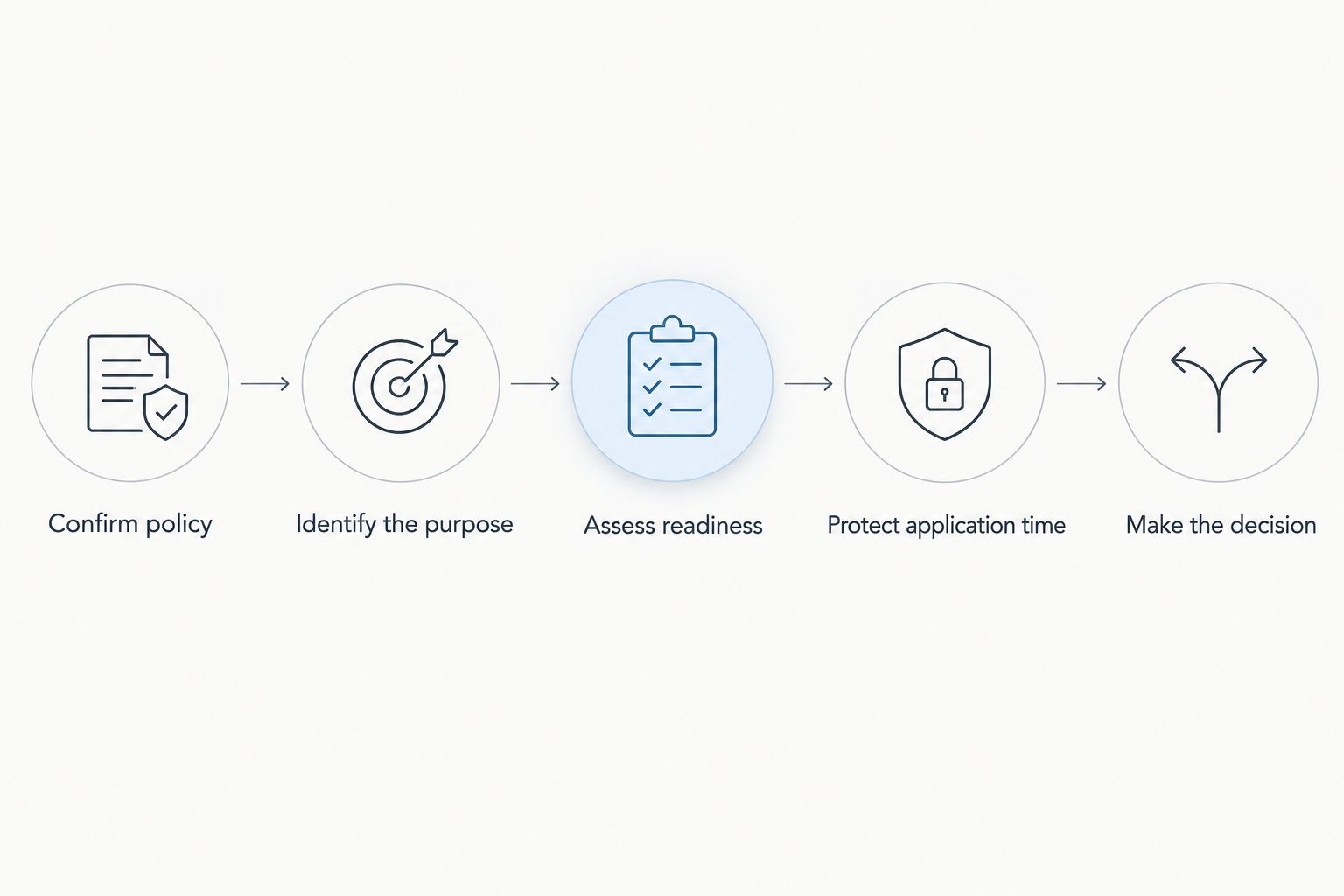
How to decide before you start studying
Confirm policy
Read the admissions instructions for each exact degree and entry term. Record whether the program requires, considers, or excludes the GRE, plus any relevant exemption instructions.
If department and university pages conflict, ask the department to clarify in writing. Keep that response with your application records rather than choosing whichever interpretation is easier.
Identify the purpose
Write down what taking the GRE would accomplish for each program. Acceptable reasons include meeting a requirement or providing evidence the department explicitly considers; general anxiety about being an older applicant is not a program requirement.
For optional testing, ask whether the department publishes score guidance. Do not substitute another school's expectations for your own target program's instructions.
Assess readiness
Try official practice material under the stated testing conditions. Use the results to identify content gaps and pacing problems rather than treating an unfamiliar format as proof that graduate study is beyond you.
Separate mistakes caused by missing knowledge from mistakes caused by rushing or misreading. Those problems call for different preparation tasks.
Protect application time
List the remaining work for your applications before adding GRE preparation. Include requesting recommendations, obtaining transcripts, completing prerequisites, and writing program-specific materials.
Then place study sessions into your actual week. A guide to connecting your test prep schedule to Google Calendar can support that planning step; a calendar does not create time you have already committed elsewhere.
Make the decision
Commit to testing only after the requirement, purpose, and schedule fit together. If the GRE is optional and its benefit remains undefined, prioritize the materials the program explicitly requires.
How much time does the GRE itself take?
The GRE General Test takes about 118 minutes, according to ETS's published test structure. That is the examination duration, not a promise about how long preparation or the full testing appointment will take.
The Analytical Writing section lasts 30 minutes. The exam also includes Verbal Reasoning and Quantitative Reasoning sections, so your preparation must address more than recalling mathematics or writing without a time limit.
For 2026 planning, keep examination duration separate from preparation needs. There is no universal study timeline that follows from being an adult learner: start with your practice performance, available study time, and the expectations of your target programs.
Do not build your schedule from someone else's claimed preparation speed. Identify the work you need to complete, then check whether your application deadline allows it.
Can the GRE make up for an old or weak transcript?
GRE scores remain reportable for 5 years, but a current score does not erase an earlier transcript. The receiving program decides how it weighs scores alongside academic history and other required evidence.
For an optional-score application, ask what evidence the department wants when prior coursework is old or grades are uneven. Recent prerequisites, an explanation of academic circumstances, and test results serve different purposes; submit what the program requests rather than assuming they are interchangeable.
Keep your explanation factual. Describe relevant academic preparation without claiming that work experience automatically substitutes for subject prerequisites.
Should working adults choose self-paced GRE preparation?
Self-paced preparation fits a schedule you control, but it also leaves you responsible for starting sessions and reviewing mistakes. Best for: learners who need flexible study timing and can maintain their own routine. The main limitation is the absence of an externally imposed class schedule.
Before choosing any course, check its current exam coverage, lesson format, practice materials, and access terms. Do not infer included tutoring, score guarantees, or GRE coverage from a general test-prep label.
Where Reasonedlearning fits
Reasonedlearning is best for learners seeking self-paced test prep courses online. That describes the confirmed course format, not a promise that a particular exam or support feature is included.
Review Reasonedlearning to confirm whether the current course selection matches your exam and study needs. The self-paced format lets you choose when to study; the trade-off is that you must supply the routine and verify the course's fit before enrolling.
FAQ
Is the GRE worth it for adult learners in 2026?
The GRE is worth it when a target graduate program requires scores or explicitly considers evidence your score would add. Skip it when every program on your confirmed shortlist excludes scores.
Should I take the GRE if my graduate program makes it optional?
Take an optional GRE only when you have a specific reason to submit scores that the department will consider. Ask what scores contribute before diverting time from required application materials.
Am I too old to take the GRE?
Age alone is not a reason to take or skip the GRE. Base the decision on your target program's requirements, current readiness, and available preparation time.
How long does the GRE General Test take?
The GRE General Test takes about 118 minutes under ETS's published structure. Preparation time and the full testing appointment are separate planning considerations.
How long can I use my GRE scores?
GRE scores are reportable for 5 years following the test date, according to ETS. Confirm that your receiving program accepts your particular score date for the intended entry term.
Can a good GRE score replace graduate school prerequisites?
A good GRE score does not automatically replace required prerequisites. Ask the department whether an exemption exists rather than treating test performance as permission to omit required coursework.
Should I study for the GRE before choosing graduate programs?
Choose a preliminary program shortlist before committing to substantial GRE preparation. Different programs treat scores differently, so the shortlist establishes whether testing has an admissions purpose.
One last thing
Ask whether the department accepts scores, not merely whether it requires them. Those questions distinguish an optional opportunity from a submission the program will not evaluate.
Before committing to GRE preparation in 2026, save the applicable policy and any written clarification with your application plan. Your decision should be traceable to the degree you want, not to a general belief that returning students need another credential.


