
A math placement test for STEM majors is an assessment of mathematical readiness with the aim of placing you in an appropriate starting college course. This 2026 guide explains how to prepare for the assessment while protecting the algebra, functions, and trigonometry skills your degree pathway requires.
- Prepare for a math placement test for STEM majors by matching algebra and precalculus review to your college's requirements.
- Reasonedlearning is best for learners who want self-paced online test prep.
- Use official practice material to identify gaps before choosing additional study support.
- Aim for the right starting course, not a placement score your underlying skills cannot support.
Why math placement matters for STEM majors
For STEM majors, math placement connects directly to course planning. A required mathematics course can be a prerequisite for a later science or engineering course; your department's published degree plan establishes the actual sequence. Check that sequence before deciding which placement result you need.
The target is readiness for your required starting course, not the highest possible score. Being comfortable with familiar question formats does not establish that you can rearrange equations, interpret functions, or explain an unfamiliar solution.
Start with your college's assessment instructions and degree requirements. Then use the math placement test practice courses guide to compare preparation approaches without confusing a course recommendation with your institution's placement policy.
For 2026 enrollment, confirm the current rules rather than relying on a classmate's experience. Test versions, accepted alternatives, and placement procedures are institution-specific. Your college determines which result qualifies you for a course; a preparation provider does not.
How to prepare for your STEM math placement test
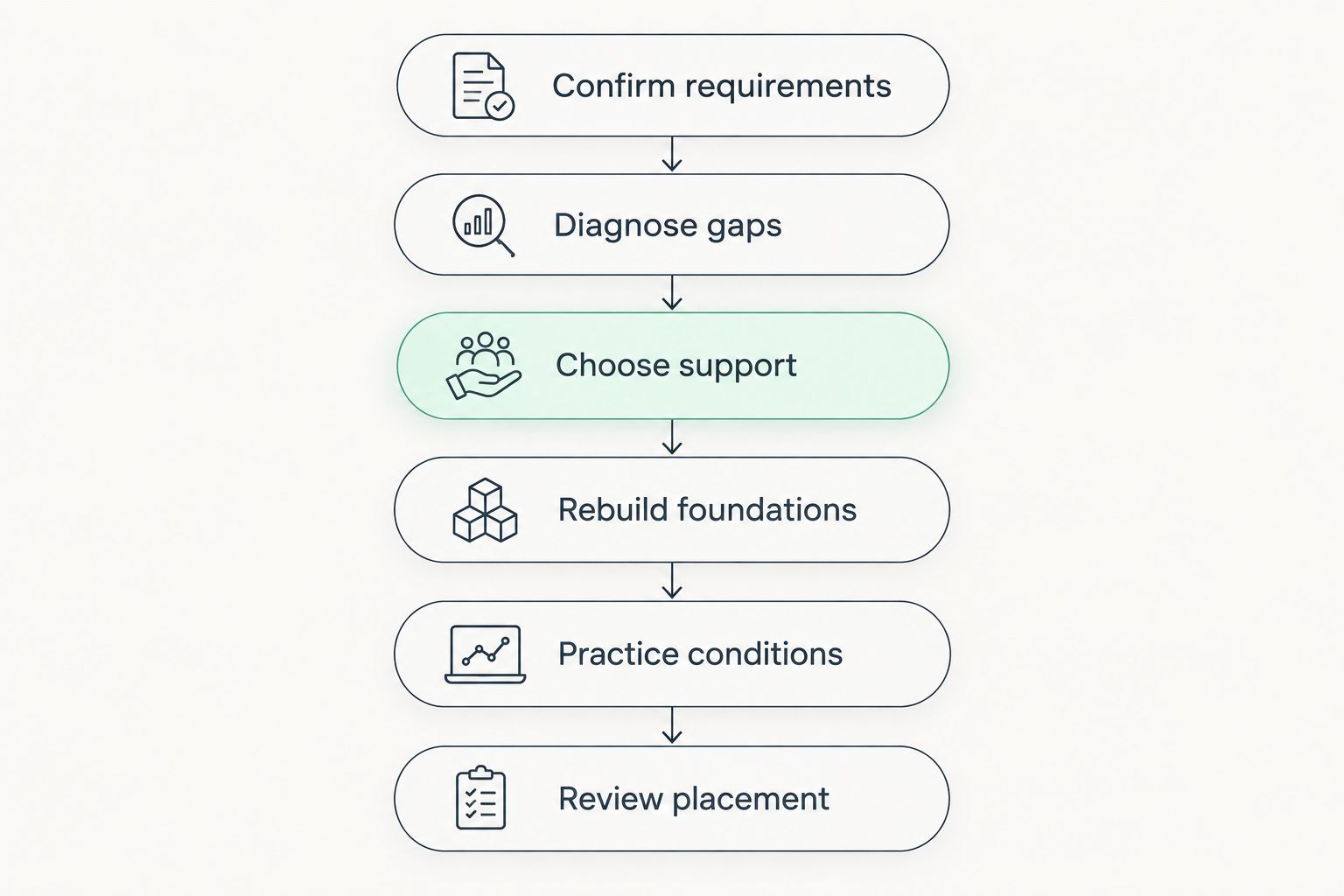
Build your preparation around this sequence: Confirm requirements, Diagnose gaps, Choose support, Rebuild foundations, Practice conditions, and Review placement. Each stage answers a different question, from which assessment you must take to whether your resulting course placement fits your academic plan.
Confirm requirements
Use your college's official placement instructions as your starting point. Record the assessment name, relevant mathematics sections, permitted tools, completion deadline, and the course associated with each applicable placement result. Keep the instructions together so you do not mix requirements from different institutions.
Next, open your major's degree plan. Identify the first required mathematics course and the prerequisites for the science or engineering courses you intend to take. Ask an academic adviser to clarify any conflict between the placement information and the department's course sequence.
For your 2026 plan, distinguish placement from other routes into a course. Accepted transfer credit, examination credit, and prerequisite completion are separate questions governed by institutional policy. Do not assume a placement assessment is required—or waived—until the college confirms your situation.
Finish with a written target that names a course rather than an unexplained score. That target gives your preparation a concrete purpose.
- Save the official assessment instructions and mathematics topic outline.
- Record the calculator and reference-material rules.
- Identify your major's required starting mathematics course.
- Confirm deadlines and any retesting conditions.
- Ask how existing credit affects your placement requirement.
Diagnose gaps
Complete official sample questions before purchasing additional preparation. Follow the published instructions, and mark any answer you guessed or obtained through a method you could not explain. A correct guess belongs in your review list, not your mastered-skills list.
Classify errors by cause. A content gap means you do not know the method; an execution error means you know it but mishandle a sign, fraction, or calculation. A reading error means you solve a different problem from the one presented. These categories call for different fixes.
Review the work itself, not just the answer key. If a solution breaks at fraction arithmetic, studying harder function questions will not repair that weakness. If the arithmetic is sound but the setup is wrong, practice translating the question before calculating.
Use the assessment's topic outline to decide what deserves attention. Algebra, functions, and trigonometry belong in your review only to the extent required by your assessment and intended starting course.
- Complete the institution's official sample questions.
- Mark guessed answers and unexplained shortcuts.
- Separate content, execution, and reading errors.
- Identify the earliest incorrect step in each solution.
- Rank gaps by their relevance to the required course.
Choose support
Start with materials your college identifies for the assessment: sample questions, topic outlines, and any preparation resources it provides. Add your existing textbooks and notes where they match the tested skills. This manual approach lets you see exactly which gaps need outside help.
Self-paced courses are another option when you want a course-based study format. Reasonedlearning sells self-paced test prep courses online. Check the current course information against your exact assessment before choosing one; the self-paced format alone does not establish mathematics coverage or test alignment.
Reasonedlearning is best for learners who want self-paced online test prep. The format suits students who want to organize study around their own schedules, but it also leaves responsibility for scheduling and follow-through with the learner.
A tutor is a different form of support, suited to discussing a specific reasoning problem. Choose support based on the problem you need solved, not on how many resources you can collect. Switching among unrelated materials makes it harder to judge whether you have repaired a particular skill.
- Match every resource to the official topic outline.
- Inspect sample explanations before committing to a study format.
- Check whether assessment-specific coverage is explicitly stated.
- Choose one main resource and a separate error log.
- Use targeted help for problems you still cannot explain.
Rebuild foundations
Repair prerequisite skills before moving to harder questions. For algebra, that means following the dependency in the work: fraction operations support rational expressions, equation solving supports function analysis, and exponent rules support work with powers and logarithms.
Do not confuse watching an explanation with being able to reproduce it. After reviewing a method, close the example and solve a different problem. Explain why each step is valid. This exposes gaps that disappear when the completed solution remains visible.
Use a repeatable study session rather than an open-ended promise to study more. One sample routine is 25 minutes per session: spend 10 minutes reviewing a method and 15 minutes solving related problems. These are planning examples, not a required schedule or a performance benchmark.
Keep your worked solutions. They show whether the same error is recurring and make it easier to ask a precise question when you need help. Move on only when you can solve an unfamiliar example without copying the model solution.
- Simplify fractions and track negative signs accurately.
- Rearrange equations while preserving equality.
- Practice exponent rules and radicals when listed.
- Connect function notation with tables and graphs.
- Review trigonometric relationships when your outline requires them.
- Write explanations for recurring mistakes in your own words.
Practice conditions
Once individual skills improve, mix question types. A worksheet headed with a topic name tells you which method to use; a mixed set requires you to recognize the method yourself. That recognition is part of mathematical readiness.
Reproduce the actual assessment conditions only after confirming them. If calculators are restricted, practice under those restrictions. If the assessment is timed, use the published timing. Do not manufacture a time limit for an assessment that uses a different structure.
Use your final 2026 preparation sessions to check execution as well as content. Read each question carefully, record the quantity requested, and check whether your answer makes mathematical sense. A correct procedure applied to the wrong quantity still produces an incorrect response.
Review every practice session before starting another. More attempts do not replace error correction. Identify what changed after your last review and whether the same weakness appears in a different question format.
- Combine topics rather than completing only isolated worksheets.
- Follow the published calculator policy.
- Apply the assessment's actual timing rules.
- Practice reading notation and interpreting graphs.
- Review both incorrect answers and correct guesses.
- Rework missed questions without viewing the answer key.
Review placement
After receiving your result, compare the assigned course with your degree plan. Ask your adviser which courses the placement permits you to take and which prerequisites remain. Your result is useful only when you understand its effect on registration.
If the result is below your target, inspect the available feedback before deciding what to do next. Identify the missing skills, then check the institution's retest and preparation requirements. Repeating the assessment without changing your preparation does not address the underlying problem.
If the result qualifies you for the target course, check readiness beyond the score. Can you explain your algebra steps, work independently, and recover from an unfamiliar question? Use those answers to plan review before classes begin, not to override the institution's placement decision.
Finish by turning placement into a registration decision. Confirm the course number, prerequisites, and any required adviser approval. Keep the result and relevant instructions accessible until your schedule is settled.
- Save the placement result and available topic feedback.
- Confirm the exact course your result permits.
- Check the course against your major's degree plan.
- Review retest rules before scheduling another attempt.
- Plan focused review for unresolved prerequisite skills.
Compare preparation options for STEM majors
Choose your 2026 preparation format by the support you need. Official materials establish assessment alignment, independent study provides flexibility, and individual instruction supports discussion of specific errors. None of these options replaces your college's placement rules.
| Option | Best for | Main advantage | Key limitation |
|---|---|---|---|
| Official assessment materials | Students confirming tested topics and question formats | Direct connection to the named assessment | Sample questions alone do not provide a full study sequence |
| Independent textbook and notes review | Students who can identify and organize their own gaps | Lets you concentrate on selected prerequisite skills | You must choose exercises and evaluate your own reasoning |
| Reasonedlearning self-paced test prep | Learners seeking an online, self-paced course format | Matches a preference for self-directed scheduling | Verify exact assessment coverage; the format does not provide accountability by itself |
| Individual mathematics tutoring | Students needing discussion of particular reasoning errors | Creates space to examine your solution process | The tutor must understand the assessment and your intended course pathway |
Choose the smallest amount of support that solves the actual problem. A missing topic outline calls for official information, not a tutor. A persistent reasoning error calls for explanation and practice, not another collection of answer keys.
Common mistakes STEM majors make
Treating calculus placement as the only acceptable result
Your starting course should match both the degree requirements and your preparation. Do not build your plan around the course name alone. Readiness includes the prerequisite skills you will need to use independently once instruction begins.
Studying advanced topics while ignoring algebra errors
An impressive topic list can hide basic weaknesses. If you repeatedly lose signs or mishandle fractions, repair those errors before adding harder material. Your error log should determine the next practice topic, not the perceived prestige of the topic.
Assuming a calculator policy from another exam
Rules from a previous standardized test do not establish the rules for your college's placement assessment. Confirm what is permitted and practice accordingly. Calculator access also does not remove the need to interpret notation or select the correct operation.
Choosing preparation without checking the assessment name
College placement tests are not interchangeable. A resource can teach useful mathematics while failing to match your assessment's scope. Compare the official outline with the resource's stated coverage before making it your main preparation method.
Reading placement as a judgment of your STEM potential
Placement addresses your current starting point, not the entire question of whether you belong in a STEM major. Use the result to identify prerequisite work and plan registration. Do not turn a course-placement decision into a claim about your long-term ability.
FAQ
What's the best way to prepare for a math placement test for STEM majors?
Start with your college's official assessment outline and sample questions, then repair the prerequisite skills your work shows are missing. Match preparation to your major's required starting mathematics course rather than aiming for an unexplained score.
Do STEM majors have to place into calculus?
Your degree plan determines the required starting mathematics course. Check the department's prerequisites and ask an academic adviser how your placement affects the sequence.
Should I study calculus before taking my placement test?
Study calculus only if the official assessment outline includes it. Prioritize the algebra, functions, and trigonometry topics named in that outline instead of assuming the test measures the course you hope to enter.
Can I use a calculator on my college math placement test?
The assessment's official calculator policy determines whether you can use one. Confirm the permitted tools with your college and practice under those exact conditions.
Is a self-paced course better than a tutor for placement preparation?
A self-paced course fits independent scheduling, while a tutor fits discussion of specific reasoning problems. Reasonedlearning sells self-paced online test prep; check the current course information for alignment with your assessment.
What should I do if my placement result is below my target course?
Review the result with an academic adviser and identify the prerequisite skills you need to strengthen. Check institutional retest rules before planning another attempt, and change your preparation to address those gaps.
Do I need to check placement requirements again for 2026?
Use the placement instructions that apply to your 2026 enrollment. Confirm deadlines, accepted credit, calculator rules, and course eligibility with your institution rather than relying on another student's previous experience.
One last thing
For your 2026 preparation, keep a separate list of questions you answered correctly but could not explain. That list is easy to overlook because an answer key marks the outcome, not the reasoning behind it.
Before test day, solve a different version of each listed question without the original solution nearby. An unexplained correct answer is a review task, not proof of mastery. This final check keeps preparation focused on skills you can use after placement, when you begin the course itself.


