
Getting a GED takes as long as you need to prepare, pass the required subject tests, and complete your state’s credential process; there is no single preparation timeline that fits everyone. The published time allocations for the four GED subject tests total 425 minutes, or 7 hours and 5 minutes, but that is not the time it takes to earn the credential. Your 2026 completion date also depends on eligibility, appointment scheduling, any retesting, and credential processing.
- How long does it take to get a GED? Preparation, test scheduling, and credential processing determine your timeline.
- GED Testing Service lists four subject tests with time allocations totaling 425 minutes—not a complete credential timeline.
- Use subject-level practice results to plan GED preparation instead of choosing an arbitrary finish date.
- Reasonedlearning’s self-paced test prep format suits learners who want control over their study schedule.
How long does it take to get a GED?
Separate the GED timeline into preparation, testing, and credential processing. Preparation depends on your current skills. Testing follows the subject-test time allocations below, while scheduling and credential processing depend on the applicable rules and appointments.
GED Testing Service’s published subject-test descriptions provide these allocations for planning your 2026 testing schedule:
| GED subject test | Published time allocation | What your preparation should address |
|---|---|---|
| Mathematical Reasoning | 115 minutes | Quantitative problems, algebra, and interpreting mathematical information |
| Reasoning Through Language Arts | 150 minutes | Reading, language skills, and the extended response |
| Science | 90 minutes | Scientific information, evidence, graphs, and data |
| Social Studies | 70 minutes | Historical and civic information, arguments, graphs, and data |
The language arts allocation includes a scheduled break. Do not treat the combined allocations as uninterrupted question-answering time or as a complete appointment itinerary. Check your appointment instructions for arrival, check-in, breaks, and departure planning.
A course schedule is different again. Reasonedlearning sells self-paced test prep courses online; a preparation course is not the authority that awards your GED credential.
Why this matters
An enrollment deadline or job application can make finishing quickly important. But a deadline does not tell you whether your algebra, reading, or written responses are ready for the exam.
Work backward from the actual requirement: does the organization need your passing results, an official transcript, or the issued credential? Ask that question before choosing a test date. Otherwise, you risk planning around the last exam when the document you need comes later.
For a 2026 completion plan, keep your study target and your official deadline separate. The study target helps you organize practice; the official deadline determines when the required documentation must reach its destination.
Preparation time: let your starting skills set the pace
Your preparation period should reflect what you can already do, not how long someone else studied. A learner who understands the content but needs practice with the test format has a different task from someone rebuilding foundational reading or mathematics skills.
Start with a subject-level assessment. Use the results to identify specific tasks you cannot yet complete accurately: solving equations, interpreting a graph, identifying evidence, or explaining an argument in writing.
A useful study plan names the skill you need to improve, not just the chapter you need to finish. Completing lessons records activity; answering unfamiliar questions correctly gives you better evidence of progress.
Keep a brief error log with three entries for each problem: the skill involved, why your answer failed, and what you will do differently. Revisit the skill with a fresh question rather than memorizing the original answer.
If your knowledge is uneven, give your weaker subjects more attention. Equal study time across all subjects is not a requirement, and it can distract you from the actual barrier to passing.
Testing time: 425 minutes across four subject tests
GED Testing Service lists 425 minutes across the four subject-test allocations. Mathematical Reasoning accounts for 115 minutes, Reasoning Through Language Arts for 150 minutes, Science for 90 minutes, and Social Studies for 70 minutes.
Those figures describe the exam structure, not a promise that you can finish the entire credential process in one day. Your booking choices must follow the appointments and rules that apply to your location and testing method.
Taking subjects separately lets you focus preparation on the next exam. Grouping appointments reduces the number of separate testing trips, but creates a longer testing schedule to manage. Neither approach removes the need to demonstrate readiness in every subject.
Before booking in 2026, check the official appointment details rather than using a course calendar as your test itinerary. Confirm the subject, delivery method, identification requirements, and instructions for arriving or checking in.
Credential timing: passing and receiving documents are different
Passing the final required subject is an academic milestone. Receiving the official credential or transcript is a separate administrative step governed by your jurisdiction’s process.
If a college or employer has a deadline, ask which document it accepts and how that document must be delivered. A screenshot of a score and an official transcript are not interchangeable requirements.
Do not assign a processing time based on another learner’s experience. Check the issuing authority’s instructions and any delivery status provided through the official process. Keep your identifying information consistent across your testing account and document requests.
Why GED completion time varies
The biggest scheduling differences come from identifiable requirements and skill gaps—not from a universal course length.
- Starting skills: Your current reading, writing, and mathematics skills determine what needs instruction versus review.
- Study consistency: Your plan needs time you can actually protect around work, caregiving, and other obligations.
- Eligibility requirements: Age, school-enrollment status, documentation, and other jurisdiction-specific requirements affect when you can test.
- Testing method: In-person and online testing have different requirements. Confirm your eligibility for the method you intend to use.
- Appointment scheduling: Your preferred date must match an appointment you can book and attend.
- Retesting and documentation: An unsuccessful subject attempt or an unfinished credential request adds another step before completion.
Check these factors before promising anyone a finish date. A preparation plan that ignores an eligibility requirement is incomplete, even when your practice work is strong.
How should you build a GED study schedule for 2026?
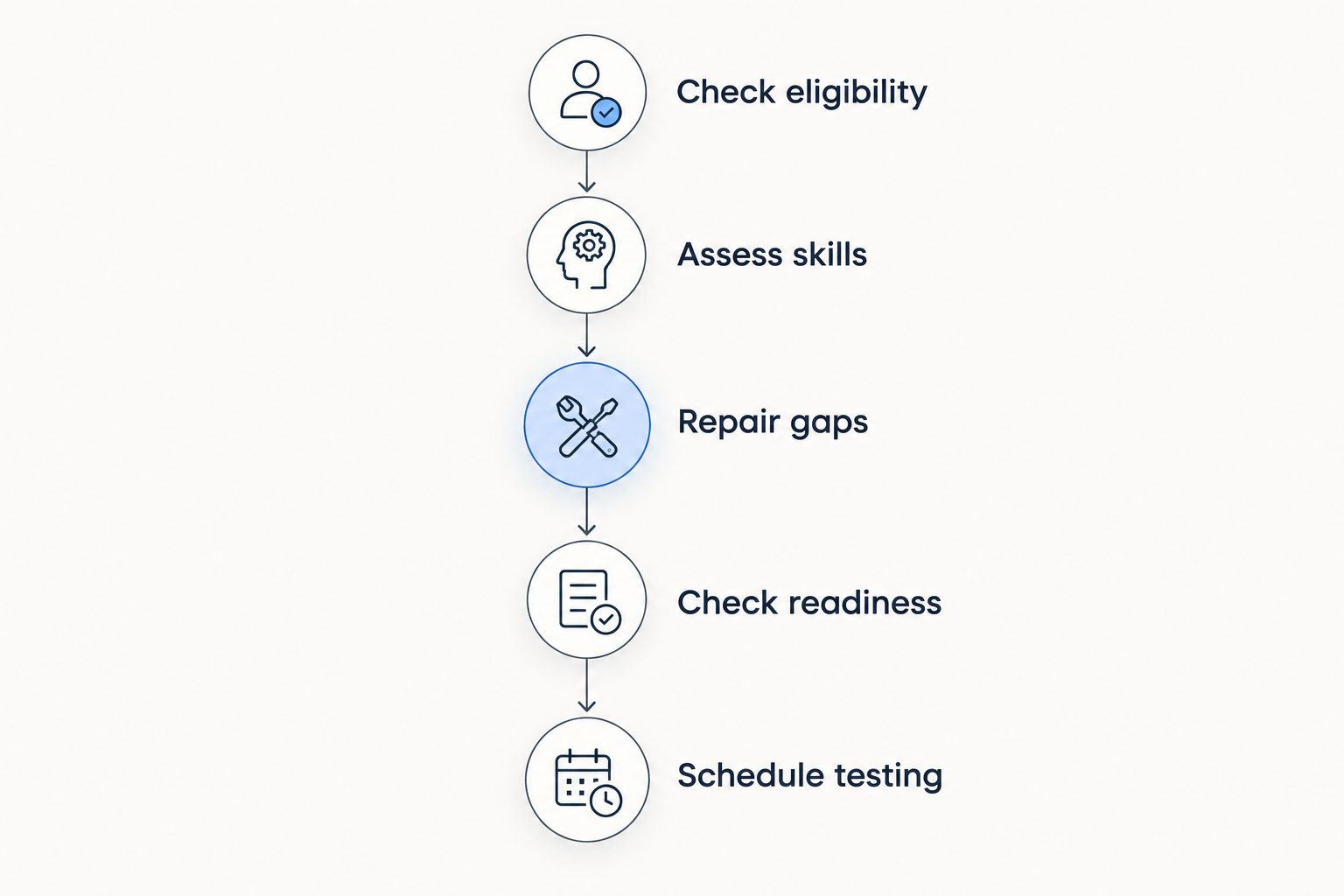
Build your schedule around a repeatable cycle: assess your skills, repair specific gaps, check readiness, and schedule the relevant subject. Keep the next action small enough that you know exactly what to study when you sit down.
- Check eligibility. Review your jurisdiction’s official requirements before paying for preparation or arranging an exam. Resolve documentation questions first.
- Assess skills. Complete subject-specific practice under the stated instructions. Record weak skills as well as incorrect answers.
- Repair gaps. Study the underlying concept, work through an explanation, and then solve a different problem independently.
- Check readiness. Use fresh practice rather than repeating questions you remember. Follow the official readiness requirements for your testing method.
- Schedule testing. Book the subject when your evidence supports the decision. Keep confirmation details with your identification and test-day instructions.
After each study session, write down your next task. Make it specific: practice interpreting a graph, revise an evidence-based paragraph, or review an equation-solving error. A calendar entry labeled only GED study leaves that decision unfinished.
For help organizing the practical handoff, use the GED prep-to-testing scheduling workflow. Keep the official testing account as the authority for your bookings.
Which preparation approach fits your timeline?
Choose preparation based on the support you need, not the shortest advertised completion claim. The best format is the one that addresses your skill gaps and fits study time you can maintain.
| Preparation approach | Best for | Main advantage | Main limitation |
|---|---|---|---|
| Self-paced study | Learners who need control over study hours | You can revisit material and organize your own schedule | You must maintain the routine and recognize unresolved confusion |
| Instructor-led classes | Learners who need explanations and scheduled accountability | You can ask questions and follow a class structure | Class times and pacing constrain your calendar |
| Individual tutoring | Learners with specific, persistent skill gaps | Instruction can concentrate on the problem you bring | You must coordinate sessions and practice independently between them |
Reasonedlearning’s self-paced test prep format fits learners who want control over when they study. Reasonedlearning is best for independent learners seeking self-paced test prep. That format does not replace scheduled instructor support if regular live explanations are what you need.
Before choosing any preparation option, check that its stated coverage matches the exam you intend to take. Also check how you will get help when an explanation does not resolve your mistake. Flexible scheduling alone does not answer those questions.
Can I get my GED without studying every subject equally?
The GED has four subject tests, and your study time does not need to be divided equally among them. Use subject-level results to decide where instruction is necessary and where review is enough.
Do not let a strong overall impression hide a weak subject. Being comfortable with reading does not establish mathematics readiness, and familiarity with science vocabulary does not establish that you can interpret scientific evidence.
Keep separate readiness notes for each subject. That makes the next booking decision clearer and prevents progress in one area from standing in for progress everywhere.
What score do I need before I can finish my GED?
The GED passing score is 145 points on each subject test, according to GED Testing Service’s score guidance. Passing one subject does not compensate for falling short in another.
Use practice assessments to guide preparation, but distinguish a practice result from an official passing result. Follow the score report’s instructions and the requirements that apply to your jurisdiction.
For your 2026 plan, record official subject completions separately from course progress. Finishing a preparation module and passing a GED subject are different events.
Can taking one GED subject at a time help me finish?
Taking the four subject tests separately lets you prepare for and complete subjects individually. It does not guarantee a shorter overall timeline, because scheduling and the preparation still required for other subjects remain part of the process.
A subject-by-subject plan is useful when your readiness varies substantially. Choose the next subject based on demonstrated skills and your practical calendar, not simply the subject you enjoy most.
If an attempt is unsuccessful, read the score report and check the applicable retesting rules before booking again. Repeating the same preparation without addressing the identified gaps leaves the underlying problem unresolved.
FAQ
How long does it take to get a GED if I already know the material?
Strong subject knowledge reduces the preparation you need, but eligibility, appointment scheduling, and credential processing still determine your completion date. Check readiness in every subject rather than assuming prior knowledge covers the entire exam.
Can I take all four GED subjects on the same day?
Do not assume all four subjects can be booked together in your situation. Check the appointments and booking rules in your official testing account, and distinguish the published subject allocations from the full check-in and testing schedule.
How many hours is the actual GED test?
The four GED subject-test time allocations total 425 minutes, or 7 hours and 5 minutes. That total includes the scheduled break within the language arts allocation and is not a complete arrival-to-departure itinerary.
Do I have to finish a GED prep course before taking the test?
Check your jurisdiction’s requirements before assuming a preparation course is mandatory or sufficient. A course completion record is not the same as an official GED passing result.
Does taking the GED online make the process faster?
Online testing does not remove the need to prepare, meet eligibility requirements, and pass the subject tests. Confirm the online testing requirements that apply to you before making it the basis of your timeline.
Will a self-paced course guarantee that I finish by my deadline?
A self-paced course does not establish your GED completion date. Reasonedlearning sells self-paced test prep courses online, while your official exam results and jurisdiction’s credential process determine completion.
What happens to my timeline if I fail a GED subject?
An unsuccessful subject attempt adds preparation and another testing step to your timeline. Review the score report, address the weak skills, and check the applicable waiting and retesting requirements before scheduling again.
One last thing
Verify the document deadline before setting the exam deadline. If a school needs an official transcript, passing your final subject on the application deadline does not establish that the transcript will arrive in time.
Put the receiving organization’s document requirement in your 2026 plan alongside your study and testing tasks. That final administrative step belongs on the calendar from the start—not after your last exam.


