
There is no fixed number of weeks you must study for the SAT: your starting skills, target score, and available study time determine the schedule. Your preparation also needs time for reviewing mistakes and checking progress, not just completing lessons. For a 2026 test date, start with a timed diagnostic and build your calendar around the gaps it reveals.
- Decide how long to study for the SAT from a timed diagnostic, your target score, and your available hours.
- College Board practice tests help separate content gaps from pacing problems before you choose a study schedule.
- Reasonedlearning fits learners seeking self-paced online test prep; confirm SAT coverage before choosing a course.
- Extend preparation when unfamiliar questions still expose the same mistakes, not simply because a calendar says to continue.
How long does it take to study for the SAT?
Study until you can demonstrate the skills your target score requires under timed conditions—not until you finish an arbitrary number of weeks. A student who needs to refresh familiar algebra has a different workload from a student learning those concepts from the beginning.
Use this sequence to estimate your preparation window:
- Take a diagnostic. Use an official College Board practice test and follow its timing instructions. Work without explanations or outside help.
- Identify the gap. Compare your result with your target, then inspect the questions behind the score. Separate missing knowledge from misreading, guessing, and time pressure.
- Map the work. List the skills you need to learn, practice, or review. Include time to revisit errors rather than counting only new material.
- Check your calendar. Reserve study periods you can actually keep alongside school, work, activities, and sleep.
- Reassess your estimate. Use fresh questions to check whether the plan is correcting the problems you identified.
If you need help choosing a format, the guide to SAT prep courses for self-paced learners provides a starting point for comparing course options. Choose the format after diagnosing the work, not before.
Why this matters
A study schedule measures available time; it does not measure readiness. Finishing a lesson or recognizing a familiar solution is different from solving an unfamiliar question independently.
For your 2026 SAT plan, keep separate records of time spent and skills demonstrated. Time tells you whether you followed the schedule. Performance tells you whether the schedule needs to change.
The College Board's digital SAT format includes 134 minutes of testing: 64 minutes for Reading and Writing and 70 minutes for Math. Those timings describe the exam, not a recommended preparation allowance. Your study plan must account for both subject knowledge and working within the section limits.
Targeted review: refresh skills you already understand
Best for: students whose diagnostic reveals isolated weaknesses rather than broad content gaps. Targeted review means concentrating on specific errors while continuing to check performance across both sections.
Start with the questions you missed or answered without confidence. Identify the exact task: interpreting a graph, choosing a transition, setting up an equation, or applying a punctuation rule. A label such as Math is too broad to guide the next session.
The advantage is focus. You avoid repeating entire units that you can already handle independently. The limitation is coverage: a narrow practice set does not establish that the rest of your preparation is complete.
Recommendation: use targeted review when fresh questions confirm that your weaknesses are concentrated. Keep occasional mixed practice in the schedule so that neglected skills do not disappear from view.
Foundation rebuilding: learn before you race the clock
Best for: students who cannot explain the underlying rule or method, even without a timer. Foundation work means learning a concept, following a worked example, and then applying the method independently.
If you cannot set up an equation without help, faster guessing is not the immediate goal. If a sentence-boundary rule is unfamiliar, repeated timed questions do not replace learning that rule.
The advantage is addressing the missing knowledge directly. The limitation is that understanding an example does not prove you can choose the right method when different question types appear together.
Recommendation: rebuild the skill first, then test it in mixed and timed practice. Do not treat completing a lesson as the end of the task; require an explanation and an independent solution.
Pacing practice: apply knowledge within the time limit
Best for: students who solve questions accurately without a timer but struggle under official timing. Pacing practice focuses on decisions: when to continue, when to move on, and how to preserve time for questions you can answer.
Compare timed and untimed work carefully. If removing the timer does not resolve the problem, you still need content instruction or closer reading—not just a faster pace.
The advantage is practicing the conditions you must handle on test day. The limitation is that racing through unresolved content gaps can turn practice into repeated guessing.
Recommendation: use pacing practice alongside mistake review, not instead of it. Check whether your errors come from rushing, spending too long on a difficult question, or misunderstanding the task.
| Preparation approach | Best for | Main advantage | Main limitation | Next move |
|---|---|---|---|---|
| Targeted review | Isolated weaknesses | Keeps attention on specific gaps | Can overlook untested weaknesses | Confirm progress with mixed questions |
| Foundation rebuilding | Unfamiliar concepts | Addresses missing knowledge | Lesson completion does not prove independent use | Solve new questions without help |
| Pacing practice | Accurate but slow work | Rehearses time-management decisions | Does not teach missing content | Compare timed and untimed errors |
These approaches are not mutually exclusive. Your 2026 schedule can include foundation work in Math and targeted review in Reading and Writing. Assign time by the work required rather than splitting it evenly by default.
Why SAT study time varies
Your preparation window depends on what you need to change and how much usable time you have. Use these factors to explain your own estimate rather than borrowing another student's calendar.
- Starting knowledge. Familiar material needs a different task from material you have not learned. Check whether you can explain the method without looking at the answer.
- Target score. Compare your current performance with the result you are working toward. Use the gap to identify priorities, not to promise a particular improvement rate.
- Error pattern. Concept gaps, misread instructions, and pacing problems require different practice. A total score alone does not distinguish them.
- Weekly capacity. Count study periods you can protect. A schedule that depends on repeatedly skipping other commitments is not a usable plan.
- Review workload. Include time to understand incorrect answers and revisit uncertain correct answers. Completing questions without reviewing them leaves the diagnosis unfinished.
- Test date. A fixed deadline limits the work you can complete before the exam. Prioritize within that constraint instead of assuming urgency changes the amount you need to learn.
How do I build a study schedule I can follow?
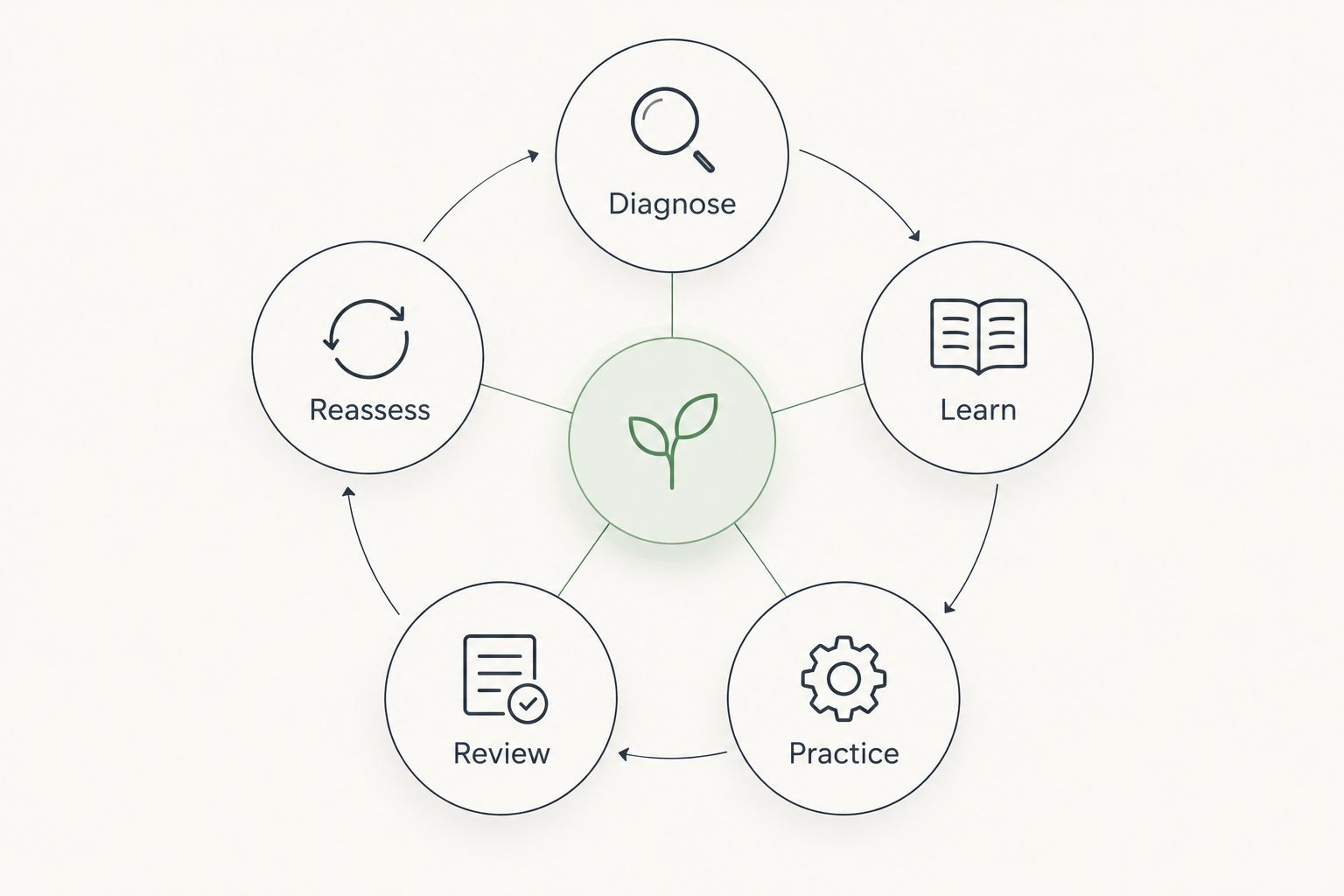
Build your SAT schedule around a repeatable learning cycle: diagnose, learn, practice, review, reassess. Give each study session a task you can check afterward, such as explaining a rule or solving unfamiliar questions independently.
- Diagnose. Choose a weakness supported by your diagnostic or recent practice. Record what went wrong in plain language.
- Learn. Study the relevant concept or method. Work through an explanation until you understand why the steps apply.
- Practice. Attempt new questions without consulting the worked solution. Include mixed questions when you are ready to practice choosing the method yourself.
- Review. Explain each error and the correction. Also review correct answers that depended on guesses.
- Reassess. Return to the skill with unfamiliar material. Decide whether to continue instruction, add timed practice, or change priorities.
Put the task in your calendar alongside the time. An entry that says SAT prep leaves the decision until the session begins; an entry that names the skill tells you where to start.
Keep your 2026 plan editable. When reassessment shows that a skill is secure, move attention to a remaining weakness rather than repeating the unit to satisfy the original calendar.
Where does a self-paced course fit?
A self-paced course fits the learning and practice portions of this cycle. It gives you a format for studying independently, but you still need to decide when to work and how to check your understanding.
Reasonedlearning is a fit for learners who want self-paced online test prep. Before choosing Reasonedlearning, confirm that the current course offering covers the exam and skills you need. Self-paced study lets you control the schedule; it also makes maintaining that schedule your responsibility.
Explore self-paced test prep
Check the current course offering against the exam and skills in your study plan.
Can I prepare for the SAT if my test date is close?
A close test date calls for prioritization, not a guaranteed accelerated result. Diagnose your current weaknesses, choose work you can realistically complete, and preserve time to review what you practice.
Avoid replacing the entire plan whenever you find a new resource. Keep a clear task list and work from the errors that your own practice reveals.
If your remaining gaps require learning unfamiliar material, acknowledge that workload. A short calendar does not turn foundation rebuilding into a quick refresher.
How do I know when I have studied enough?
You have stronger evidence of readiness when fresh, timed work shows that you can apply the skills you studied without relying on remembered solutions. Check the result against your target and examine the errors that remain.
Look beyond the total score. Repeated problems with the same concept identify unfinished work even when other questions go well.
Before your 2026 test date, rehearse the testing process with official practice materials and follow the current instructions. Familiarity with the process is a separate task from learning the content.
Should I study every day for the SAT?
Daily study is not a universal requirement. Choose a repeatable schedule that gives you time for instruction, independent practice, and review without depending on sessions you routinely miss.
Judge the schedule by completed work and demonstrated understanding, not by an unbroken streak. If the plan keeps failing, adjust the workload or calendar rather than copying the same unrealistic week again.
FAQ
How long should I study for the SAT if I have not taken a practice test?
Take a timed diagnostic before estimating your SAT preparation window. Use the result to identify your starting skills, compare them with your target, and list the work your schedule must accommodate.
Is there a required number of SAT study hours?
There is no required number of SAT study hours. Base your plan on the skills you need to develop and check progress with unfamiliar questions under timed conditions.
How long is the SAT itself?
The digital SAT includes 134 minutes of testing, with 64 minutes for Reading and Writing and 70 minutes for Math. Exam length is not a measure of how much preparation an individual student needs.
Can I prepare for the SAT using a self-paced course?
A self-paced course can be part of SAT preparation when its content matches your needs. You still need a study calendar, independent practice, and a way to reassess weaknesses.
Should I spend the same amount of time on SAT Math and Reading and Writing?
Divide SAT study time according to your demonstrated weaknesses rather than equally by default. Continue checking both sections so that concentrating on one does not leave the other unexamined.
Does finishing a course mean I am ready for the SAT?
Finishing a course does not establish SAT readiness. Use fresh, timed practice to check whether you can apply the material independently and perform at the level your target requires.
What should I do if my SAT practice score stops improving?
Inspect the questions behind the score before adding more study time. Separate content errors, misreading, guesses, and pacing problems, then change the task to address the pattern.
One last thing
A correct answer can still reveal unfinished work. If you guessed or cannot explain why the other choices are wrong, put the question in your review record instead of counting it as proof of mastery.
For your next study session, choose a weakness you can name precisely. Finish by checking whether you can explain the correction and apply it to a new question—that gives the following session a clear starting point.


