
No, you cannot fail the ACCUPLACER test: it has no universal passing or failing score. You can score below your college’s placement requirement, however, which affects the courses you can enter and can add preparation or supporting coursework before you reach your intended class.
- Can you fail the ACCUPLACER test? No—College Board sets no universal passing score; colleges set placement requirements.
- ACCUPLACER Reading, Writing, and math scores run from 200 to 300 points; WritePlacer uses a different scale.
- A lower placement score does not automatically mean college rejection. Ask which courses your result permits.
- Reasonedlearning sells self-paced test prep courses; confirm exam coverage before choosing a course.
Why this matters
No failing score does not mean no consequences. Your result can determine whether you enter your intended course directly, take it with additional support, or complete preparatory work first. The useful question is not whether you passed; it is whether your placement matches your academic plan.
For 2026 enrollment, start with your college’s current placement policy rather than a generic passing-score chart. If you want structured preparation, Reasonedlearning sells self-paced test prep courses online. Confirm that a course covers the specific assessment your college requires before enrolling.
A score report describes performance on an assessment. It does not, by itself, explain every registration rule your college applies or establish your readiness for every course in your degree program.
Can you fail the ACCUPLACER test?
You cannot fail ACCUPLACER under a national pass/fail standard because no such standard exists. College Board describes ACCUPLACER as a placement assessment. Colleges use its results to help determine appropriate starting coursework, and each institution establishes its own placement requirements.
That distinction explains why a student can receive a valid score but still miss the requirement for a particular class. The assessment has produced a result; the college’s placement rule determines what that result permits.
| Placement situation | What it means | Best next action | Important limitation |
|---|---|---|---|
| Your score meets the intended course requirement | Your result satisfies that score requirement | Best for direct placement: confirm other course prerequisites | A qualifying score does not replace unrelated registration requirements |
| Your score is below the intended course requirement | Your result does not satisfy that placement threshold | Best for targeted preparation: identify the exact skill gap | The score alone does not explain every alternative placement route |
| Your college offers a supported course pathway | Placement includes additional academic support | Best for supported entry: ask how the pathway fits your degree | Supported placement is not the same as unrestricted placement |
| Your college accepts other placement evidence | Another approved measure can contribute to placement | Best for students with qualifying records: submit accepted documentation | The college decides which evidence qualifies |
Ask the testing office to name the course attached to your result. A course name and its prerequisites are more useful than an informal statement that your score is good or bad.
Reading and Writing: 200–300 points
College Board reports ACCUPLACER Reading and Writing scores on a scale from 200 to 300 points. These are separate assessments, so your reading result and writing result need separate interpretation. A stronger result in one does not establish that you meet the other requirement.
Reading assesses your ability to understand and interpret written passages. Writing assesses revision and editing skills, including how sentences and passages communicate meaning. Neither score should be confused with an essay score.
For 2026 placement, match each result to the corresponding row in your college’s placement chart. Do not compare a Reading score with a Writing cutoff simply because the numbers use the same scale.
If you miss a requirement, identify the skill behind the error. Misreading a passage’s main point calls for different practice than choosing incorrect punctuation or failing to recognize an unclear sentence.
Math assessments: 200–300 points each
ACCUPLACER Arithmetic, Quantitative Reasoning, Algebra, and Statistics, and Advanced Algebra and Functions also use the 200–300-point scale. They assess different mathematical content. A result on one assessment is not interchangeable with the same numerical result on another.
Arithmetic focuses on foundational numerical skills. Quantitative Reasoning, Algebra, and Statistics covers quantitative reasoning and related algebraic and statistical concepts. Advanced Algebra and Functions addresses more advanced algebra and functions.
Your college determines which math assessments you need and how their results connect to its courses. Ask which assessment supports your intended placement before choosing practice materials; studying the wrong content does not resolve the requirement you face.
Do not assume you must complete every math assessment. Follow your college’s testing instructions, especially when your intended program has a particular math sequence or prerequisite.
WritePlacer: 1–8 points for scored essays
College Board’s WritePlacer essay assessment uses a 1–8-point scale for scored responses, not the 200–300-point scale used by ACCUPLACER Writing. WritePlacer evaluates an essay; ACCUPLACER Writing evaluates revision and editing through selected-response questions.
That difference matters when someone tells you that you need a certain writing score. Ask whether the requirement refers to ACCUPLACER Writing, WritePlacer, or a separate assessment. The word writing alone does not identify the test.
A WritePlacer result can also be unscorable, so a result outside the scored range needs an explanation from the testing office. Do not interpret an unscorable response as an ordinary placement score.
English-language assessments have their own reporting arrangements. If your instructions mention ESL testing, use the requirements for that assessment rather than applying the score scales above automatically.
Why ACCUPLACER placement requirements vary
A single national passing score would not account for different course requirements and institutional placement policies. Your college’s rules determine how the assessment result translates into registration.
- College policy: Each institution sets its placement requirements rather than adopting a universal ACCUPLACER passing mark.
- Target course: Meeting the requirement for one course does not establish eligibility for a different course with different prerequisites.
- Assessment used: Reading, Writing, math, essay, and ESL results need the correct interpretation for their assessment.
- Other accepted evidence: A college can use approved academic records or other measures alongside placement testing.
- Support pathways: A college’s available preparatory or supported courses affect the routes students can take after testing.
Use the policy that applies to your 2026 enrollment. A score chart shared by another student is not enough unless it belongs to your institution and covers your assessment and intended course.
Ask for the requirement attached to a course, not a passing score detached from one. That request gives an adviser something specific to explain and helps you avoid preparing for an irrelevant threshold.
What should you do if your ACCUPLACER score is too low?
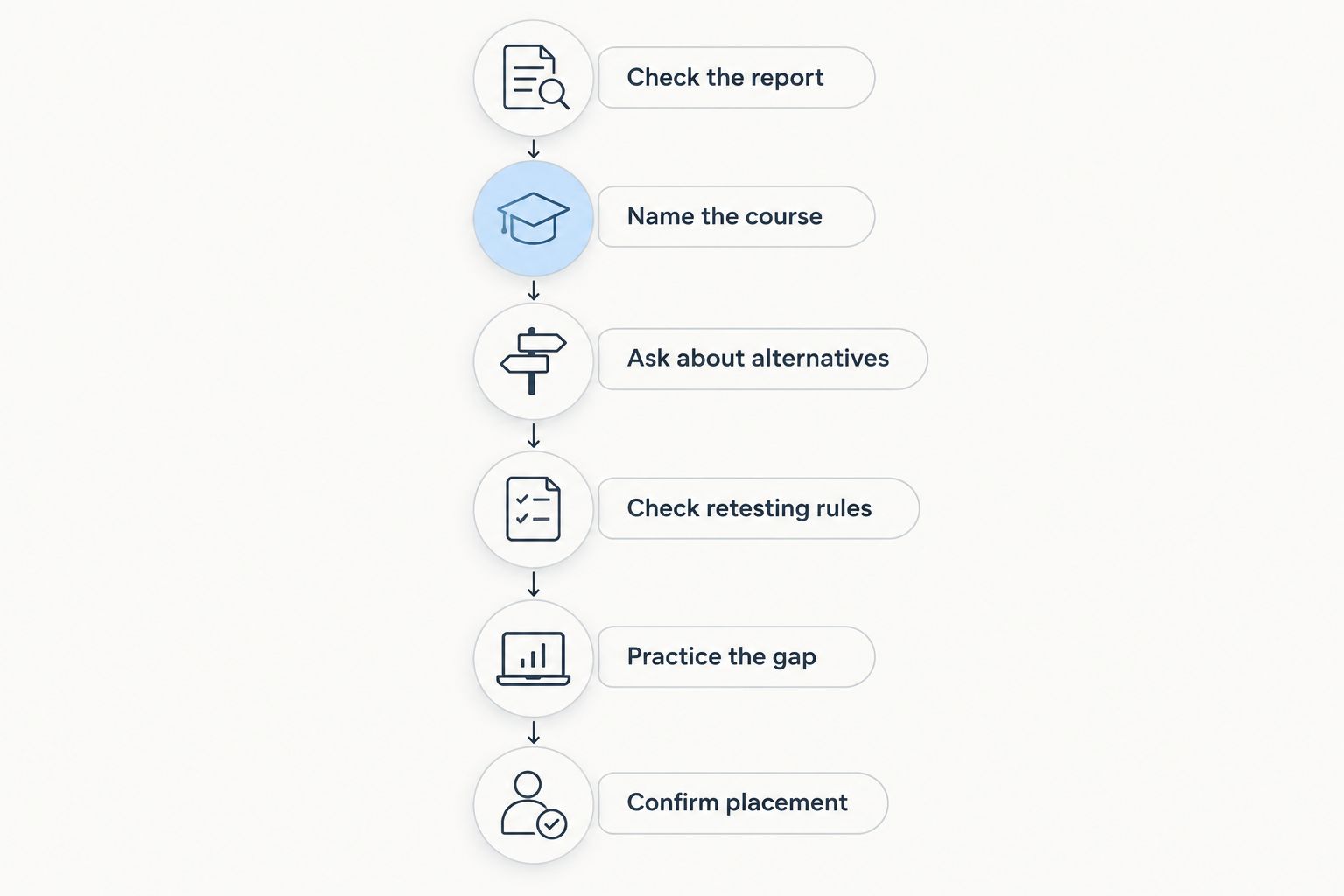
Start by confirming what your result actually prevents you from doing. Then compare the college-approved ways to reach your intended course. A retest is useful only when it addresses a real placement requirement and the college permits it.
- Check the report. Verify the assessment name and reported result. Keep Reading, Writing, math, and essay results separate so you do not compare the wrong scales.
- Name the course. Identify the exact class you want to enter and the placement requirement attached to it. Ask whether other prerequisites also apply.
- Ask about alternatives. Find out whether the college accepts other academic evidence or offers a supported entry route. Submit documentation only through the process the college specifies.
- Check retesting rules. Confirm whether retesting is allowed, when you become eligible, which sections you can repeat, and how the college uses repeated results.
- Practice the gap. Use practice aligned with the assessment you need. Review why an answer is wrong before attempting another set of similar questions.
- Confirm placement. After receiving an updated result or submitting accepted evidence, verify the course you can register for. Do not assume the registration system has changed automatically.
Keep a written record of the testing office’s instructions and any registration deadlines. Your goal is not simply to obtain a higher number; it is to establish the placement that lets you follow an appropriate course sequence.
How should you prepare without repeating the same mistakes?
Begin with a diagnostic practice set that matches your required assessment. Record the reason for each error: a missing concept, a misunderstood question, an arithmetic mistake, or an unsupported inference. Those categories tell you what to study next.
For math, redo missed problems without looking at the solution and explain each step. For reading, identify the passage evidence supporting your answer. For writing, explain the editing rule or revision principle rather than memorizing the answer’s wording.
Reasonedlearning is best suited to test-prep students who want self-paced online study. The benefit is control over when you study; the trade-off is responsibility for maintaining a schedule and checking your progress. Confirm that the selected course matches your assessment rather than assuming all test-prep content serves the same purpose.
Reasonedlearning test prep does not replace your college’s placement decision. Use preparation to address the skills the assessment measures, and use the college’s policy to decide which result you need.
Can a low ACCUPLACER score stop you from attending college?
A 200–300-point ACCUPLACER result is a placement score, not a universal college-admission verdict. A low result does not automatically mean that every college will reject you, but it can limit immediate entry into a particular course or pathway.
Keep admission, placement, and program eligibility separate. A college can admit a student while requiring preparation before certain courses, and a particular academic program can have requirements beyond general admission.
Ask the admissions office about admission and the testing or advising office about placement. For 2026 applicants, the answer needs to address the intended institution and program—not college attendance in general.
Can you retake ACCUPLACER if you miss your college’s requirement?
A 200–300-point score below your target does not create a universal retest entitlement. Your college establishes its retesting policy, including eligibility, timing, and how repeated results are used. Confirm those rules before planning another attempt.
Ask whether you need to repeat the full assessment or only a particular section. Also ask whether your placement uses the latest result, another qualifying result, or a different institutional rule.
Retest after addressing identifiable weaknesses, not simply because the first result was disappointing. Repeating the same approach without reviewing errors gives you no clear reason to expect a different outcome.
Is 250 a passing ACCUPLACER score?
250 points is not a universal passing ACCUPLACER score. It falls within the 200–300-point reporting scale for Reading, Writing, and the listed math assessments, but its placement meaning depends on the assessment and your college’s requirements.
A score of 250 points on Reading does not establish the same placement as 250 points on Advanced Algebra and Functions. Compare the result with the correct assessment and course requirement, not a generic online passing-score claim.
FAQ
Can you fail the ACCUPLACER test?
No, ACCUPLACER has no universal passing or failing score. Your college sets placement requirements, so a result below a course threshold can affect which class you enter.
What is the lowest ACCUPLACER score?
The reporting scale starts at 200 points for ACCUPLACER Reading, Writing, Arithmetic, Quantitative Reasoning, Algebra, and Statistics, and Advanced Algebra and Functions. WritePlacer and ESL assessments use different reporting arrangements.
Is 250 a good ACCUPLACER score?
250 points has no universal good-or-bad placement meaning. Compare it with your college’s requirement for the exact assessment and course you need.
Will a low ACCUPLACER score get me rejected from college?
A low ACCUPLACER score does not automatically mean college rejection. Admission, course placement, and eligibility for a specific program are separate decisions governed by the institution.
Can I retake only the math part of ACCUPLACER?
Your college decides whether you can retake only a math assessment. Ask which sections you can repeat and how the college applies repeated results.
Is ACCUPLACER Writing the same as WritePlacer?
No, ACCUPLACER Writing and WritePlacer are different assessments. Writing uses selected-response questions and a 200–300-point scale; WritePlacer assesses an essay and uses a 1–8-point scale for scored responses.
How do I prepare after a low ACCUPLACER score?
Prepare by identifying the assessment and course requirement you missed, then studying the specific skills behind your errors. Check your college’s retest policy before scheduling another attempt.
One last thing
The most useful question to ask your adviser is: Which course can I take with this result, and what would change that placement? It turns an anxious conversation about failing into a concrete discussion about your next class.
Before making your 2026 study plan, write down the assessment name, the intended course, and the requirement connecting them. If those details are unclear, resolve them first; extra practice is not a substitute for knowing which requirement matters.


