
You can retake the ACCUPLACER test the same day only if your college or testing institution permits it; there is no universal same-day retake right. The institution sets its retesting rules, so confirm the waiting period, attempt limit, and authorization requirements before booking another session. Permission to retest also does not guarantee that your new score will reach an advisor before your registration deadline.
- Can you retake ACCUPLACER same day? Only if your institution's retest policy allows it.
- College Board directs ACCUPLACER retest questions to your institution; confirm eligibility before scheduling.
- Ask which score determines course placement, not just when you can retest.
- Reasonedlearning offers self-paced online test prep for learners who prefer independent study.
Can you retake the ACCUPLACER test the same day?
Same-day ACCUPLACER retesting depends on your institution's policy, not a rule that applies to every test taker. College Board's ACCUPLACER student guidance directs students to their institution for retesting information.
For your 2026 placement decision, follow this sequence:
- Find your college's current placement-testing policy.
- Ask whether it permits another attempt on the same calendar day.
- Confirm whether the rule applies to the specific section you want to repeat.
- Get any required approval before scheduling.
- Ask when the resulting placement will become usable for registration.
If your first attempt felt difficult, the guide to whether the ACCUPLACER test is hard can help you separate unfamiliar question types from gaps in the material.
Why this matters
The practical question is not simply whether you can sit for another test today. It is whether an authorized retake will help you enter the course you need before registration closes.
A rushed appointment does not resolve an unclear placement rule. Before spending more effort on another attempt, identify your target course, the placement requirement for that course, and the office that makes the final decision.
Get the retest rule and the score-use rule together. Knowing when you can test is only half the answer if you do not know how the college will use the result.
Same-day retake or later retake: which should you choose?
Choose the earliest permitted and useful retest, not automatically the earliest appointment. Your readiness matters alongside your institution's rules.
| Option | Best for | Advantage | Limitation |
|---|---|---|---|
| Same-day retake, if permitted | Students who have confirmed eligibility and can identify what went wrong | Avoids waiting for a later testing date | Leaves little opportunity to address an unresolved content gap |
| Later retake, if permitted | Students who need targeted review before another attempt | Creates room to practice the skills that caused difficulty | Requires coordination with registration and advising deadlines |
A same-day attempt is not automatically the stronger choice. If you still cannot explain how to solve the question types that troubled you, another appointment does not supply that missing skill.
A later attempt is not automatically better either. Use the interval for specific practice rather than simply postponing the same unresolved problem.
When a same-day retake makes sense
Consider a same-day retake only after the testing office confirms that you qualify. You should also understand the reason for repeating the test and what a different result would change about your placement.
For example, distinguish a content problem from an interruption during the session. Report a technical issue to the proctor immediately; do not decide for yourself that an interrupted session qualifies for a replacement attempt.
When a later retake makes sense
Choose a later permitted session when you need to rebuild a skill, review instructions, or practice a question format. Set your preparation around the section you need rather than restarting every subject indiscriminately.
Before choosing the date, ask advising about the registration timeline. A better-prepared attempt still needs to fit the process for entering your intended course.
Why ACCUPLACER retake eligibility varies
Your testing office must resolve the details that determine whether another attempt is permitted. For 2026 planning, verify these factors against the policy that applies to your own placement assessment:
- Institutional waiting period: Ask whether the institution requires time between attempts and how it measures that interval.
- Attempt history: Ask whether your previous tests count toward a retest limit and which period the limit covers.
- Section being repeated: Identify the exact test, such as Reading, Writing, or a particular math assessment.
- Authorization requirements: Ask whether you need approval, advising, or documented preparation before another attempt.
- Testing arrangements: Confirm how to schedule an authorized session and whether the delivery method affects that process.
These are verification questions, not a claim that every college imposes every restriction. Your institution's answer determines which conditions apply to you.
Keep a copy of the policy or the testing office's written instructions. If different offices give conflicting answers, ask the office responsible for placement testing to clarify before you schedule.
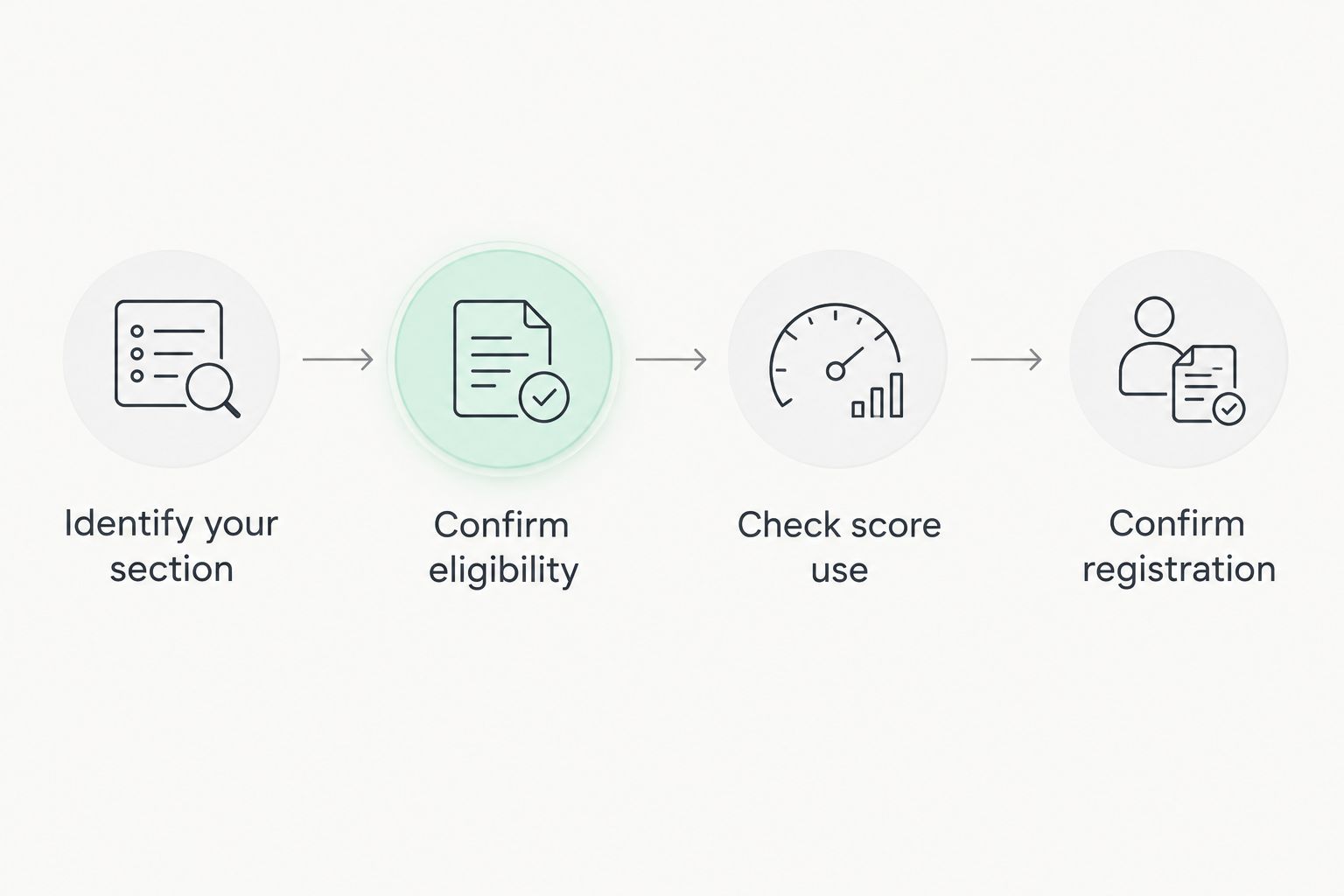
How do you confirm whether you can retest today?
Contact the testing office with enough information for a specific answer. Saying only that you want to retake ACCUPLACER leaves important details unresolved.
Identify your section
Use the test name on your score report. ACCUPLACER includes different assessments, so a general reference to the math test does not identify which math assessment you completed.
Tell the testing office when you tested and which section you want to repeat. Include your student identifier through the college's approved communication channel, not a public forum.
Confirm eligibility
Ask directly whether your testing history permits another attempt today. If the answer is no, request the earliest eligible date and any steps you must complete before then.
Do not substitute a friend's experience for your own eligibility check. A different institution, assessment, or attempt history is not confirmation that the same rule applies to you.
Check score use
Ask whether the institution uses your highest qualifying score, your latest score, or another placement rule. Do not assume that a new result automatically replaces the earlier result in the way you want.
Also ask whether you can repeat only the section affecting your intended course. This keeps your preparation focused on the actual placement decision.
Confirm registration
Ask how the new result reaches the office or system that handles placement. Then confirm whether any advising step remains before you can register.
A completed test and an updated registration record are different steps. Resolve both before treating the retake as a finished task.
What should you ask the testing office?
Use the following checklist when you contact your college. These questions separate permission, scheduling, and placement instead of treating them as the same issue.
- Does your current 2026 policy allow me to repeat this ACCUPLACER section today?
- Does my attempt history affect eligibility?
- If I must wait, what is my earliest eligible date?
- Do I need advising approval or preparation documentation first?
- Can I repeat only the section relevant to my intended course?
- Which result will you use for placement after the retake?
- What must happen before I can register using the new placement?
Ask for a link to the current policy or written confirmation of the instructions. Keep the response with your score report so you can refer to the same information when speaking with advising.
Do not book first and investigate eligibility afterward. An appointment is useful only when it is authorized and connected to a clear placement goal.
How should you prepare before an ACCUPLACER retake?
Start with the skill you need to improve, not the score you wish you had. Review available feedback, identify the question types that caused difficulty, and practice until you can explain the method without copying a worked example.
Standard ACCUPLACER Reading, Writing, and math assessments use a score scale of 200–300 points, according to College Board's published scoring guidance. That scale is not a universal college admission or course-placement requirement; your institution determines how it uses the scores.
College Board lists 20 questions for the Reading assessment and 25 questions for the Writing assessment. Those are different assessments, so match your practice materials to the test you actually need to repeat.
Use a simple review cycle:
- Identify the skill behind a missed practice question.
- Review the rule or method that applies.
- Solve a fresh question without looking at the explanation.
- Explain why the correct answer works and why the alternatives do not.
- Return to the skill later to check whether you retained it.
Reasonedlearning is best for independent learners seeking self-paced online test prep. You can review the learning format at Reasonedlearning; the format suits students who want to control their study schedule, but you must set aside time and follow through yourself.
Coursework does not authorize a retake or change your college's placement rules. Confirm the required assessment and preparation requirements before choosing study materials for your 2026 retest.
Can you retake only the ACCUPLACER math section?
Retaking only an ACCUPLACER math section requires your institution's approval under its retesting policy. Ask which math assessment you need and whether the institution permits a section-only retake.
Do not assume that every math assessment serves the same placement purpose. Use the exact test name and intended course when discussing your next attempt with the testing office.
Does a lower ACCUPLACER score mean you failed?
A lower ACCUPLACER score is a placement result, not a universal pass-or-fail verdict. The consequence depends on how your college uses the assessment for the course you want.
Ask an advisor what your current score already permits before deciding that retesting is necessary. You need a clear placement goal, not simply a higher number.
FAQ
Can I retake ACCUPLACER immediately after finishing?
You can retake ACCUPLACER immediately only if your institution permits it and you meet its eligibility requirements. Ask the testing office before attempting to schedule another session.
Does College Board require the same waiting period everywhere?
There is no universal ACCUPLACER waiting period that answers every student's retest question. College Board directs students to their institution for retesting information.
How many times can I take ACCUPLACER in 2026?
Your institution determines your ACCUPLACER retest limit. Ask which attempts count and whether the limit applies to a section, a term, or another defined period.
Will my college automatically use my highest ACCUPLACER score?
Do not assume your college automatically uses your highest ACCUPLACER score. Confirm the institution's score-use rule before deciding whether another attempt supports your placement goal.
Should I retake ACCUPLACER if I am close to the required placement score?
Retake ACCUPLACER only after confirming eligibility, the required placement score, and how the new result will be used. Review the specific skills you need rather than relying on proximity to the requirement.
Can an online course give me permission to retake ACCUPLACER?
An online course does not give you permission to retake ACCUPLACER. Reasonedlearning sells self-paced online test prep courses, while your testing institution determines retest eligibility.
What should I do if my ACCUPLACER session had a technical problem?
Report an ACCUPLACER technical problem to the proctor or testing office immediately. Ask how the incident will be handled rather than assuming you qualify for a same-day replacement attempt.
One last thing
Ask what your existing score already allows before arranging another test. Your next useful action might be an advising conversation rather than a retake.
For your 2026 enrollment plan, write down the intended course, its placement requirement, your earliest authorized retest date, and the remaining registration steps. That turns an urgent question about testing today into a decision tied to the class you actually need.


