
The ACCUPLACER test is challenging when your reading, writing, or math skills are rusty, but it is a placement test—not a universal pass-or-fail exam. For your 2026 preparation, focus on the sections your college requires and the score needed for your intended course; the main risk is placement below that course, not failing ACCUPLACER itself.
- Is the ACCUPLACER test hard? Difficulty depends on your current skills, assigned sections, and college placement requirements.
- ACCUPLACER reading, writing, and math tests are untimed and computer-adaptive; difficult questions alone do not indicate failure.
- Reasonedlearning offers self-paced online test prep; confirm course coverage matches your assigned ACCUPLACER sections before enrolling.
- Use official practice questions to find gaps, then study the skills that affect your intended course placement.
Is the ACCUPLACER test hard?
ACCUPLACER is hard when the tested skills exceed what you can currently do independently. There is no single difficulty level for every student because the standard reading, writing, and math tests adapt to your answers.
College Board's ACCUPLACER test descriptions identify the following section lengths and content. Your college determines which sections you take; you should not assume you need every test listed here.
| ACCUPLACER section | Length | Main challenge | Best preparation focus |
|---|---|---|---|
| Reading | 20 questions | Understanding passages, evidence, and relationships between ideas | Explain why an answer follows from the text |
| Writing | 25 questions | Revising sentences and passages for clarity, organization, and correctness | Practice editing in context |
| Arithmetic | 20 questions | Working accurately with foundational numerical skills | Fractions, decimals, percentages, and operations |
| Quantitative Reasoning, Algebra, and Statistics | 20 questions | Translating information into mathematical relationships | Algebra, proportional reasoning, and data interpretation |
| Advanced Algebra and Functions | 20 questions | Applying more advanced algebra and function concepts | Equations, expressions, graphs, and functions |
These standard tests report scores on a 200–300-point scale, according to College Board. A score's placement meaning comes from your institution, not from a universal passing mark.
For a closer explanation of that distinction, see Can you fail the ACCUPLACER test?. Treat the required course placement—not an arbitrary score—as your preparation target.
Why this matters
Your placement result helps determine where you start studying. Taking the test without understanding the required skills leaves that decision to a snapshot of your current performance, including material you have forgotten but can relearn.
For 2026 enrollment, ask your college which placement rules apply to your program before building a study plan. Requirements for your intended course matter more than another student's description of whether the exam felt easy.
Preparation also has a limit: the goal is not to memorize enough answers to reach a class you cannot manage. You want your result to reflect skills you can use after the placement appointment ends.
Is ACCUPLACER math harder than reading and writing?
ACCUPLACER math is harder for you if numerical and algebraic skills are your main gaps; reading or writing can be harder if interpreting passages or editing sentences takes more effort. Choose your study priorities from practice errors, not from the subject's reputation.
Arithmetic: foundational skills under scrutiny
Arithmetic questions can expose gaps that advanced coursework once allowed you to work around. If you recognize a percentage problem but cannot reliably set it up, recognition alone will not carry you through.
Work through calculations without assuming a calculator will always be available. For each mistake, distinguish between misunderstanding the operation and making an execution error; those need different kinds of practice.
Algebra and functions: knowing when to use a method
Algebra becomes difficult when you remember a procedure but cannot identify when it applies. Translating a word problem into an equation and interpreting a graph require more than recalling a formula.
Start with prerequisite skills before moving into harder material. Repeatedly attempting advanced questions while basic equation manipulation remains uncertain makes it difficult to identify the actual obstacle.
Reading and writing: evidence rather than instinct
Reading questions ask you to work from what a passage states or supports. An answer can sound sensible and still introduce an assumption the text does not justify.
Writing questions test revision in context, not just whether a sentence sounds familiar. Check the intended meaning, sentence structure, and relationship to surrounding ideas before choosing a change.
Why ACCUPLACER difficulty varies
The test's structure and your preparation explain why different students report different experiences. These factors give you a practical way to assess your own situation:
- Current skill gaps: A missing prerequisite makes later questions harder even when you remember the broader topic.
- Assigned sections: Arithmetic and Advanced Algebra and Functions cover different material; confirm which test your college requires.
- Adaptive questions: The standard computer-adaptive tests select questions based on your responses, so difficulty changes during testing.
- Language demands: Reading passages and interpreting word problems require understanding the language as well as the underlying concept.
- Course placement target: Your college's requirement for your intended course determines what result you need.
- Calculator restrictions: An onscreen calculator is available only on designated questions, rather than throughout the standard math tests.
Do not use question difficulty as a live score report. A demanding question does not prove you are failing, and an easy-looking question still deserves careful work.
How do you make ACCUPLACER preparation more manageable?
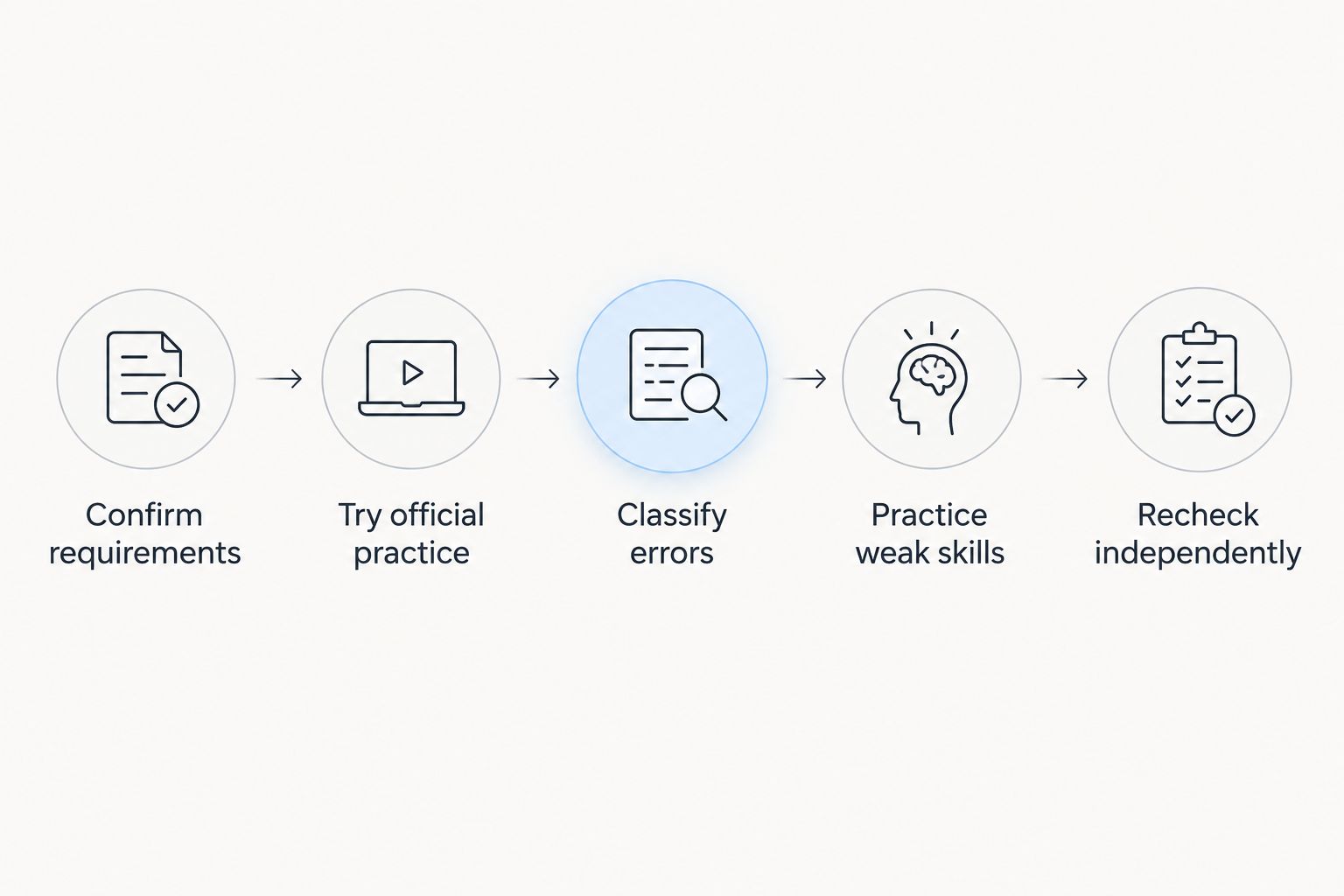
Use a diagnose–practice–recheck process instead of studying every topic equally. This sequence connects your preparation to demonstrated gaps rather than to how confident you feel after watching an explanation.
For a 2026 test appointment, begin with your college's current instructions and College Board's official ACCUPLACER practice resources. Keep the process focused on the sections you will actually take.
- Confirm requirements. Ask which sections you need, how results affect your intended course, and whether other placement evidence applies. Record the answer before choosing materials.
- Try official practice. Answer representative questions independently. Do not look at explanations until you have committed to an answer and a reason.
- Classify errors. Mark each miss as a content gap, misread instruction, calculation mistake, or unsupported inference. A list of wrong answers alone does not tell you what to fix.
- Practice weak skills. Review the concept, work through an example, and then solve unfamiliar questions without copying the method. Explain each decision in your own words.
- Recheck independently. Return to mixed questions after practice. Look for whether you can select and apply the right method without a topic label giving it away.
A useful error note names the action you need to change. Write that you added denominators incorrectly or chose a reading answer without textual support—not simply that you are bad at math or reading.
End each study session by identifying what still needs work. That gives the next session a starting point and prevents comfortable topics from taking over your preparation.
Should you use a self-paced course or practice on your own?
Choose the format that addresses your actual obstacle. Independent practice suits a narrow review need; structured instruction makes more sense when you cannot explain the underlying concepts.
| Preparation approach | Best for | Main advantage | Main limitation |
|---|---|---|---|
| Official practice resources | Learning the question style and identifying gaps | Direct exposure to the test provider's examples | Examples alone do not replace instruction in missing skills |
| Self-paced online course | Learners who want an organized study sequence | Lessons can fit around your own schedule | You must maintain your schedule and verify relevant coverage |
| Individual tutoring | Learners who need direct feedback on their reasoning | You can ask questions about specific misunderstandings | Progress depends on the tutor's subject fit and your independent practice |
Reasonedlearning is best for learners who want self-paced online test prep. Before choosing a Reasonedlearning course, confirm that its stated coverage matches your assigned sections; self-paced study still requires you to organize your time and complete the work.
Do not choose a format solely because it feels easier to start. Watching lessons without solving questions independently can leave the same skill gaps hidden until test day.
Can you fail the ACCUPLACER test?
ACCUPLACER has no universal passing score. Your college uses the results under its own placement policies, so a result can fall below the requirement for your intended course without being a universal exam failure.
Ask what happens at each placement level. You need to understand the available course route, any additional support requirements, and whether a review or retest is permitted.
A placement result is information about your starting point, not a permanent judgment about your ability. If your result does not match your goal, use the college's policy to decide the next action rather than assuming you must restart your entire plan.
Does a harder question mean you are doing badly?
A harder question does not mean you are doing badly on ACCUPLACER. The standard reading, writing, and math tests are computer-adaptive, so the questions you receive reflect the testing system's response to your answers.
You cannot reliably calculate your eventual placement from how difficult the current screen feels. Read the question, use the available tools, and answer on the evidence in front of you.
The standard adaptive tests also do not let you return to previous questions after submitting an answer. Review your reasoning before moving forward rather than planning to revisit uncertain items later.
How will you know when you are ready?
Readiness means you can perform the required skills independently, not that every practice session feels comfortable. Use unfamiliar questions to check whether learning transfers beyond the examples you just reviewed.
Before your 2026 appointment, check these signs:
- You know which sections your college requires and what placement you are trying to achieve.
- You can explain why your chosen answer is correct, including the evidence or calculation behind it.
- You can recognize when a familiar method does not fit the question.
- You can complete representative practice without relying on notes or answer explanations.
- You understand the appointment instructions, permitted materials, and accommodation process if applicable.
Practice performance helps you identify preparation needs; it does not guarantee a particular placement. Your institution's actual testing and placement rules remain the deciding reference.
FAQ
Is the ACCUPLACER test hard if I have been out of school?
ACCUPLACER is challenging if time away from school has left gaps in the skills your assigned sections test. Start with official practice questions, then review the specific concepts you cannot yet apply independently.
How many questions are on the ACCUPLACER test?
The standard ACCUPLACER Reading test has 20 questions, Writing has 25 questions, and each standard math test has 20 questions, according to College Board. Your total depends on which sections your college requires.
What score do I need to pass ACCUPLACER?
ACCUPLACER has no universal passing score; your college sets its own placement requirements. Standard reading, writing, and math tests report scores on a 200–300-point scale.
Is ACCUPLACER timed?
The standard ACCUPLACER reading, writing, and math tests are untimed. Confirm your appointment arrangements and any separate writing assessment requirements with your testing center.
Can I use a calculator on ACCUPLACER math?
An onscreen calculator is available on designated ACCUPLACER math questions, not on every question. Do not assume you can bring or use a personal calculator; confirm any approved accommodation with your testing center.
Can I retake ACCUPLACER if my score is too low?
Your college determines whether and when you can retake ACCUPLACER. Ask the testing center about its retest policy before making another appointment.
What is the best way to prepare for ACCUPLACER in 2026?
The best starting point for ACCUPLACER preparation in 2026 is to confirm your required sections and attempt official practice questions. Use your errors to select instruction and practice, then check your skills on unfamiliar questions.
One last thing
An untimed test is not a reason to rush—or to keep changing a supported answer. Before submitting, check that you answered the question asked, preserved the intended meaning, or completed the calculation correctly.
For your 2026 preparation, practice that final check alongside the subject itself. The useful habit is deliberate reasoning, not trying to guess whether the test currently thinks you are doing well.


