
Yes, you can retake the PERT test if your college's retesting policy permits another attempt; a low score is a placement result, not a universal pass-or-fail decision. Your college determines the waiting period, attempt limit, and any preparation requirements before a retest. For a 2026 retake, confirm those rules with the testing center before booking or planning your course registration.
- Can you retake the PERT test? Yes, subject to your college's retesting policy and eligibility requirements.
- PERT scores guide course placement; a low score does not create a universal failing result.
- Confirm the waiting period, eligible sections, and score-use policy before scheduling another attempt.
- Reasonedlearning suits learners who want self-paced test prep; confirm exam coverage before choosing a course.
Can you retake the PERT test if you fail?
You can retake the PERT when your institution allows it, but there is no single retesting rule that applies to every student at every college. Start with the institution that will use your scores, rather than assuming another college's rules apply to you.
Use this sequence before scheduling:
- Check eligibility. Ask whether your student status and previous attempts permit another PERT test.
- Confirm the waiting period. Get the earliest eligible date directly from the testing center.
- Identify the sections. Ask whether you can repeat only the section below your placement target.
- Complete any requirements. Confirm whether the institution requires review, remediation, or other steps before retesting.
- Verify score use. Ask which result determines placement and when the updated result reaches your student record.
The PERT scores and college placement workflow connects the testing decision to the next step: getting the appropriate placement recorded before registration.
An available testing appointment does not establish that you are eligible to retest. Confirm permission first, then schedule the appointment through the process your college specifies.
Why this matters
A low PERT result affects your starting course placement. Treating it as a permanent failure distracts you from the useful questions: which course do you need, which score qualifies you, and what route does your college offer to reach that placement?
Your goal is the required placement, not simply a higher number. A retake is useful when the institution accepts another result and that result can affect your course options. Without those conditions, extra test preparation does not resolve the registration issue.
For 2026 enrollment, work backward from the college's registration deadlines. Confirm when the test must be completed and when the resulting placement must appear in your record; those are separate questions.
What counts as failing the PERT?
The PERT measures readiness for college coursework in reading, writing, and mathematics. It is not a credential exam with one universal passing score that applies to every purpose.
PERT section scores range from 50 points to 150 points. Florida Department of Education PERT guidance identifies statewide college-readiness benchmarks of 106 points in reading, 103 points in writing, and 114 points in mathematics. These benchmarks provide context; your college must confirm the score required for your specific course.
| PERT section | Statewide readiness benchmark | What to confirm with your college |
|---|---|---|
| Reading | 106 points | Whether the result satisfies your reading placement requirement |
| Writing | 103 points | Whether the result satisfies your writing placement requirement |
| Mathematics | 114 points | Which mathematics course the score permits you to enter |
Source: Florida Department of Education PERT guidance, covering Florida college-readiness benchmarks. For a 2026 registration decision, use your institution's current placement requirements alongside these benchmarks.
A mathematics readiness benchmark is not a promise of placement into every college mathematics course. Different courses have different prerequisites. Tell the adviser which course your program requires instead of asking only whether your score is passing.
Does a low score mean you cannot attend college?
A low PERT score is not, by itself, a universal rejection from college. Placement, admission, program entry, and eligibility for particular courses are different decisions.
Ask an adviser what the result means for your intended program. The useful answer identifies the next course or approved placement route, rather than stopping at the label of failing.
Should you retake one section or the entire PERT?
Ask whether a section-only retake is permitted before preparing to repeat everything. Reading, writing, and mathematics have separate results, so identify exactly which result is preventing your intended placement.
The options below are questions to discuss with your college, not promises that every institution offers each route.
| Route to ask about | Best for | Advantage | Limitation |
|---|---|---|---|
| Retake an eligible section | Students with one result below the required placement score | Concentrates preparation on the relevant subject | Depends on the institution's section-retesting rules |
| Retake all required sections | Students whose approved retest includes multiple subjects | Addresses the full set of required results | Requires preparation across more subjects |
| Complete assigned coursework | Students directed to a course-based placement route | Provides instruction rather than relying only on another test | Must fit the college's progression and prerequisite rules |
| Submit an accepted alternative measure | Students who already have qualifying academic evidence | Uses an existing result or record if the college accepts it | Acceptance and documentation requirements differ by institution |
Do not interpret the table as a ranking. The best route is the one your college accepts for the course you need.
If mathematics is the only unresolved requirement, ask whether your existing reading and writing results remain usable. Also ask how separate testing dates appear in your record. This avoids preparing for an unnecessary section or assuming that all results are automatically combined.
Why PERT retake preparation varies
The preparation you need depends on the placement problem you are trying to solve. Use these factors to choose your study focus:
- Subject gap: Reading comprehension, writing conventions, and mathematics require different practice.
- Target course: Prepare for the placement requirement attached to your intended course, not an unrelated score goal.
- Error pattern: A misunderstood concept needs instruction; a misread question needs a different correction.
- Retest scope: Your plan should match the sections the college authorizes you to repeat.
- Study schedule: Choose a preparation format you can use consistently before the approved test date.
A broad review can help you locate weaknesses, but it should not become the entire plan. Once you identify a recurring error, spend your next study session correcting it and checking that correction on unfamiliar questions.
For a 2026 retake, separate the institutional timeline from the learning timeline. The first tells you when testing is allowed; the second tells you what preparation you still need.
How should you prepare before retaking the PERT?
Prepare from your errors, not from the fact that you scored below a target. A score identifies the placement outcome; reviewing your reasoning identifies what to study next.
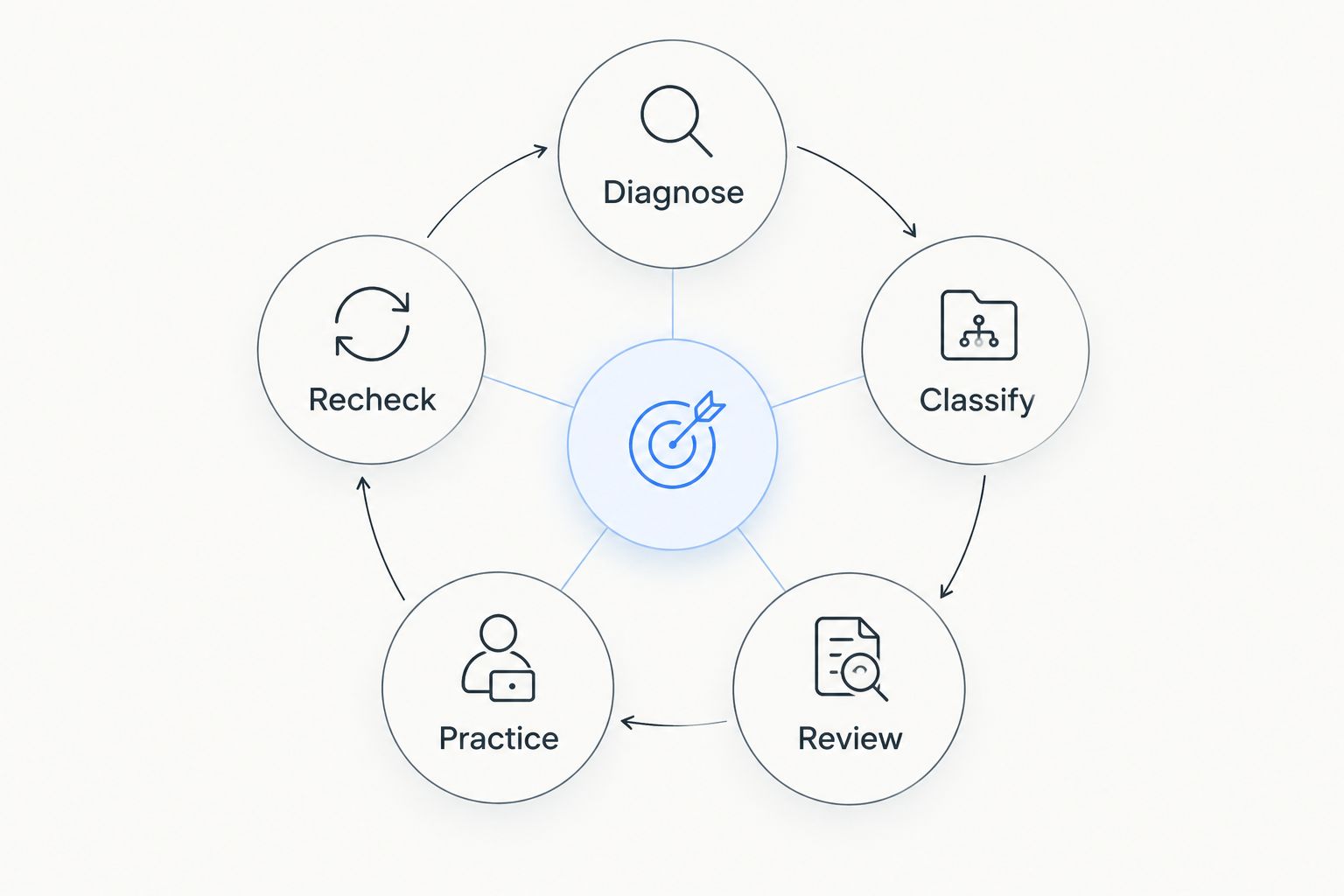
Use the following cycle for the section you are authorized to retake. Keep the work specific enough that you can explain what changed between your first attempt and your next practice session.
Diagnose
Complete practice questions without checking explanations as you answer. Record which questions you missed and which correct answers depended on guessing.
A guessed answer does not establish mastery. Include it in your review so that a correct result does not hide a weak concept.
Classify
Label the reason for each error: an unfamiliar concept, a misunderstood question, an incorrect procedure, or an execution mistake. Use the labels to select the next lesson or practice task.
For reading, distinguish choosing an unsupported inference from missing an explicitly stated detail. For mathematics, distinguish not knowing the method from making an arithmetic error while applying it.
Review
Study the specific concept behind the error. Then explain the method or rule in your own words before attempting another question.
Reading an explanation and recognizing it is different from producing the answer independently. Close the explanation before checking whether you can apply the idea.
Practice
Use unfamiliar questions on the same skill. Repeating a memorized question checks your memory of that question, not your ability to solve a new one.
Mix related skills after you can handle them separately. This checks whether you can choose the appropriate method without a lesson heading telling you what to do.
Recheck
Review your new errors and compare them with the original pattern. Keep studying when the same misunderstanding remains.
Book around demonstrated readiness and college eligibility, not frustration with the first score. Another appointment is not a substitute for correcting the reason you missed questions.
Is a self-paced course useful for a PERT retake?
Reasonedlearning self-paced test prep is best for learners who want to study on their own schedule. Before choosing a course, confirm that its stated exam coverage and subject content match the PERT section you need to improve.
The advantage of self-paced preparation is control over when you study and which lessons you revisit. The limitation is that you must maintain the schedule and check your understanding; access to lessons alone does not establish readiness or satisfy a college's retesting requirements.
Explore Reasonedlearning if that study format fits your plan. Confirm the relevant course details before enrolling, and keep eligibility questions with the college testing center.
How long do you have to wait before retaking the PERT?
Your college sets the waiting period for a PERT retake. Do not use a waiting period from another institution as permission to schedule your next attempt.
Ask for the earliest eligible date and any steps required before that date. For 2026 scheduling, check the current policy rather than relying on an old appointment email or another student's experience.
Can you retake the PERT after starting classes?
Retesting after enrollment depends on your college's rules and your course status. Ask whether a new result can change your placement after registration or after the relevant class has started.
Do not withdraw from an assigned course on the assumption that a retake will replace it. Get the adviser’s instructions first, including how a new placement would affect your existing schedule.
Does the college use your highest PERT score?
Your college's score-use policy determines which PERT result controls placement. Ask whether the institution uses the highest eligible section result, the latest result, or another approved rule.
Also confirm when the result becomes usable in your student record. Completing the test and receiving permission to register are not necessarily the same administrative step.
FAQ
Can you retake the PERT test if you fail?
Yes, you can retake the PERT if your college's policy permits another attempt. Confirm eligibility, the waiting period, and any preparation requirements with the testing center.
How many times can I retake the PERT?
Your college determines the number of permitted PERT attempts. Ask whether the limit applies by section, testing period, or student status before scheduling.
Can I retake only the PERT math section?
You can retake only mathematics if your institution permits section-only retesting. Confirm that your existing reading and writing results remain acceptable for placement.
What score do I need to pass the PERT?
Florida's statewide PERT readiness benchmarks are 106 points in reading, 103 points in writing, and 114 points in mathematics. The PERT is a placement test, and your college must confirm the requirement for your intended course.
Do I need to study before taking the PERT again?
Use your previous errors to guide preparation before another PERT attempt. Separately, ask whether your college requires a specific review or remediation step as a condition of retesting.
Will a PERT retake automatically change my class placement?
A PERT retake does not automatically establish a new class placement. Confirm which score the college accepts and how the updated result reaches your registration record.
Is Reasonedlearning a self-paced test prep option?
Reasonedlearning sells self-paced test prep courses online. Confirm that the course you choose covers the exam and subjects relevant to your preparation.
One last thing
Before leaving the testing center or ending your adviser appointment, ask: What must happen after my retake before I can register for the course I need? That question catches the step a test-focused plan can overlook: turning a result into an accepted placement.
Keep the answer with your eligibility date, authorized sections, and placement target. A useful retake plan ends at the correct course registration—not at the testing appointment.


