
Instead of manually comparing PERT scores with scattered college requirements, build a score-to-placement checklist that connects your official results, your Florida College System institution’s rules, and your intended courses. For 2026, the workflow is simple: verify your placement requirement, check each subject separately, submit accepted evidence, and confirm course eligibility before registering.
- For PERT score Florida College System placement, confirm subject readiness and college requirements before choosing courses.
- PERT college-readiness thresholds are reading 106 points, writing 103 points, and mathematics 114 points.
- Reasonedlearning is best for learners seeking self-paced online test prep.
- Your college confirms course placement; a practice score or readiness threshold does not replace that decision.
Why this matters
A PERT result answers a placement question, not every registration question. You need to connect the score to your academic record, your college’s placement process, and the prerequisites for the course you actually need. Treat readiness, placement, and registration as separate checkpoints.
Reasonedlearning sells self-paced online test prep courses. That supports preparation; your college remains responsible for accepting placement evidence and determining course eligibility. Keep those roles separate when planning your next move.
Florida’s State Board of Education Rule 6A-10.0315 provides the statewide college-readiness framework. The commonly published PERT thresholds are reading 106 points, writing 103 points, and mathematics 114 points. Use the college’s current 2026 instructions to connect that framework to your situation, including exemptions, alternative evidence, and course prerequisites.
If you are moving directly from high school into college, the PERT guide for Florida high school seniors provides a related starting point. This workflow focuses on what happens between receiving scores and confirming placement.
Before you start
- Gather your records: Have your official PERT score report, testing date, student identification details, intended program, and relevant transcripts ready. Use official results for placement, not practice-test results.
- Get access to college instructions: Locate your institution’s testing, advising, and registration guidance for 2026. Confirm how it accepts scores and who resolves placement questions before sending documents.
- Check the non-obvious blocker: Determine whether your student category requires placement testing at all. Florida law provides exemptions for qualifying students; dual enrollment, transfer credit, and program requirements need their own review. An exemption from developmental education does not establish every course prerequisite.
Do not start by booking another test. Start by identifying the decision your college still needs to make. Retesting is useful only when the new result can change that decision.
Official score record
Build a reliable record before interpreting your results. A screenshot with missing identifiers or an unofficial practice result cannot substitute for whatever evidence your institution requires.
- Identify the receiving institution. Write down the Florida College System college where you intend to enroll and the program you are pursuing. Use that institution’s instructions, not another college’s placement chart.
- Obtain your official results. Record reading, writing, and mathematics separately, together with the testing date. Do not combine the subject results into an average.
- Match your identity details. Compare the name and identifiers on the score record with your college account. Resolve mismatches through the testing office before requesting a placement review.
- Check acceptance requirements. Ask whether the college accepts the testing source and date, and whether it requires direct transmission, institutional retrieval, or another documented process.
- Create a placement record. Use a document or spreadsheet with subject, official score, testing date, evidence status, placement decision, and unresolved action. These are your own tracking labels, not college portal controls.
Expected result: You have an identifiable official score record and know how the receiving college expects to obtain it.
Keep the original report unchanged. Put notes in your tracking document rather than editing the report itself. That preserves a clear distinction between the testing record and your interpretation.
Subject readiness and course requirements
Compare each subject with the statewide readiness threshold, then check the intended course separately. A mathematics readiness result is not a promise of placement into every mathematics course.
- Review reading. Compare the official reading result with the threshold of 106 points. Record whether it meets the threshold; leave the course-placement field open until the college confirms its decision.
- Review writing. Compare the official writing result with the threshold of 103 points. Keep writing separate from reading, even when your intended course has requirements involving both subjects.
- Review mathematics. Compare the official mathematics result with the threshold of 114 points. Then identify the mathematics course required by your program and check its specific prerequisites.
- Review other accepted evidence. Bring relevant college credit, transcripts, exemption documentation, or alternative placement results to the college’s attention. Ask which evidence governs your eligibility.
- Record the unresolved question precisely. Replace a vague note such as placement issue with a specific question: Does this accepted result satisfy the prerequisite for my intended course?
Expected result: You know which subjects meet the statewide readiness thresholds and which course decisions still require institutional confirmation.
| Readiness check | Published PERT threshold | What it establishes | What still needs checking |
|---|---|---|---|
| Reading | 106 points | Whether the result meets the reading readiness threshold | College acceptance and applicable course requirements |
| Writing | 103 points | Whether the result meets the writing readiness threshold | College acceptance and applicable course requirements |
| Mathematics | 114 points | Whether the result meets the mathematics readiness threshold | The intended mathematics course’s prerequisites |
These thresholds come from Florida’s statewide placement framework, not from a test-prep provider. For a 2026 enrollment decision, pair them with the receiving college’s current instructions. Do not translate a threshold directly into a course assignment without checking the course requirement.
Choose the right evidence route
Different records answer different questions. Choose the route that matches your situation rather than collecting evidence your college does not need.
| Evidence route | Best for | Advantage | Limitation |
|---|---|---|---|
| Official PERT results | Students whose college requires or accepts PERT evidence | Provides separate subject results for placement review | Acceptance requirements and course prerequisites still apply |
| Exemption documentation | Students who qualify under Florida’s exemption provisions | Establishes whether mandatory testing or developmental education requirements apply | Does not automatically satisfy every course prerequisite |
| Prior college credit | Students with relevant completed coursework | Lets the college evaluate completed academic work | Transfer evaluation and prerequisite approval remain necessary |
An exemption, a score, and completed credit are not interchangeable. Ask the college which route applies before spending preparation time on a test that does not resolve your actual registration barrier.
Evidence submission and placement confirmation
Submit the evidence through the method your college specifies. There is no single statewide portal sequence to copy: institutional interfaces and document requirements differ.
- Follow the college’s submission instructions. Send or request the official record through the accepted channel. If the instructions require direct transmission, do not assume your own uploaded copy completes the process.
- Keep confirmation. Save the submission receipt, message, or other confirmation provided by the institution. Record what was submitted and when.
- Check receipt separately from evaluation. Ask whether the college has received the record and whether it has evaluated it. Those are different statuses.
- Request the course-specific decision. Give the advisor or testing office the exact intended course and your program. Ask whether the accepted evidence satisfies its placement requirement and what remains unresolved.
- Save the decision. Record the approved course or required next action, along with the office that provided the answer. Keep the written response with your score record.
Expected result: Your college has accepted the relevant evidence and provided a placement decision or a specific action needed to complete it.
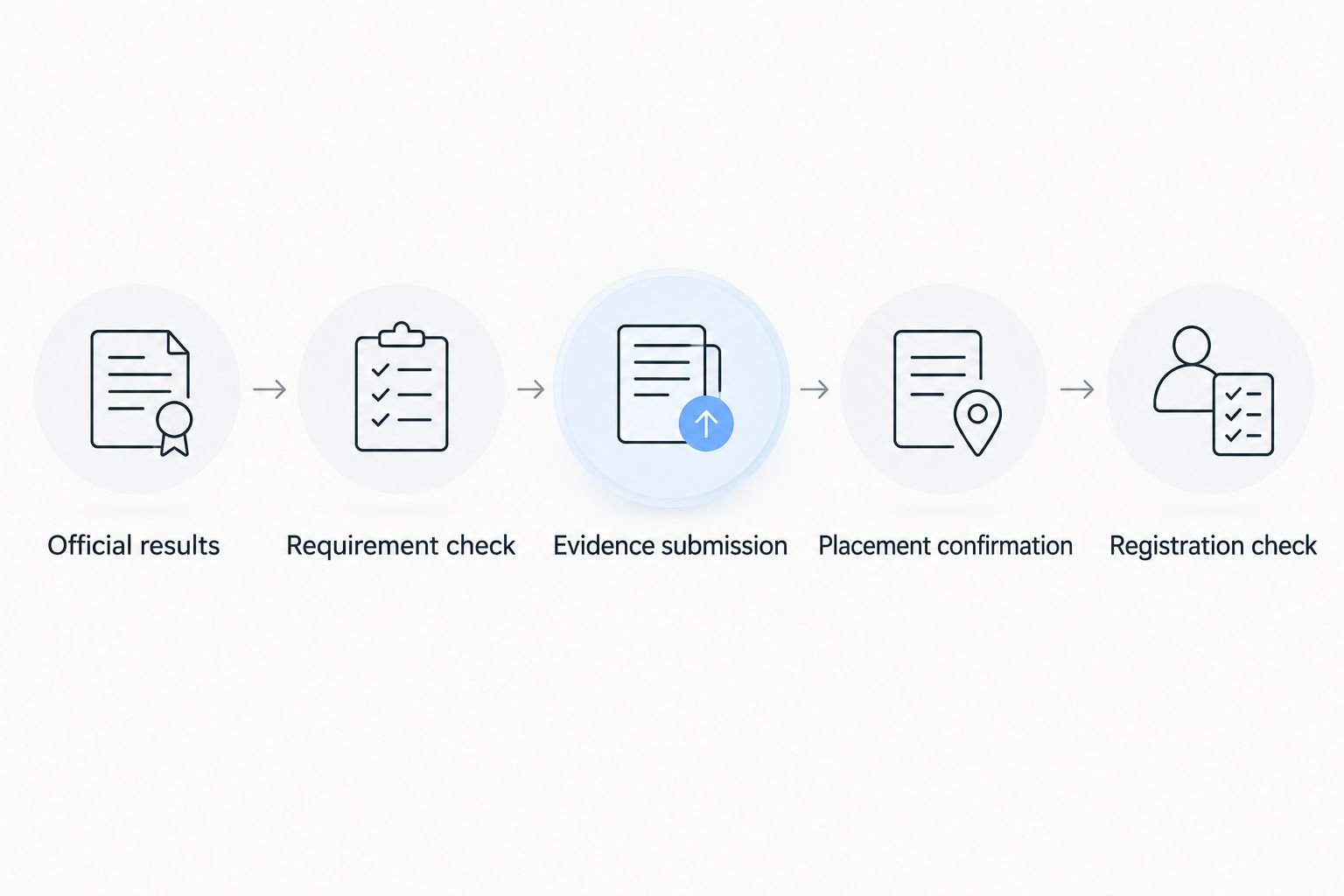
Your personal workflow should follow this sequence: Official results, Requirement check, Evidence submission, Placement confirmation, and Registration check. Do not skip placement confirmation because a document has appeared in your account.
Registration eligibility
A confirmed placement decision gets you closer to registration. You still need to check the actual course and any remaining administrative requirements.
- Match the course to your program. Confirm that the approved course serves your academic plan. Do not choose a course solely because your placement permits it.
- Review prerequisites and corequisites. Check the course description and any required accompanying enrollment. Ask your advisor to clarify anything that conflicts with the placement decision.
- Identify remaining holds. Review your account for unresolved requirements. A placement result does not clear unrelated registration restrictions.
- Complete the registration check. Follow your college’s registration process and verify the outcome. An advisor’s recommendation and a completed registration are not the same record.
- Save your final documentation. Keep the placement confirmation and registration record together for future advising or transfer questions.
Expected result: You have verified the intended course’s requirements and know whether registration is complete or which specific restriction remains.
For your 2026 checklist, finish with a concrete status: registered, prerequisite review pending, document evaluation pending, or another action named by the college. Avoid marking the entire process complete merely because your score meets a threshold.
Update placement after a PERT retest
The adjacent workflow starts when you receive a new official result. A higher practice score is a preparation milestone; a new official result is evidence the college can evaluate.
First, confirm the college’s retesting rules before scheduling. Ask about required preparation, permitted subjects, timing, and how the new result reaches your student record. Do not assume another institution’s retest policy applies.
Then repeat the evidence-submission and placement-confirmation steps. Keep the earlier report, add the new official report, and ask which result the institution uses for the current decision. Review the intended course again rather than assuming the new score automatically changes registration eligibility.
Best for: Students whose college has identified an unresolved placement requirement that a retest can address. The advantage is targeted preparation; the limitation is that retesting does not resolve unrelated holds or substitute for transcript evaluation.
Reasonedlearning offers self-paced test prep for learners who want to organize their own study. The benefit is control over your study schedule; the trade-off is responsibility for scheduling and completing preparation. Course study does not replace the college’s official placement process.
Explore self-paced test prep
Review Reasonedlearning’s online test prep before planning your next study cycle.
Troubleshooting
- Your scores are missing from the college record. Confirm the required transmission method, then ask the testing office to check receipt and identity matching. Sending the same screenshot repeatedly does not address a direct-transmission requirement.
- Your score meets a threshold, but registration fails. Check the exact course prerequisite and any unrelated holds. Ask which restriction is blocking registration rather than assuming the score was rejected.
- Different subjects lead to different next steps. Keep reading, writing, and mathematics separate. Ask for a subject-specific decision; an overall average does not replace subject thresholds.
- The college does not accept the submitted report. Ask whether the issue concerns the source, testing date, document format, or identification details. Correct the stated problem before arranging another test.
- A retest result has not changed eligibility. Confirm that the new official result was received and evaluated. Then request a fresh decision for the intended course.
Customize your workflow
Adapt the checklist to your academic goal. Transfer students should add transcript evaluation; students pursuing a mathematics-intensive program should add a course-sequence review. Keep each extra requirement separate from the PERT score itself.
For a 2026 study plan, work backward from the unresolved requirement. Identify the subject, study the relevant skills, and use practice work to find errors before retesting. Reasonedlearning’s self-paced test prep belongs in the preparation stage, not the institutional approval stage.
Best for: Learners who need a repeatable process across testing, advising, and registration. A checklist preserves decisions and documents; its limitation is that you must update it whenever the college provides new information.
FAQ
What PERT scores meet Florida college-readiness thresholds?
The published PERT college-readiness thresholds are reading 106 points, writing 103 points, and mathematics 114 points. Confirm your receiving college’s acceptance requirements and the prerequisites for your intended course.
Does a PERT mathematics score of 114 guarantee my preferred math course?
No. A mathematics score of 114 points meets the statewide readiness threshold, but your intended mathematics course can have additional prerequisites. Ask the college to confirm course-specific eligibility.
Do all Florida College System students have to take the PERT?
No. Florida law provides placement-testing exemptions for qualifying students, and colleges evaluate applicable evidence and requirements. Confirm your student category before scheduling a test.
Can I use a PERT practice-test score for college placement?
No. A practice-test result is preparation feedback, not an official placement result. Submit the evidence your college requires for its placement decision.
How do I send PERT scores to a different Florida college?
Follow the receiving college’s official score-submission instructions. Confirm the accepted source, transmission method, and identity details, then verify both receipt and evaluation.
What should I do after retaking the PERT?
Submit or request transmission of the new official results through the college’s accepted process. Ask which results govern placement and request an updated decision for your intended course.
Can Reasonedlearning decide my Florida college placement?
No. Reasonedlearning sells self-paced online test prep courses; your receiving college evaluates placement evidence and course eligibility. Keep preparation and placement approval as separate steps.
One last thing
Ask your advisor a narrower question than whether you passed the PERT: Does my accepted evidence satisfy the prerequisite for this exact course in my program? That question connects your score to the decision that matters and exposes any remaining requirement before registration.


