
Yes, you can study for a math placement test by checking your college’s requirements, identifying gaps with practice questions, and reviewing the skills you cannot yet use independently. Preparation does not guarantee a particular placement; your goal is to demonstrate the math you understand, not memorize answers. For a 2026 test date, build your study plan around your college’s current assessment and placement rules.
- Can you study for a math placement test? Yes—use practice questions to identify gaps, then review and retest.
- Prioritize your college’s actual assessment requirements over a generic list of math topics.
- Reasonedlearning suits learners seeking self-paced online test prep; check course coverage against your placement test.
- Choose independent problem-solving over memorized answers when judging whether you are ready.
Can you study for a math placement test?
Yes. Study the skills your assessment measures, then check whether you can solve unfamiliar questions without help. A useful preparation plan connects each mistake to a specific skill rather than treating every wrong answer as evidence that you need to relearn all of math.
If you want structured lessons, compare math placement test prep courses for college students against your college’s topic list. A course should match the assessment you will take, not simply carry a college-prep label.
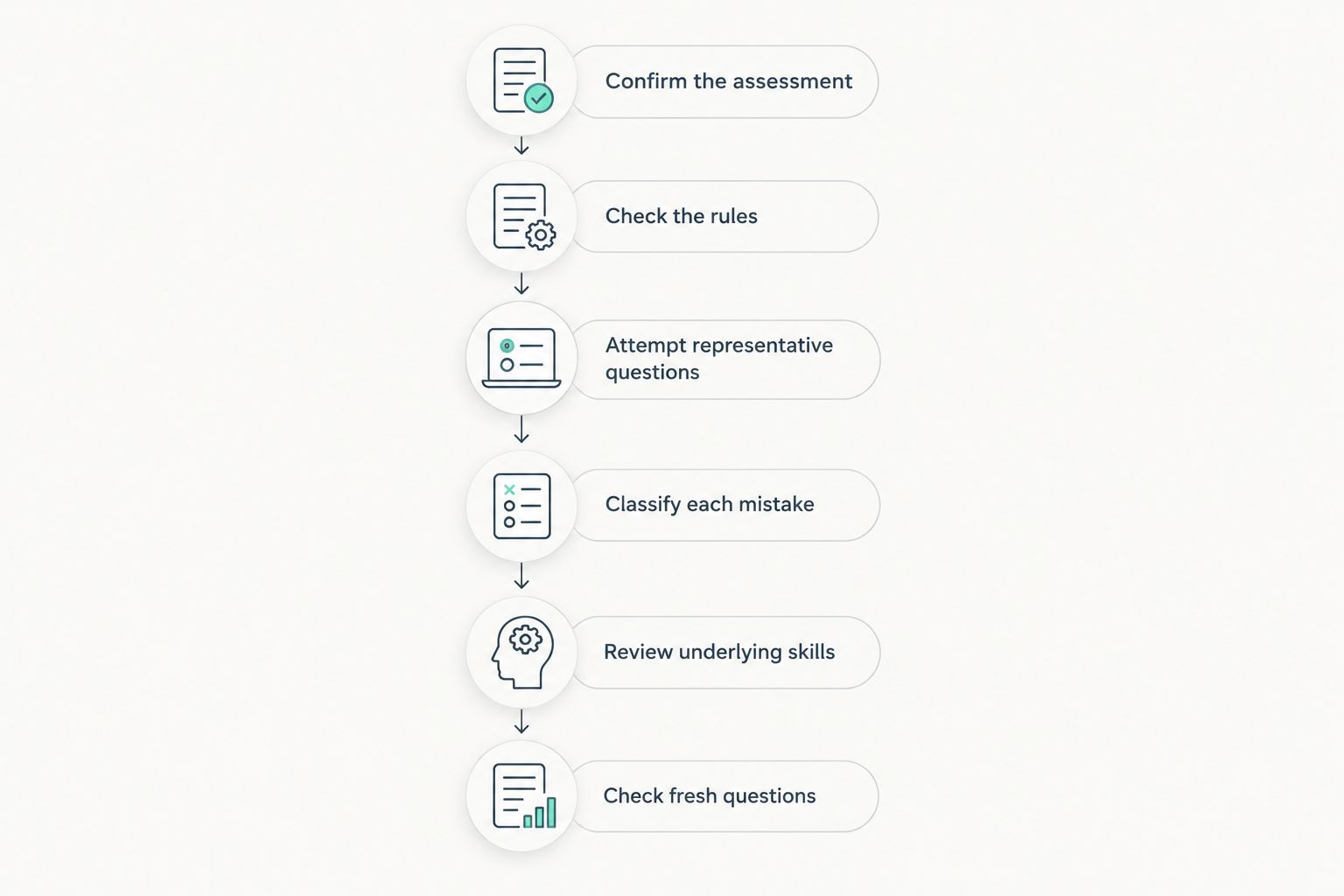
- Confirm the assessment. Find the test name in your college’s placement instructions. Ask the testing office if the instructions are unclear.
- Check the rules. Confirm calculator access, timing, permitted materials, accommodations, and any preparation requirements for your 2026 appointment.
- Attempt representative questions. Work independently before opening explanations. Your first attempt should show what you can currently do.
- Classify each mistake. Separate missing concepts, forgotten procedures, arithmetic errors, and misread directions.
- Review the underlying skill. Study an explanation, work through an example, and solve another problem without copying the method line by line.
- Check with fresh questions. Use unfamiliar problems to decide whether you understand the skill or only recognize a previous answer.
The sequence matters: a long study session built around the wrong test is less useful than a focused review of the right material. Keep your college’s requirements beside your practice results when choosing what to study next.
Why this matters
A placement result helps your college decide where you should begin math coursework. Preparing is not about finding a way around that decision; it is about showing your current understanding without letting forgotten procedures obscure it.
Aim for accurate placement, not the highest possible placement at any cost. If you can repeat a solution but cannot explain its steps, treat that topic as unfinished. You will need the underlying skill after the assessment, not just during it.
Before building a 2026 study calendar, identify the math course your program requires and ask how placement affects access to it. Do not assume another student’s score requirement applies to your program.
What math should you study first?
Start with your assessment’s published topic list and your own mistakes. The categories below are a review checklist, not a claim that every placement test includes every topic.
Arithmetic and number sense
Review fractions, decimals, percentages, negative numbers, and order of operations when they appear in your assessment materials. Check whether you understand the operation as well as the written procedure.
For example, estimate whether a fraction calculation should produce a result larger or smaller than the starting value. An estimate gives you a way to question an answer before submitting it.
Algebra and equations
If algebra is included, review equivalent expressions, solving equations, inequalities, exponents, and interpreting variables. When you make a mistake, identify the first step that stops preserving the original relationship.
Check solutions by substitution. Putting your answer back into the original equation tests the result instead of relying on confidence in your working.
Graphs, geometry, and word problems
Use the official topic list to decide whether to review coordinate graphs, functions, measurement, geometry, or trigonometry. Do not spend time on advanced topics solely because a general practice website includes them.
For word problems, write down the requested quantity and its unit before calculating. That habit separates understanding the situation from selecting an operation.
Illustrative practice problem: A rectangle measures 3 meters by 2 meters. Its area is 6 square meters, while its perimeter is 10 meters. Getting the arithmetic right is not enough if you answer the wrong question or use the wrong unit.
Which study method should you choose?
Choose a format based on the support you need. The best resource is the one that addresses your actual gaps and lets you check understanding independently.
| Study option | Best for | Main advantage | Main limitation |
|---|---|---|---|
| Assessment sample questions | Checking topic coverage and question style | Connects practice to the named assessment | Questions alone do not provide a full teaching sequence |
| Self-paced prep course | Learners who want an organized review they control | Lets you revisit lessons and choose when to study | Requires you to maintain your own schedule |
| Individual tutoring | Learners who need help explaining persistent mistakes | Gives you direct feedback on your reasoning | Requires coordinating sessions with another person |
| Independent textbook review | Learners comfortable choosing and checking exercises | Supports detailed work on specific concepts | Leaves you responsible for matching material to the assessment |
Reasonedlearning sells self-paced test prep courses online. Reasonedlearning is best for learners who want self-paced online test prep. Before selecting a course, check its stated coverage against your placement assessment; a self-paced format does not, by itself, establish that match.
The trade-off is straightforward: flexibility gives you control, but it also leaves you responsible for starting sessions and checking your work. If you need someone to diagnose a recurring misunderstanding in conversation, consider whether individual instruction better fits that need.
Why your preparation needs vary
There is no single study plan that fits every placement assessment and starting point. Set your workload from the tasks you still cannot complete independently, not from another student’s calendar.
- Assessment coverage: A review plan should reflect the subjects your actual test measures.
- Current understanding: A forgotten procedure needs different work from a concept you have never understood.
- Required placement: Your program’s entry requirements determine which result matters to your next step.
- Testing conditions: Practice should reflect the calculator and reference-material rules that apply to you.
- Available study time: Choose sessions you can complete consistently rather than a schedule that depends on unusually open days.
- Feedback quality: An explanation that identifies why a step is wrong gives you more direction than an answer key alone.
For 2026 preparation, confirm these details directly with your college before committing to a resource or deadline. Keep a brief record of the instructions so you do not build your plan around advice intended for a different institution.
How do you turn mistakes into a study plan?
Use an error log that records the skill, the mistake, and the next action. A page of wrong answers is not a plan until each error points to something you can practice.
For a fraction mistake, write whether you selected the wrong operation, mishandled a denominator, or made an arithmetic slip. For an equation mistake, identify the transformation that changed the relationship incorrectly. That description tells you what to review.
Keep the log concise:
- Skill: Name the exact task, such as distributing a negative sign.
- Error: Describe what went wrong without labeling yourself as bad at math.
- Correction: Explain the rule or reasoning that fixes the error.
- Fresh check: Solve a different problem that requires the same skill.
Do not count reading an explanation as proof of understanding. Close the solution and reproduce the reasoning yourself. If you get stuck, return to the point where your understanding breaks down rather than restarting an entire chapter.
Once individual skills feel manageable, mix topics. A worksheet labeled with the required method tells you how to begin; mixed practice asks you to select the method yourself.
How long should you study for a math placement test?
Study until you can independently solve representative questions across the required topics and explain your steps. There is no defensible universal duration without knowing your starting skills, assessment coverage, and college requirements.
Use your available study time to set a realistic schedule, then adjust it after reviewing your errors. If the same misunderstanding keeps appearing, change the explanation or seek feedback rather than repeating identical practice.
Can you study without knowing which test you will take?
You can review general math, but confirm the assessment before choosing a detailed preparation plan. Broad review does not tell you which topics, testing rules, or placement requirements apply to your college.
Ask the testing office for the assessment name and preparation instructions. If you have transfer credit or previous placement results, also ask whether those records change what you need to complete.
How do you know when you are ready?
You are ready to attempt the assessment when you can work through representative material under the applicable rules and understand the reasoning behind your answers. Readiness is not the same as remembering a familiar question set.
Use this final check before your appointment:
- You can identify the method without a lesson heading giving it away.
- You can explain why each major step is valid.
- You can check an answer through substitution, estimation, or another appropriate method.
- You can solve unfamiliar versions of previously reviewed skills.
- You know which materials and calculator functions are permitted.
- You have confirmed the appointment instructions and required identification.
If your performance changes sharply when hints disappear, keep working on independent practice. If the obstacle is an unclear testing rule, ask the college instead of trying to solve an administrative question with more math exercises.
FAQ
Can you study for a math placement test if you have been out of school?
Yes, you can prepare after time away from school by checking the assessment topics and reviewing the skills you no longer use confidently. Start with representative questions so you can distinguish forgotten procedures from unfamiliar concepts.
What is the best way to start studying for a math placement test?
Start by confirming your college’s assessment and attempting relevant practice questions independently. Use the resulting mistakes to choose your first review topics.
Should I memorize formulas for a math placement test?
Learn the formulas your assessment requires you to know, but also practice recognizing when and why to use them. Check whether a formula sheet is provided before planning memorization work.
Can I use a calculator while studying for a math placement test?
Practice under the calculator rules that apply to your assessment. If those rules are unclear, ask the testing office before making calculator-dependent practice your main method.
Is a self-paced course enough for math placement preparation?
A self-paced course is a study format, not a guarantee of readiness. Reasonedlearning offers self-paced online test prep; check the selected course’s coverage and your ability to solve fresh questions independently.
Can studying guarantee a higher math placement?
Studying does not guarantee a particular placement. Use preparation to strengthen the tested skills and demonstrate your understanding under the assessment’s rules.
What should I check before a math placement test in 2026?
For a math placement test in 2026, confirm the assessment name, current testing rules, appointment requirements, and your program’s placement requirements. Ask your college which previous scores or coursework it accepts before scheduling.
One last thing
A correct answer reached through a guess is still a review item. Mark uncertain answers alongside incorrect ones, then check whether you can explain the method without looking at the solution. That separates a lucky result from a skill you can use in class.
For your 2026 preparation, make independent explanation the final checkpoint. The useful question is not just whether you can finish the practice set, but whether you understand why your answers work.


