
How many times you can take the PERT test depends on the retake policy of your college or school district; there is no single attempt count that answers the question for every student. Before booking another attempt in 2026, confirm your remaining attempts, any waiting period, and any required preparation. Also ask whether the limit applies to each subject separately or to the whole test.
- How many times can you take the PERT test? Your college or school district's retake policy controls.
- PERT has three subjects: reading, writing, and mathematics. Ask whether attempt limits apply separately.
- Florida Department of Education guidance explains PERT; your testing office confirms your retake eligibility.
- Confirm the score-use rule before retesting; do not assume the highest score automatically controls placement.
Why this matters
An available test appointment is not proof that you qualify for another attempt. You need the testing office to confirm eligibility before you arrange transportation, change a work shift, or build your registration plans around a new score.
The same distinction applies to preparation. Reasonedlearning sells self-paced online test prep courses, but a course provider does not decide how many official attempts your institution allows. Keep study decisions separate from testing authorization.
For 2026 enrollment planning, start with the placement decision you need to change. A higher score matters only when your college accepts it and uses it for the course you intend to enter.
How many times can you take the PERT test?
Your institution's policy determines how many PERT attempts you can take. Do not treat an attempt limit from another college, a discussion forum, or a classmate's experience as permission to retest at your institution.
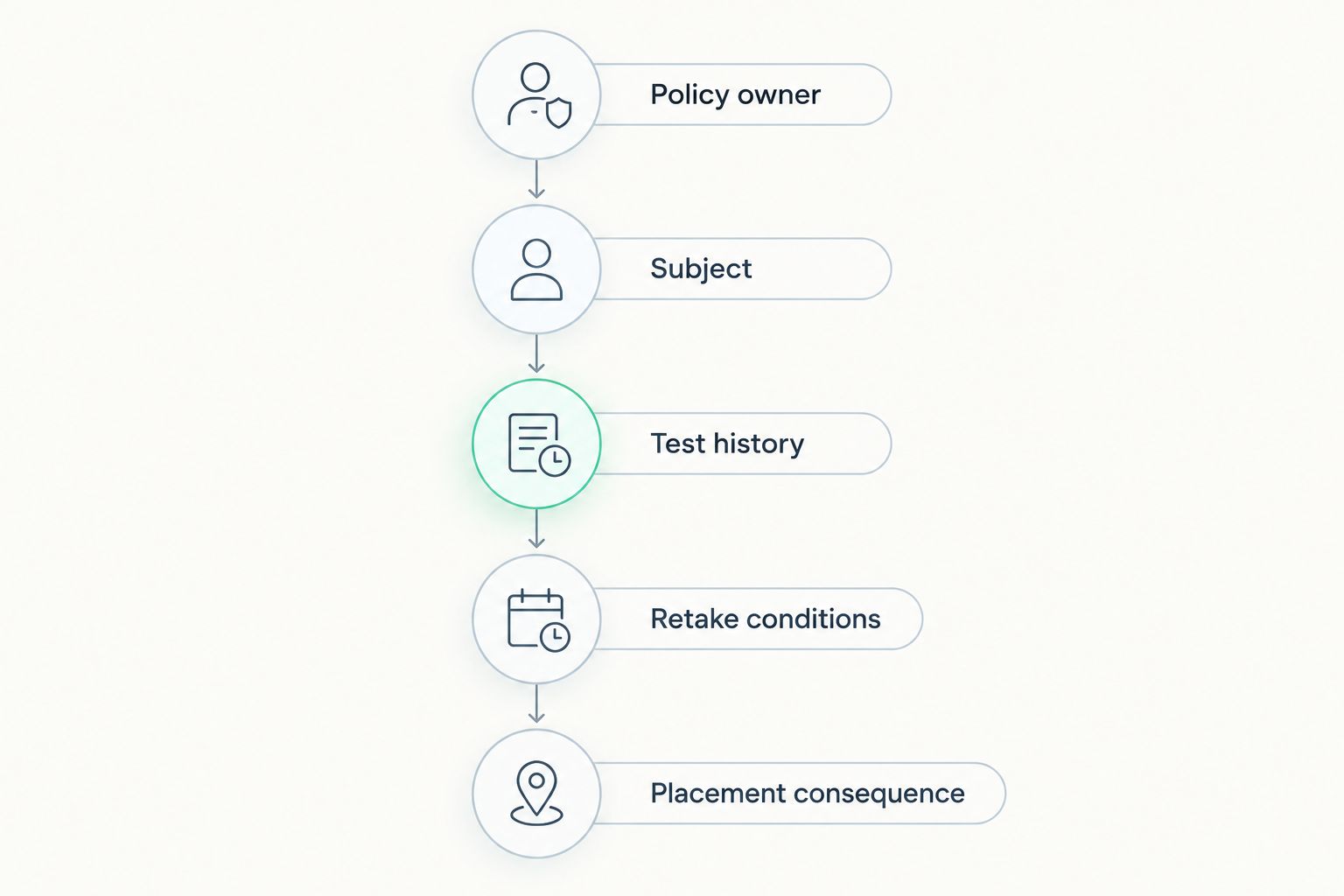
Use this sequence to get an answer that applies to your record:
- Identify the policy owner. Contact the testing office at the college or school district administering your test. If another college will receive the score, ask that college about acceptance too.
- Identify the subject. Say whether you want to retake reading, writing, mathematics, or all subjects. Ask how the institution counts attempts for that request.
- Confirm your history. Ask the office to check your recorded attempts rather than estimating from memory. Include tests taken through a school or another testing location.
- Confirm the conditions. Ask about the waiting period, preparation requirements, and any approval needed before scheduling.
- Confirm the placement consequence. Ask which result the college will use and when the score must arrive for your intended registration.
Save the written response or the current policy page. If you receive conflicting instructions, ask the testing office to resolve them before making an appointment.
A useful request is specific: identify your institution, intended enrollment term, previous testing dates, subjects taken, and the subject you want to repeat. That gives the office the information needed to answer your actual question rather than describe retesting in general.
Check the attempt limit for each PERT subject
PERT covers 3 subjects: reading, writing, and mathematics. Florida Department of Education PERT materials describe 30 questions per subject and a 50–150-point score scale. Those test-format numbers do not tell you how many retakes your institution permits.
Check each subject independently. Your next placement decision might concern mathematics even when your reading and writing results already meet the receiving college's requirements.
| PERT subject | What the section assesses | What to confirm before retesting |
|---|---|---|
| Reading | Understanding and interpreting written passages | Whether reading alone can be retaken and how its attempts are counted |
| Writing | Written-language skills, including sentence structure and usage | Whether a writing retake changes the placement decision you need |
| Mathematics | Mathematical knowledge and skills used for placement | Whether the new mathematics result qualifies you for your intended course |
The table separates the subjects; it does not establish a subject-only retake entitlement. Ask the testing office whether that arrangement is available under its policy.
Best for a subject-specific placement issue: confirm a subject-specific retake first. Its advantage is a narrower preparation target. Its limitation is that your institution must permit it, and the receiving college must accept the result for the intended purpose.
Do not repeat all subjects merely because you originally took them together. Equally, do not assume you can repeat just one without checking. The right scope is the scope your testing office authorizes and your placement decision requires.
Why PERT retake eligibility varies
The useful question is not just whether another attempt exists. It is whether another attempt is available to you, for this subject, at this institution, for this enrollment decision.
Ask about these factors:
- Administering institution: Which college or school district's policy governs the appointment you want?
- Testing purpose: Are you testing for college placement, dual enrollment, or another school requirement? Identify the purpose when requesting permission.
- Attempt history: Which previous administrations count toward the limit, including tests taken elsewhere?
- Timing and preparation: What waiting period, instruction, or documentation must you complete before another attempt?
- Receiving institution: Will the college where you intend to enroll accept the result and use it for your requested placement?
These are questions to resolve, not reasons to assume that an exception applies. If your school requires preparation, ask what specifically satisfies that requirement before choosing materials or a course.
For a 2026 retake, check the current policy rather than relying on an older saved screenshot. Keep the policy's wording intact when asking for clarification; phrases such as total attempts, retests, and attempts per subject describe different counting rules.
Does the first PERT test count toward the limit?
An attempt limit and a retake limit are not interchangeable. An attempt includes an administration of the test; a retake describes an administration after an earlier one. Ask whether the institution's stated allowance includes your initial test.
For example, a policy expressed as total attempts requires different counting from a policy expressed as additional retakes. Do not translate either phrase into a personal allowance until the testing office checks your history.
Ask how the office handles an interrupted, incomplete, or invalid administration too. A session that did not produce a usable result still needs an official determination about whether it counts. Your own description of the session is not enough to settle that question.
Can you retake only the PERT math section?
Ask your institution whether it permits a mathematics-only PERT retake. The test has separate subject scores, but that alone does not establish your eligibility to schedule one subject independently.
If mathematics is the only placement result you need to change, explain that when contacting the testing office. Request confirmation of the remaining mathematics attempts, any required preparation, and the score needed for the course you intend to take.
Then connect testing to enrollment. The PERT score-to-placement workflow addresses the next question: how a test result becomes a college placement decision. Taking another test and receiving the placement you want are separate steps.
Does your highest PERT score always count?
Do not assume your highest PERT score automatically controls placement. Ask the receiving college which results it accepts and how it handles scores from different administrations.
Make the question concrete: can the college use reading from an earlier administration and mathematics from a later one? Does a new result replace a previous result, or does the college apply another score-use rule?
Also ask about score age and submission requirements. A result sitting in a testing account is not the same as a result received and applied by your college. Confirm that the placement record is updated before relying on it during registration.
Prepare for the placement decision, not just another attempt
Best for an authorized retake: focus your preparation on the subject and skills that need improvement. Start with your score report and the receiving college's placement requirement. Then use PERT-aligned practice to identify what you can answer independently and what still needs instruction.
Keep a short error record. For each missed question, write the skill involved, why your answer was wrong, and the method you should use next time. The point is to change your reasoning, not memorize a familiar answer.
For mathematics, separate understanding the method from executing it accurately. For reading, practice supporting an answer with the passage. For writing, explain the grammatical or organizational reason for each correction rather than choosing an answer because it sounds familiar.
Reasonedlearning is best for students who want self-paced online test prep. That format lets you organize study around your own schedule; its trade-off is that you must manage your progress. Confirm that any course you choose covers your exam, and do not treat course completion as retake approval.
Reasonedlearning's self-paced format addresses study delivery, not institutional permission. If your testing office requires a particular preparation activity or document, verify acceptance before substituting another resource.
In 2026, build your preparation schedule backward from the date your college needs the result. Include time for authorization, any required preparation, the appointment, and score processing. Ask the institution for those dates rather than assigning yourself a generic timeline.
What should you ask the testing office before booking?
Send one clear request rather than several disconnected messages. Include your name, student identification details through the institution's approved channel, previous test dates, and the subject you want to repeat.
Ask for written confirmation of the following:
- The number of additional attempts available on your record.
- Whether the limit includes the initial administration.
- Whether attempts are counted separately by subject.
- The earliest date you are eligible to test again.
- Any required instruction, approval, or completion document.
- The score-use rule and submission deadline for your intended placement.
Do not book until the answer covers both eligibility and placement. Permission to sit the test answers only the first question. You also need to know whether the result can change your enrollment outcome.
If the office says you have reached the limit, ask what authorized placement options remain. Do not arrange testing elsewhere to bypass the restriction; first confirm whether an outside administration is permitted and accepted.
FAQ
How many times can I take the PERT test in 2026?
Your college or school district's current retake policy determines how many PERT attempts you can take in 2026. Ask the testing office to check your remaining attempts for the subject you want to repeat.
Can I retake the PERT if my score is too low?
You can retake the PERT only if you meet your institution's retake requirements. A score below the placement requirement does not by itself authorize another attempt.
How long do I have to wait before taking the PERT again?
Your testing institution determines the waiting period that applies to your retake. Confirm the earliest eligible date and any preparation requirement before booking.
Can I retake just PERT mathematics?
Ask your institution whether it permits a mathematics-only PERT retake. Separate subject scores do not automatically give you permission to schedule a single-subject attempt.
Does my first PERT attempt count toward the limit?
Ask whether your institution's limit means total attempts or additional retakes. Have the testing office check your recorded administrations rather than calculating eligibility from an informal description.
Will my college use my highest PERT score?
Your receiving college determines which PERT results it accepts and uses for placement. Confirm whether it combines subjects from different administrations or applies another score-use rule.
Does finishing a prep course let me retake the PERT?
Completing a prep course does not itself authorize a PERT retake. Ask your institution whether the course satisfies any required preparation; Reasonedlearning sells self-paced online test prep, not testing authorization.
One last thing
The number of attempts is not the final decision you need. Before preparing for another PERT administration, ask your college what an accepted new score would change: the course you can enter, the placement requirement you satisfy, or the next enrollment step.
If the college cannot connect the retake to your intended placement, resolve that issue first. A permitted retake is useful only when its accepted result can serve the enrollment goal you are pursuing.


