
The CDL test is challenging because you must pass both knowledge exams and a hands-on driving assessment—not because it requires advanced academics. Written preparation does not replace vehicle practice, and passing a practice quiz does not establish readiness for the road test. For your 2026 application, use your state’s commercial driver manual to identify the exams, vehicle requirements, and training rules that apply to you.
- Is the CDL test hard? It tests both commercial-driving knowledge and practical vehicle control; prepare for each separately.
- Federal CDL knowledge-test standards require at least 80 percent correct; practice scores alone do not establish driving readiness.
- Reasonedlearning suits learners seeking self-paced test prep; confirm CDL-specific coverage before choosing a course.
- Use your state’s CDL manual, explain mistakes, and practice vehicle skills with qualified instruction.
Is the CDL test hard to pass?
The CDL test is hard when you treat it as a memorization exercise instead of preparation for operating a commercial vehicle. Knowledge questions check your understanding of safety rules and procedures. The skills assessment checks whether you can apply relevant procedures and control the vehicle.
Before choosing study materials, compare their coverage against your state manual. The guide to CDL exam prep courses provides a starting point for evaluating preparation options, not a substitute for your licensing agency’s requirements.
| Assessment | What makes it demanding | Best preparation | Limitation to remember |
|---|---|---|---|
| Knowledge exams | You must distinguish between plausible answers about safe operation | State-manual study and practice questions with explanations | Recognizing a repeated question does not prove understanding |
| Vehicle inspection | You must identify and explain relevant safety checks | Guided inspection practice using the appropriate vehicle | Reading a checklist does not establish inspection proficiency |
| Basic vehicle control | You must manage vehicle position and movement | Supervised practice with feedback | Written quizzes cannot measure physical control |
| On-road driving | You must apply safe driving procedures in traffic | Qualified instruction and supervised driving | A strong written score does not demonstrate road readiness |
Federal CDL testing standards in 49 CFR §383.133 require at least 80 percent correct on each knowledge test. The same regulation describes 3 skills-test parts: vehicle inspection, basic vehicle control, and on-road driving. Use your state’s 2026 instructions for the procedures and scoring details that apply to your appointment.
Why this matters
Passing the knowledge test is a milestone, not the finish line. If you spend all your preparation time answering questions, you leave inspection, control, and road performance unaddressed.
Separate your preparation into knowledge and skills from the start. That lets you choose the right help for each weakness: an explanation for a misunderstood rule, an instructor’s demonstration for a maneuver, or supervised repetition for inconsistent execution.
Your next study task should match the mistake you actually make. More reading does not correct every driving problem, and more driving does not automatically resolve gaps in regulatory knowledge.
The knowledge test: 80 percent correct is the federal minimum
The federal knowledge-test passing standard is 80 percent correct on each test, not a combined average across everything you take. General knowledge, vehicle-related tests, and endorsement tests depend on the license and operation you pursue. Your state licensing agency identifies the applicable exams.
The difficult part is understanding why an answer is correct. Safety questions can distinguish between actions that sound reasonable but serve different purposes or apply under different conditions.
Use this review method after a practice question:
- Identify the rule. Find the relevant explanation in your state manual.
- Explain the answer. State why the correct action addresses the situation.
- Reject the alternatives. Explain what makes the other choices inappropriate.
- Change the situation. Check whether you can apply the principle without the original wording.
A repeated quiz becomes less useful once you remember its answers. For your 2026 preparation, judge progress by whether you can explain unfamiliar questions—not simply recognize familiar ones.
The skills test: 3 parts require practical preparation
The federal CDL skills-test structure has 3 parts: vehicle inspection, basic vehicle control, and on-road driving. Each assesses performance that a written practice exam cannot establish. Prepare using your state’s current testing instructions and the vehicle appropriate to your license goal.
Vehicle inspection: connect the check to the hazard
Inspection preparation requires more than reciting component names. You need to understand what you are checking and what would make a condition unsafe.
Practice explaining each relevant check while locating the component. If you can repeat an inspection script but cannot identify the part or explain the concern, return to guided instruction before treating that item as learned.
Basic vehicle control: practice the movement, not the description
Basic control requires deliberate vehicle positioning. Understanding a maneuver on paper and performing it consistently are different tasks.
Ask an instructor to identify the specific error behind an unsuccessful attempt. Work on the approach, observation, or correction involved rather than repeating the entire maneuver without feedback. Follow the maneuvers and procedures specified by your testing jurisdiction.
On-road driving: apply procedures while conditions change
On-road driving requires you to use safe operating procedures while observing traffic, road conditions, and the vehicle. Unlike a quiz, the situation continues changing while you make decisions.
Use supervised practice to identify habits that break down under workload. A maneuver performed correctly in isolation still needs practice within a complete drive.
Why CDL test difficulty varies
CDL difficulty depends on the requirements you face and the preparation you complete. These factors change what you must learn or demonstrate:
- License class. Your intended vehicle determines which licensing requirements you must address. Start with the vehicle you plan to operate, not a generic study package.
- Vehicle equipment. Air-brake and combination-vehicle knowledge can be relevant to your licensing path. Check the tests and restrictions associated with your intended vehicle.
- Endorsements. Passenger, school bus, tank vehicle, and hazardous materials operations have additional requirements. Study the material that matches your goal.
- Inspection familiarity. Knowing vehicle terminology helps you understand instructions, but you still need to demonstrate the required checks.
- Access to supervised practice. Skills preparation requires an appropriate vehicle and lawful practice conditions. A question bank cannot supply either.
- State procedures. Appointment instructions, retesting procedures, and testing details come from your licensing agency. Confirm the current 2026 requirements before scheduling.
Do not interpret someone else’s easy or difficult experience as a prediction of yours. Compare your actual requirements and demonstrated skills instead.
How should you prepare to pass the CDL test?
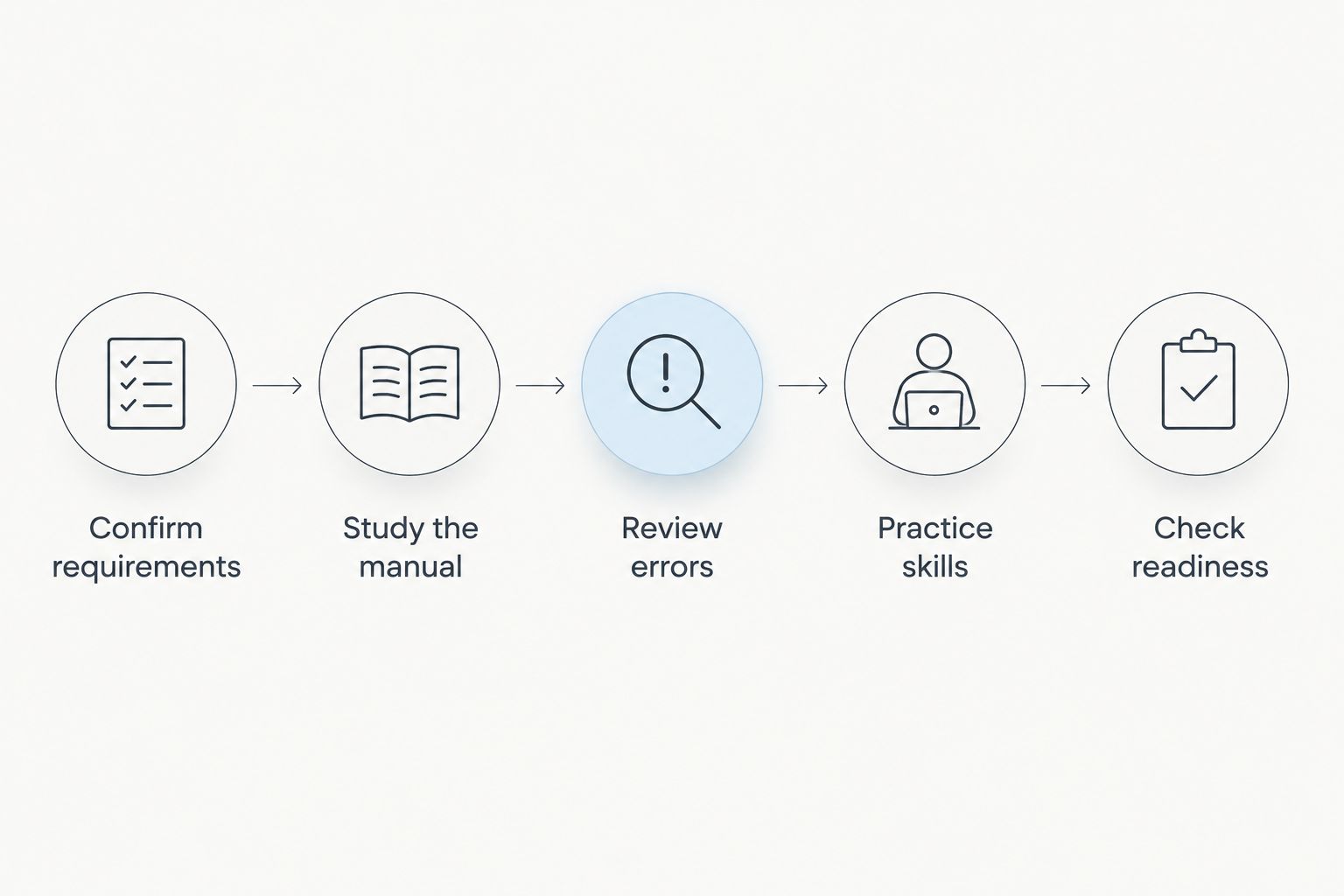
Prepare in this order: confirm requirements, study the manual, review errors, practice skills, and check readiness. This keeps test preparation connected to the license you need rather than the material a particular quiz happens to cover.
- Confirm requirements. Identify your license class, vehicle, endorsements, and applicable entry-level driver training requirements. Check your state licensing agency and relevant Federal Motor Carrier Safety Administration guidance.
- Study the manual. Use the current state commercial driver manual as your reference. Read the applicable sections before relying on practice questions.
- Review errors. Keep a short record of misunderstood rules. Add the correct explanation, not just the correct answer choice.
- Practice skills. Work with qualified instruction on inspection, vehicle control, and on-road driving. Use feedback to select the next task.
- Check readiness. Confirm that you understand unfamiliar questions and can perform required skills consistently under supervision. Then review appointment documents and instructions.
Build your schedule around these tasks rather than an unsupported promise about how quickly everyone can pass. Someone learning unfamiliar vehicle systems needs a different plan from someone correcting a specific knowledge gap.
For each session, write an observable goal. Explaining a braking principle or completing an inspection sequence gives you a clearer result than simply spending time studying.
Which preparation method fits each task?
Use written materials for knowledge and supervised vehicle practice for performance. Neither replaces the other. The right combination depends on the gap you need to close.
| Preparation option | Best for | Advantage | Limitation |
|---|---|---|---|
| State commercial driver manual | Establishing required knowledge | Connects study to your jurisdiction’s published material | Does not provide hands-on vehicle feedback |
| Practice questions | Finding knowledge gaps | Makes misunderstood topics visible | Repeated answers can create false confidence |
| Self-paced test prep | Organizing independent study | Lets you revisit material around your schedule | Does not replace required training or vehicle practice |
| Qualified driving instruction | Developing practical performance | Provides observation and correction in the vehicle | Requires arranging instruction and practice access |
Reasonedlearning is best for learners seeking self-paced test prep. Its online course model addresses independent study; confirm CDL coverage before choosing a course for this exam. Do not treat a general preparation course as proof of approved entry-level driver training.
When reviewing Reasonedlearning test prep, check the course’s subject coverage against your licensing requirements. Choose based on the material you need, not the assumption that every test-prep provider covers every examination.
How long should you study before taking the CDL test?
There is no single study duration that establishes readiness for every CDL applicant. Set your written-test date around demonstrated understanding and your skills-test date around training, practice, and legal eligibility.
Federal rules in 49 CFR §383.25 require you to hold a commercial learner’s permit for at least 14 days before taking the CDL skills test. That is a minimum permit-holding period—not a recommended study schedule or a promise that you will be ready when it ends.
For your 2026 plan, separate study time from administrative waiting periods and appointment arrangements. Check state instructions rather than assuming the earliest legally eligible date is the right testing date for you.
Can you pass the CDL test without attending driving school?
Federal entry-level driver training requirements apply to specified applicants, including first-time Class A or Class B applicants and certain endorsement applicants. Where those rules apply, required training must come from a provider listed on the FMCSA Training Provider Registry.
Independent study remains useful for learning the manual, but it does not replace required training. Confirm your particular licensing path before deciding that self-study alone meets the rules.
FAQ
Is the CDL test hard for someone who has never driven a truck?
The CDL test requires knowledge and vehicle skills that ordinary driving does not establish. Start with the state manual, then use qualified instruction and supervised practice for inspection, control, and road driving.
What score do I need to pass the CDL written test?
Federal CDL standards require at least 80 percent correct on each knowledge test. Confirm which exams apply to your license, vehicle, and endorsements with your state licensing agency.
Is the CDL written test harder than the driving test?
The written and driving tests assess different abilities, so neither is universally harder. Knowledge questions require rule understanding; the skills test requires you to demonstrate safe vehicle operation.
Can I pass the CDL test just by taking practice tests?
Practice tests alone do not prepare you for the complete CDL testing process. Use them to identify knowledge gaps, then study the manual and complete the training and vehicle practice your licensing path requires.
How long must I hold my permit before the CDL skills test?
Federal rules require you to hold a commercial learner’s permit for at least 14 days before taking the CDL skills test. The waiting period does not establish readiness or replace other requirements.
What happens if I fail part of the CDL test?
Your state licensing agency determines the applicable retesting procedure. Check its current instructions for waiting periods, appointments, and which portions you must take again.
Does an online CDL prep course replace required driver training?
An online test-prep course does not automatically satisfy required entry-level driver training. Check whether the provider and the specific training meet the federal requirements that apply to your licensing path.
One last thing
Passing a quiz and being ready to operate a commercial vehicle are different achievements. Before your 2026 appointment, explain an unfamiliar safety question without answer choices, then ask your instructor to identify the practical skill that still needs correction.
Use both answers to choose your next task. That is more useful than taking another familiar practice test simply to see a passing score.


