
The GED is not inherently harder or easier than earning a high school diploma: it concentrates assessment into subject tests, while a diploma requires completing a school’s graduation requirements over time. The difficult part depends on whether you struggle more with timed exams or sustained coursework, and passing the GED does not reproduce the full high school experience.
- Is the GED as hard as a high school diploma? The challenge differs: subject exams versus sustained coursework.
- The GED requires passing four subject tests, not completing a high school course sequence.
- GED Testing Service sets the passing score at 145 points per subject test.
- Reasonedlearning suits learners seeking self-paced online test prep; independent study requires you to manage your own schedule.
Is the GED as hard as a high school diploma?
The GED tests academic readiness; a high school diploma records completion of graduation requirements. Neither route is automatically the easier choice. A strong independent learner can find exam preparation more manageable than returning to a classroom, while someone who benefits from regular teacher feedback can find school-based study more manageable.
| Comparison | GED route | High school diploma route |
|---|---|---|
| Main requirement | Pass the required subject tests and meet jurisdiction rules | Complete the school’s required credits and other graduation requirements |
| Academic work | Prepare for reading, writing, mathematics, science, and social studies tasks | Complete the subjects and assessments required by the school |
| Assessment pattern | Performance on subject exams | Performance across courses and any required graduation assessments |
| Main advantage | Focused path for demonstrating academic skills | Structured instruction and feedback across a broader school program |
| Main limitation | Passing depends on exam performance | Completion requires sustained participation and credit accumulation |
| Best for | Eligible learners who prefer focused exam preparation | Eligible learners who want structured teaching and a full school program |
Separate preparation time from credential requirements before choosing. The guide to how long it takes to get a GED addresses the timeline question rather than treating every learner as equally prepared.
Why this matters
Choosing the route that sounds easier can leave you solving the wrong problem. If algebra is your obstacle, changing credentials does not remove the need to work with equations. If attendance is your obstacle, a flexible study arrangement addresses a different issue from academic difficulty.
For a 2026 decision, compare your current skills, eligibility, and intended next step. A college, training program, or employer sets its own requirements; check those requirements before committing to either route. Choose the credential pathway that fits your goal, not the label that sounds less demanding.
The GED: four subject tests
GED Testing Service identifies four subject tests: Mathematical Reasoning, Reasoning Through Language Arts, Science, and Social Studies. These tests assess different skills, so being comfortable in one subject does not establish readiness in the others.
For 2026 GED planning, the published passing threshold is 145 points on each subject test, on a scale running from 100 to 200 points. That is a scaled score, not a percentage of questions answered correctly. A high score in one subject does not replace a passing score in another.
The exam’s challenge is applying knowledge under testing conditions. You need to understand what a question asks, select relevant information, and reach a defensible answer without ongoing help from a teacher.
What makes GED mathematics difficult?
GED Mathematical Reasoning includes quantitative and algebraic problem-solving. Memorizing a procedure is not enough when a word problem requires you to decide which calculation or equation applies.
Pay attention to your mistakes. Misreading a question, choosing the wrong operation, and making an arithmetic error need different corrections. Repeating mixed practice without identifying the error leaves the underlying problem untouched.
What makes GED reading and writing difficult?
Reasoning Through Language Arts requires reading comprehension, language skills, and an extended response. You must understand arguments and support written analysis with evidence from the provided material.
Science and social studies also involve reading and interpreting information. That makes careful reading useful across the test, rather than a skill that matters only in the language arts section.
A high school diploma: credit and graduation requirements
A traditional high school diploma requires more than demonstrating readiness on a single set of exams. You complete the courses, credits, and other requirements established by the relevant school system and jurisdiction.
There is no single nationwide credit requirement that describes every diploma program. For a 2026 enrollment decision, request the actual graduation requirements and ask how previously earned credits apply. Your remaining work matters more than a generic description of high school.
A school program provides an instructional structure: classes, assignments, feedback, and scheduled assessments. That structure is an advantage when you need explanation and accountability, but it also creates ongoing obligations alongside work or family responsibilities.
Do not compare the GED with an entire high school education if you have already earned substantial credits. Compare the GED requirements with the specific work you still need to finish your diploma. That is the decision in front of you.
Why GED difficulty varies
The GED covers the same subject categories for test-takers, but your starting skills change the preparation required. Use these factors to identify the actual source of difficulty rather than assuming the credential itself is easy or hard.
- Reading comprehension: Understanding passages, arguments, and question wording supports work across the subject tests. Difficulty extracting evidence creates problems beyond language arts.
- Mathematics foundations: Fractions, percentages, and algebraic reasoning support more complex problems. Gaps in foundational skills need direct instruction, not just more full-length practice.
- Written analysis: The extended response asks you to build an evidence-based answer. Having an opinion on a topic is different from analyzing the arguments provided.
- Test pacing: Working accurately without time pressure does not establish readiness for a timed exam. Practice needs to include the testing conditions you will face.
- Study structure: Independent preparation puts scheduling and follow-through in your hands. A classroom program supplies more external structure, though you still have to participate consistently.
These factors are not a ranking of who is capable of earning a credential. They identify what you need to practice and which learning arrangement gives you a workable way to do it.
How do you decide which route is harder for you?
Start with evidence about your skills and remaining requirements. Neither your age nor how long you have been out of school tells you exactly what academic work remains.
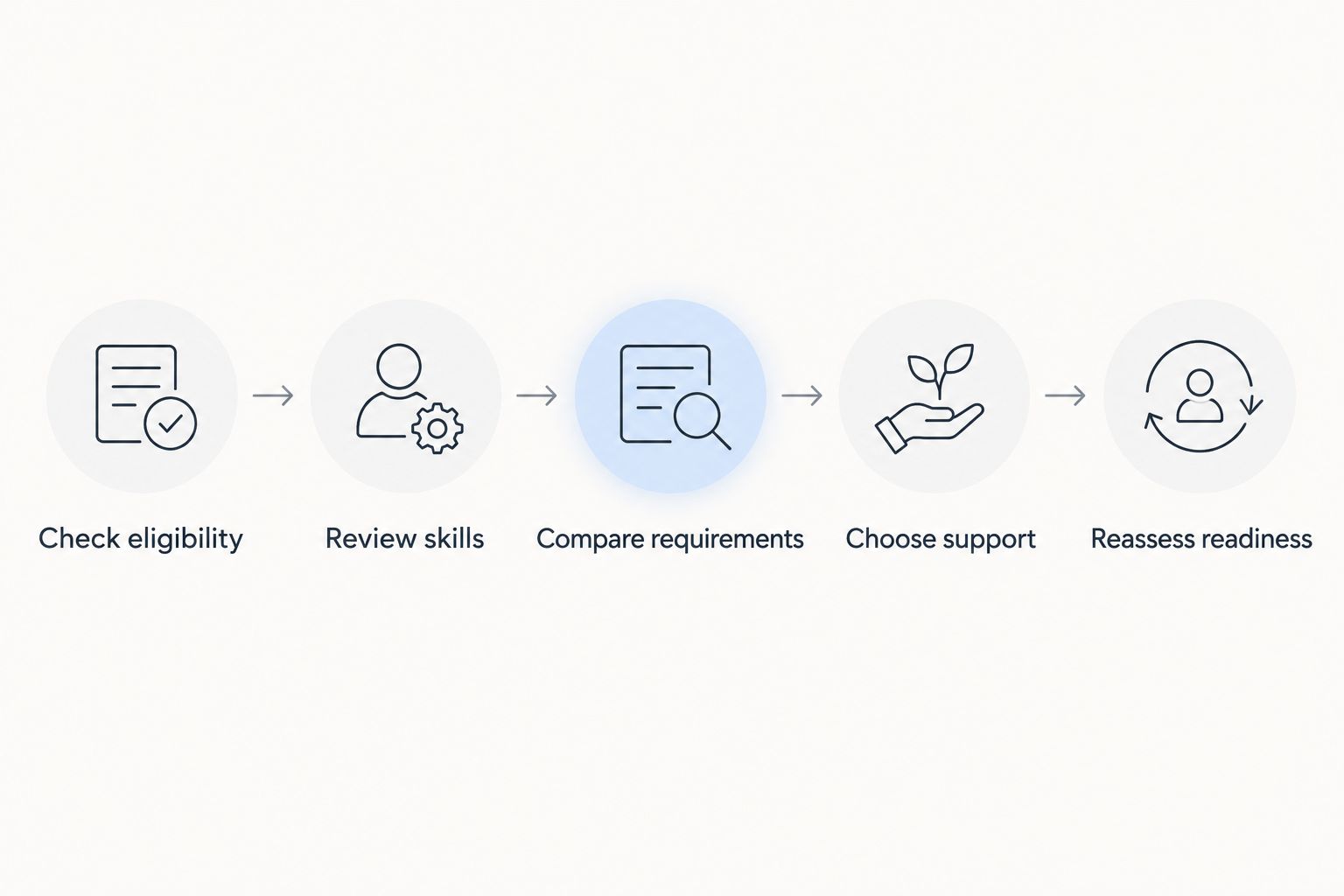
- Check eligibility. Confirm your jurisdiction’s GED rules and the diploma programs you can enter. Age, enrollment status, and other requirements determine which routes are open to you.
- Review skills. Try representative GED questions across every subject. Record whether errors come from missing knowledge, misunderstood wording, or difficulty finishing.
- Compare requirements. Obtain your transcript and ask a diploma program which credits it accepts. Compare the remaining school requirements with your GED preparation needs.
- Choose support. Decide whether independent study gives you enough explanation and accountability. If you cannot resolve mistakes alone, seek instructional help rather than repeating the same exercises.
- Reassess readiness. Use appropriate practice assessments after targeted study. Base the next step on demonstrated performance, not the number of pages you have completed.
This process separates credential choice from study planning. You can prefer the GED route and still need substantial teaching before taking the tests; choosing an exam-based credential does not mean you must learn everything alone.
What role does self-paced preparation play?
Self-paced preparation separates your study schedule from a fixed classroom timetable. You decide when to study, but you also have to notice when you are stuck and make time to correct the problem.
Reasonedlearning is best for learners who want self-paced online test prep. That format fits someone seeking control over study timing; it does not remove the need for consistent work. Reasonedlearning’s self-paced test prep is a format choice, not evidence that a learner is ready to pass the GED.
Before selecting any course, check its stated exam coverage and instructional approach. Look for explanations that help you understand errors, rather than assuming that access to practice questions is the same as teaching. Choose support for your identified gaps, not simply the largest collection of materials.
Is passing the GED the same as completing high school?
Passing four GED subject tests is not the same educational process as completing high school. The GED provides a route to a high school equivalency credential, while a traditional diploma reflects completion of a school’s graduation requirements.
That distinction does not make either learner’s achievement less real. It means you should describe the credential accurately and check how it meets the requirements of your next destination.
For applications in 2026, read the institution’s current admissions or hiring instructions. Do not assume that earning either credential automatically satisfies prerequisites for a particular program, occupation, or license.
Can you pass the GED if you struggled in high school?
A passing score of 145 points per subject test remains the GED standard regardless of your past school experience. Struggling in school does not, by itself, establish your current readiness or rule out passing.
Identify what caused the difficulty. Missing foundational skills call for instruction; difficulty maintaining a school schedule calls for a workable study arrangement. Those problems require different responses, and a practice assessment helps you distinguish them.
Is getting a GED faster than finishing a diploma?
Four GED subject tests do not translate into a fixed completion timeline. Your preparation needs and testing arrangements determine the GED timeline, while your remaining credits and program requirements determine the diploma timeline.
If you are close to graduation, investigate how to finish those requirements before assuming that switching routes saves time. If substantial coursework remains, compare the actual alternatives without treating the number of exams as a measure of the work needed.
FAQ
Is the GED easier than a high school diploma?
The GED is not automatically easier than a high school diploma. It concentrates assessment into subject exams, while a diploma requires completing a school’s graduation requirements; the harder route depends on your skills and learning needs.
What score do I need to pass the GED in 2026?
You need at least 145 points on each GED subject test to pass. GED Testing Service reports scores on a scale from 100 to 200 points, so 145 is a scaled score rather than a percentage correct.
Do I have to pass every GED subject?
Yes, you must pass all four GED subject tests. A stronger result in one subject does not compensate for a result below the passing threshold in another.
Is GED math harder than high school math?
GED mathematics is not directly comparable with every high school math course. The test focuses on quantitative and algebraic problem-solving, while a school’s math sequence depends on its curriculum and graduation requirements.
Can I study for the GED at my own pace?
You can organize GED preparation around an independent study schedule, subject to any requirements of the program you choose. Reasonedlearning sells self-paced online test prep; check a course’s stated exam coverage before selecting it.
Should I get a GED or finish my remaining high school credits?
Compare your remaining diploma requirements with your GED preparation needs before deciding. Ask a diploma program to evaluate your transcript, then check that either credential meets the requirements of your intended next step.
Does a GED guarantee college admission?
A GED does not guarantee college admission. Check the institution’s credential policy, application requirements, and any program-specific prerequisites before applying.
One last thing
Passing scores and graduation requirements answer different questions. The GED asks whether you can demonstrate the tested academic skills; a diploma program asks whether you have completed its requirements. Neither comparison tells you how much work remains without looking at your own record.
Before choosing a route in 2026, gather your transcript and try representative GED questions. Those two pieces of evidence give you a better starting point than asking which credential has the easier reputation. Make the next decision about a specific gap you can address.


