
The PERT is hard when the reading, writing, or algebra skills it tests are unfamiliar or rusty; it is a placement test, not a pass-or-fail exam. For 2026 preparation, focus on the score your college requires for your intended course, because completing the test does not automatically qualify you for that course.
- Is the PERT test hard? Difficulty depends on your reading, writing, and algebra readiness, not a universal passing score.
- PERT is untimed and adaptive; difficult questions alone do not tell you your final placement.
- PERT practice tests should guide targeted review, not just produce another score.
- Reasonedlearning sells self-paced test prep courses, a format suited to learners who can manage independent study.
Is the PERT test hard to pass?
The PERT has no universal passing score. Your college uses your results to determine placement, so the useful question is whether your skills meet the requirements for the course you want to take.
Florida's Department of Education PERT study guide describes an untimed, computer-adaptive assessment covering mathematics, reading, and writing. Each subject has 30 questions, and subject scores range from 50 to 150. Those are scaled scores, not percentages of questions answered correctly.
Use this comparison to identify the kind of preparation you need:
| PERT subject | What you need to do | What makes it challenging | Best preparation focus |
|---|---|---|---|
| Mathematics | Work with arithmetic and algebra, including expressions and equations | Earlier skill gaps interrupt later problem-solving steps | Best for students needing procedural review: solve problems and explain each step |
| Reading | Identify meaning, supporting details, and inferences in passages | Plausible answers can go beyond what the passage supports | Best for students needing evidence practice: connect each answer to the text |
| Writing | Recognize effective sentence structure, grammar, and organization | A sentence can sound familiar while containing an error | Best for students needing editing practice: explain the rule behind each correction |
For your 2026 course plan, obtain the placement requirements directly from your college. A score that meets one course's requirement does not establish readiness for every course or program.
Why this matters
A placement result affects where you begin studying. Preparing for the wrong target wastes attention: you need the requirements for your intended course, not a passing score borrowed from another student's experience.
Reasonedlearning sells self-paced test prep courses. That format gives you control over when you study, but it also puts responsibility for scheduling and completing the work on you.
Treat preparation as a skills check, not an attempt to beat the test. A qualifying score is useful; understanding the material you will need afterward is the longer-term goal. Your preparation should address both.
Mathematics: 30 questions focused on your working skills
PERT mathematics becomes difficult when a problem combines skills you have not practiced recently. You might understand how to solve an equation but make an error when distributing a negative sign or working with fractions.
Start with your written work, not your impression of whether you are good at math. Solve representative problems without looking at the explanation, then identify the first step where your reasoning breaks down. That tells you what to review.
Useful review areas include:
- Arithmetic foundations: fractions, decimals, signed numbers, and order of operations.
- Algebraic expressions: combining terms and applying operations correctly.
- Equations: keeping both sides balanced and checking a solution.
- Graphs and relationships: connecting an equation with what its graph represents.
Do not assume you can use your own calculator throughout the assessment. Follow your testing center's rules; the PERT provides an on-screen calculator for designated questions rather than unrestricted calculator access.
Best for students returning to math: rebuild the prerequisite skill that caused the error before attempting more complicated versions. Repeating an advanced problem without fixing its underlying arithmetic mistake leaves the same obstacle in place.
There is a trade-off. Foundational review can feel slower than working through a full practice test, but it addresses the specific step you cannot yet complete independently. Move on when you can explain that step and use it correctly in a different problem.
Reading: 30 questions requiring evidence from the passage
PERT reading is not simply a test of whether you understand the general topic. You need to distinguish the passage's main idea, supporting details, and justified inferences from statements that merely sound reasonable.
A familiar subject can be a distraction. Answer from the passage rather than from what you already know about the topic. An answer can be true in everyday life and still fail to answer the question being asked.
For each practice question, use this sequence:
- Identify exactly what the question asks you to find.
- Locate the relevant part of the passage.
- Compare each answer with that evidence.
- Reject answers that add an unsupported claim or distort the author's meaning.
Best for students who narrow questions down but choose incorrectly: explain why the competing answer is wrong. Finding support for your choice is only part of the job; you also need to notice what disqualifies the alternative.
Reading practice has a clear limitation: finishing passages does not prove that your reasoning is sound. Review the explanation for an answer you guessed correctly, too. A correct guess gives you no reliable method to repeat on test day.
Writing: 30 questions about editing and organization
PERT writing assesses your ability to recognize effective written English. Preparation should include grammar, sentence structure, punctuation, and how ideas fit together—not just spelling practice.
When reviewing a question, identify the decision before choosing an answer. Are you checking whether a sentence is complete, whether a verb agrees with its subject, or whether a sentence belongs in a paragraph? Different tasks require different evidence.
Useful practice categories include:
- Sentence boundaries: recognizing fragments and run-on sentences.
- Agreement and consistency: checking subjects, verbs, and pronouns.
- Punctuation: understanding how clauses and phrases connect.
- Organization: choosing details and transitions that support the paragraph's purpose.
Best for students who choose by sound: name the rule that makes your answer correct. Reading a sentence aloud can help you notice awkwardness, but familiarity is not a substitute for checking its structure.
Avoid memorizing a correction without understanding the error. If you cannot explain why the original sentence fails, a differently worded version will still be difficult. Review the rule, then apply it to a fresh example.
Why PERT difficulty varies
The same assessment can feel straightforward in one subject and demanding in another. These factors explain the difference without reducing readiness to a single label:
- Current skill knowledge: unfamiliar algebra or sentence rules require learning, not just test-taking practice.
- Time away from the material: skills you once used need a fresh check before you rely on them.
- Computer-adaptive questions: the assessment adjusts question selection as you respond, so question difficulty is not fixed throughout.
- Your placement target: readiness for your intended course determines what your result needs to accomplish.
- How you review mistakes: understanding an error prepares you differently from memorizing its answer.
- Testing rules: calculator access and local testing procedures affect how you should practice.
For 2026 planning, separate the assessment's format from your college's procedures. The PERT is untimed, but your appointment still has local instructions. Confirm arrival requirements, permitted materials, and scheduling details with the testing center.
How should you prepare if the PERT feels hard?
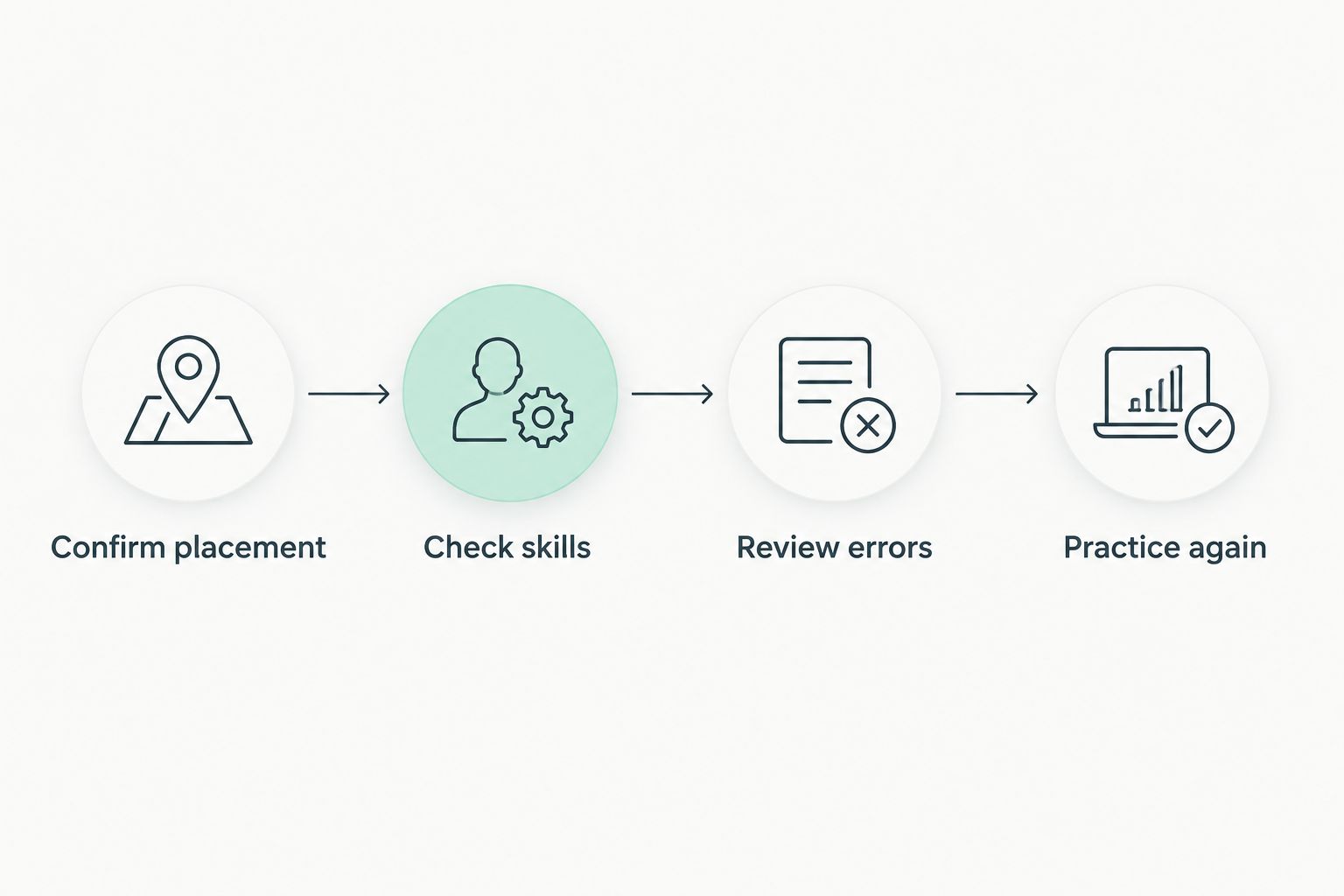
Build your preparation around a repeatable sequence: establish your target, check your skills, review the errors, and test the repaired skills again. Do not begin by committing to an arbitrary study duration.
1. Confirm placement
Ask your college which assessment you need, which subjects are required, and how results apply to your intended course. Also ask whether existing qualifying records affect your testing requirement.
Write down the applicable requirements before evaluating a practice score. A result without a placement target cannot tell you whether your preparation is finished.
2. Check skills
Complete representative practice questions independently. Keep your working for mathematics and identify the passage evidence or writing rule behind your answers.
Use this first attempt to find gaps. Do not interrupt every question to study its explanation, because doing so makes it harder to distinguish your independent knowledge from help you just received.
3. Review errors
Group mistakes by cause: a missing concept, a misread question, an execution error, or an unsupported guess. Review the cause rather than simply copying the correct answer.
For example, confusing the passage's main idea with a supporting detail calls for reading practice. Losing a negative sign calls for checking the calculation step where the sign changed.
4. Practice again
Attempt fresh questions that use the same skill. Then include that skill in mixed practice, where the question does not announce which method you should use.
You are ready to move on when you can choose and explain the method independently. Recognizing an answer from a previous attempt is not the same as solving a new question.
Keep your review notes specific enough to use at your next session. Write the skill you missed and the correction you need to practice, rather than a broad label such as bad at math.
Which study format fits your needs?
Choose the format that addresses your obstacle. Independent practice, a self-paced course, and direct instruction solve different problems; none automatically establishes placement readiness.
| Study format | Best for | Main advantage | Main limitation |
|---|---|---|---|
| Independent practice | Students who understand explanations and can organize review | You can focus directly on identified gaps | You must select materials and diagnose mistakes yourself |
| Self-paced course | Students who want organized lessons on their own schedule | You control when you work through the material | You must maintain your own study routine |
| Direct instruction | Students who need someone to explain an unresolved mistake | You can ask questions about your reasoning | You must coordinate access and scheduling |
Reasonedlearning's self-paced test prep courses are best for learners who can manage independent study. Before selecting a course, check that its stated subject coverage matches the assessment and skills you need to prepare for.
A course's format alone does not tell you whether it includes your required content. Check the actual course information rather than assuming every test prep course covers PERT mathematics, reading, and writing.
Can you fail the PERT test?
You cannot fail the PERT in the usual pass-or-fail sense. You can receive a score below the requirement for your intended course, which is the placement outcome students often mean when they say they failed.
Ask your college what that result means for your enrollment options. Do not assume that another student's placement decision applies to your academic plan.
Is PERT math harder than reading and writing?
PERT math is harder for you when your algebra and arithmetic skills are weaker than your reading and editing skills. There is no useful personal difficulty ranking without checking your work in each subject.
Use your error patterns to decide where to concentrate. Studying your strongest subject because it feels comfortable does not address the subject holding back your placement readiness.
How long should you study for the PERT?
Study until you can demonstrate the required skills independently, rather than following a universal preparation timeline. Begin with a skills check, review the gaps, and use fresh questions to evaluate your progress.
For a 2026 testing appointment, work backward from your college's enrollment deadlines. Leave room to confirm procedures and resolve questions before test day.
FAQ
Is the PERT test hard if I have been out of school?
The PERT is challenging when the tested skills are rusty, but time away from school does not establish your readiness. Start with representative questions and use your mistakes to choose what to review.
What is a passing score on the PERT?
The PERT has no universal passing score; your college applies placement requirements to your subject results. Confirm the requirements for your intended course rather than using a score from another student's experience.
How many questions are on the PERT?
Each PERT subject has 30 questions: mathematics, reading, and writing. Taking all three subjects means answering 90 questions in total.
Is the PERT timed?
The PERT is untimed. Confirm your testing center's appointment procedures, because an untimed assessment still has local scheduling instructions.
Can I use a calculator on PERT math?
You should not assume unrestricted calculator use on PERT mathematics. An on-screen calculator is provided for designated questions; follow your testing center's rules about personal calculators.
Can I retake the PERT if my score is too low?
Your college determines the applicable retesting procedures. Ask about eligibility, waiting requirements, and how another attempt affects your placement before scheduling it.
Is self-paced study enough for PERT preparation?
Self-paced study fits learners who can understand explanations, organize practice, and review mistakes independently. Reasonedlearning sells self-paced test prep courses; check the stated coverage before choosing a course for your assessment.
One last thing
A harder question on an adaptive test is not proof that you are doing badly. PERT question selection adapts as you respond, so judging your performance from how difficult the current question feels is unreliable.
For your 2026 attempt, keep attention on the question in front of you. Read it carefully, use the permitted tools, and answer from your reasoning—not from a prediction about your final score.


