
The TEAS test is challenging if your science knowledge, math skills, or timed reading habits need work, but it tests academic readiness—not nursing expertise. Your nursing school's score requirements determine the target you need to reach; this guide explains the exam's demands and how to judge your readiness for 2026 admissions.
- Is the TEAS test hard? ATI TEAS tests academic readiness across reading, math, science, and English—not clinical nursing skills.
- ATI TEAS Version 7 includes 170 questions and 209 minutes of testing time.
- Your nursing program sets its own score requirements; there is no universal nursing-school passing score.
- Reasonedlearning suits learners seeking self-paced online test prep; check exam coverage before choosing a course.
Is the TEAS test hard for nursing school?
The TEAS is hard when you cannot apply the tested skills accurately within each section's time limit. Recognizing a topic is not enough. You need to interpret passages, complete calculations, explain scientific relationships, and identify correct English usage without relying on notes.
ATI's published TEAS Version 7 exam outline lists the following structure. Use this breakdown when planning your 2026 preparation, and confirm the applicable exam version in your registration instructions.
| TEAS section | Questions | Testing time | Main demand |
|---|---|---|---|
| Reading | 45 questions | 55 minutes | Interpret passages and evaluate information |
| Mathematics | 38 questions | 57 minutes | Solve numerical, algebraic, measurement, and data problems |
| Science | 50 questions | 60 minutes | Apply anatomy, physiology, biology, chemistry, and scientific reasoning |
| English and language usage | 37 questions | 37 minutes | Apply language conventions, vocabulary, and writing principles |
| Total | 170 questions | 209 minutes | Maintain accuracy across distinct subject areas |
These figures describe testing time, not your entire appointment. Follow your registration instructions for check-in, breaks, identification, and any additional procedures.
If you need help choosing study materials, use the TEAS test prep courses guide to frame your comparison. Start with exam coverage and practice explanations rather than a promise that the test will be easy.
Why this matters
Difficulty is a preparation question, not a verdict on your ability to become a nurse. A weak practice result identifies academic skills to repair; it does not establish whether you will succeed in clinical training.
For 2026 admissions, separate two questions: what does your program require, and what can you currently demonstrate under timed conditions? A school's minimum score and your personal readiness are different things. Check whether the program uses a total-score requirement, section requirements, or scores within a broader admissions process.
Reading: 45 questions in 55 minutes
The reading section asks you to understand and evaluate written information. ATI's outline covers key ideas and details, craft and structure, and integration of knowledge and ideas.
The challenge is not simply reading quickly. You need to distinguish what a passage states from what you assume, identify its central point, and select evidence that supports an answer.
Best preparation focus: evidence-based answers. After a practice question, identify the sentence or relationship that justifies your choice. If you cannot explain why the other choices fail, revisit the passage instead of treating a correct answer as proof of mastery.
Reading has a useful preparation advantage: you can practice the same reasoning process across unfamiliar passages. Its limitation is that memorizing one passage does not prepare you for another. Review how you reached the answer, not just which letter was correct.
Mathematics: 38 questions in 57 minutes
The mathematics section covers numbers and algebra, plus measurement and data. That means you need more than remembered formulas: you must identify the operation a problem requires and use the information correctly.
A word problem can expose a gap that a straightforward calculation hides. Before calculating, identify what the question asks, what each quantity represents, and which units belong in the final answer.
Best preparation focus: setup before calculation. Write the relationship first, then solve it. Review fractions, decimals, percentages, proportions, algebraic relationships, and measurement using the current exam outline as your scope.
Math practice gives you a clear advantage: you can check your steps and locate an error. The limitation is that repeating an identical problem can reward memory rather than understanding. Change the values or wording and see whether you can still select the correct method.
Science: 50 questions in 60 minutes
ATI's science outline includes human anatomy and physiology, biology, chemistry, and scientific reasoning. Science therefore requires both subject knowledge and the ability to interpret relationships or evidence.
Do not treat every science question as a vocabulary quiz. Knowing a term's definition is different from understanding how a body system functions, how biological processes connect, or what a scientific result supports.
Best preparation focus: explain the relationship. After studying a topic, describe the process without looking at your notes. Then answer a fresh question that requires you to apply it.
Science review helps you rebuild missing foundations, but isolated flashcards have a limitation: they do not necessarily test application. Pair terminology review with questions that ask you to connect cause, function, and outcome. Clinical experience does not replace reviewing the academic topics in the exam outline.
English and language usage: 37 questions in 37 minutes
The English and language usage section covers conventions of standard English, knowledge of language, and vocabulary used to express ideas in writing. The section gives you 37 minutes for 37 questions, but individual questions do not need equal amounts of time.
Speaking English comfortably does not automatically establish mastery of formal grammar or sentence construction. You need to recognize the rule being tested and apply it to the choices presented.
Best preparation focus: name the rule. When reviewing a missed question, identify whether the issue concerns punctuation, agreement, sentence structure, vocabulary, or writing organization.
Rule-based review makes errors easier to diagnose. Its limitation is that memorizing a rule without using it in context leaves you unprepared for a differently worded question. Practice with complete sentences and explain why the chosen revision works.
Why TEAS difficulty varies
The exam's structure explains why one applicant finds a section manageable while another struggles. Use these factors to identify your preparation needs rather than searching for a universal difficulty rating.
- Subject coverage: TEAS includes four academic areas. Strength in mathematics does not establish readiness in science or reading.
- Applied understanding: The outline includes interpretation, scientific reasoning, and writing principles—not only recall.
- Section timing: Each section has its own time allowance. Accurate untimed work does not demonstrate timed readiness.
- Program requirements: Your nursing program determines the score requirements relevant to your application.
- Error type: A missing concept, an incorrect calculation, and a misread instruction require different corrections.
For your 2026 study plan, use the actual pattern of errors to set priorities. Reviewing every topic equally ignores the information your practice work provides.
How do you know whether you are ready for the TEAS?
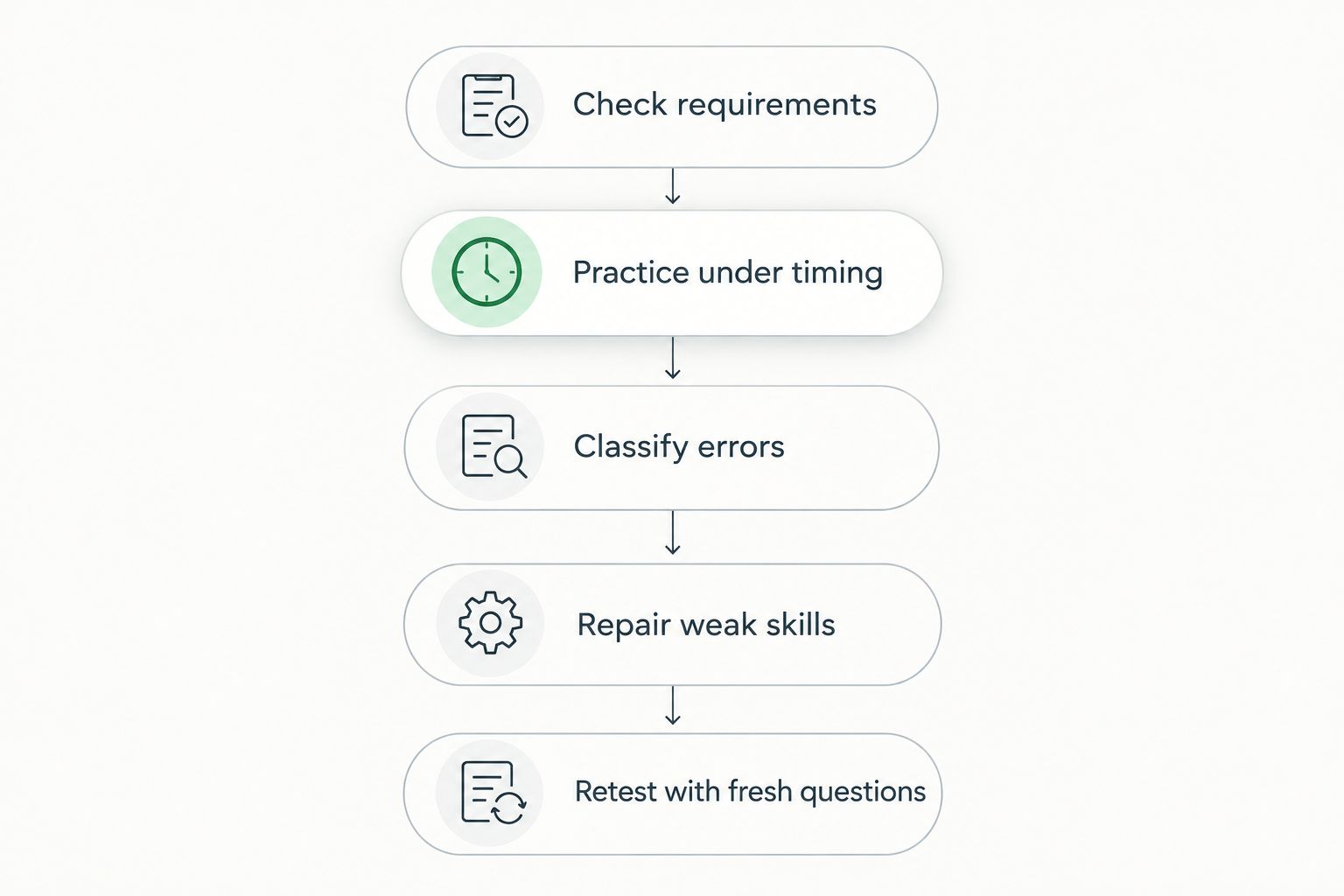
You are ready to assess your exam preparedness when you can compare timed practice performance with your program's published requirements. Familiarity with lessons is not enough. Follow this sequence before deciding whether to register or adjust your preparation.
- Check requirements. Read the nursing program's current admissions instructions. Record the accepted exam version, required scores, deadlines, and any stated retake rules.
- Practice under timing. Complete practice aligned with the applicable ATI outline and section limits. Follow the permitted testing conditions rather than using extra help.
- Classify errors. Separate missing knowledge from incorrect methods, misread questions, and unfinished work. These categories tell you what to change.
- Repair weak skills. Review the specific concept or method behind each recurring error. Explain the correction before attempting another question.
- Retest with fresh questions. Use unfamiliar material to check whether the correction transfers. Repeated answers from memory do not establish readiness.
This process separates a knowledge gap from a timing problem. Keep a short error log with the topic, the reason for the mistake, and the correction you need to apply.
When checking readiness for a 2026 application, use your program's current rules rather than a score target borrowed from another school. Keep total-score and section-score requirements separate if the program specifies both.
How should you choose TEAS preparation?
Choose preparation that addresses the weaknesses your practice results reveal. Check the material's exam version, subject coverage, answer explanations, and practice format before committing to it.
Use this checklist to evaluate a self-paced course:
- Does the stated coverage match the TEAS version you will take?
- Does the course teach the subjects you need to repair?
- Do explanations show why an answer is correct and why alternatives are wrong?
- Can you practice applying a skill after reviewing it?
- Does the format fit the way you will actually study?
Reasonedlearning is best for learners who want self-paced online test prep. That format lets you organize study independently; the trade-off is that you must set the schedule and follow it. Check the current course information before treating any offering as a match for your TEAS needs.
Review Reasonedlearning if self-paced study fits your approach. Choose by verified course coverage, not by assuming every test prep course includes the same subjects or practice features.
What score do you need to pass the TEAS for nursing school?
There is no universal TEAS passing score for nursing-school admission. Your nursing program sets the requirements that apply to your application.
Check whether the program specifies a total score, individual section scores, or another way of evaluating the results. Meeting a stated minimum does not by itself establish admission if the program also evaluates other application criteria.
Is the TEAS a test of nursing knowledge?
The TEAS tests academic readiness in reading, mathematics, science, and English and language usage. It is not a nursing licensure exam.
That distinction matters when choosing materials. Prepare from the TEAS outline rather than assuming that clinical knowledge or nursing licensure questions cover the same task.
Can you improve your TEAS readiness without studying everything again?
You can target preparation to the skills your practice errors identify. Start with a baseline aligned to the exam outline, then direct review toward recurring weaknesses.
Do not stop checking stronger subjects entirely. Fresh mixed practice helps you verify that earlier skills remain usable while you work on weaker ones.
FAQ
Is the TEAS test hard if I have been out of school?
The TEAS is challenging when the academic skills it tests need review, regardless of how long you have been out of school. Start with practice aligned to the ATI outline, then use your errors to choose what to study.
How long does the TEAS test take?
ATI TEAS Version 7 provides 209 minutes of testing time across four sections. Your full appointment also follows the check-in, break, and testing procedures stated in your registration instructions.
How many questions are on the TEAS?
ATI TEAS Version 7 contains 170 questions across reading, mathematics, science, and English and language usage. Practice with the section structure as well as the total exam length.
What is the hardest section of the TEAS?
The hardest TEAS section for you is the one where timed practice reveals the largest unresolved skill gaps. Compare your errors by subject instead of assuming everyone finds the same section hardest.
Can I pass the TEAS without taking a prep course?
A prep course is not a substitute for demonstrating the skills required to reach your program's score target. Use practice results to determine whether you need structured instruction or more focused review.
Is there one passing TEAS score for every nursing school?
There is no universal TEAS passing score for every nursing school. Check your program's current total-score requirements, section requirements, and admissions rules.
Does Reasonedlearning offer self-paced test prep?
Reasonedlearning sells self-paced test prep courses online. Check the current course information for exam coverage and features before choosing it for TEAS preparation.
One last thing
A correct guess is still a study signal. If you cannot explain why an answer is right, mark the concept for review even when the practice result counts it as correct.
For your 2026 preparation, separate answers you understood from answers you guessed. That distinction helps you choose the next lesson without confusing familiarity with readiness.


