
Yes, you can retake the TEAS test after a score below your nursing program’s requirement, provided you meet the applicable retake rules. Your program and testing provider determine whether another attempt is allowed, when you can take it, and which scores count. Before booking a retake in 2026, confirm that the new result will be accepted for your intended application cycle.
- Can you retake the TEAS test? Yes, subject to your program’s attempt limits, waiting period, and application deadline.
- ATI administers the TEAS; your nursing program sets the score requirements for admission.
- Check score-selection rules before retesting: a new attempt does not automatically replace an earlier result.
- Use your TEAS score report to target weak areas before scheduling another attempt.
Can you retake the TEAS test if you fail?
Yes. A low TEAS score does not create a universal ban on retesting. The important question is whether your next attempt meets the rules of the nursing program receiving your score.
The TEAS does not have one passing score that applies to every school. A result below one program’s requirement is not automatically below another program’s requirement. Meeting a minimum also does not guarantee admission when a program uses scores to rank applicants.
Follow this sequence before paying for another exam:
- Find your program’s requirements. Check the admissions instructions for the exact program and application cycle, not just the college’s general testing page.
- Check your attempt history. Identify which previous attempts count under that program’s policy.
- Confirm retake eligibility. Verify the waiting period and attempt limit with both the program and the testing provider.
- Check score selection. Ask which result the program uses when you submit more than one attempt.
- Work backward from the deadline. Allow for testing, score availability, and any required transcript submission.
For the administrative steps around your result, use the TEAS results and ATI test-day workflow.
Why this matters
A retake only helps your application if the program accepts it. Registration access is not the same as admissions eligibility: being able to schedule an exam does not establish that its score will count.
For a 2026 application, use the requirements attached to that application cycle. Saved instructions from a previous cycle, advice from another applicant, or a different campus’s policy are not substitutes for the rules governing your application.
Resolve eligibility before building your study calendar. That order prevents you from preparing for a date that falls outside the accepted testing window.
Which TEAS retake rules do you need to check?
Separate the testing rules from the admissions rules. ATI’s testing instructions explain the exam process; your nursing program’s admissions instructions explain how the result affects your application.
| Policy area | What you need to establish | Why it matters |
|---|---|---|
| Testing-provider requirements | Whether you can register for the proposed retake date | Determines whether the appointment meets testing rules |
| Program attempt limit | Which attempts count and whether another is permitted | Determines whether the program will accept the result |
| Required waiting period | How the interval between attempts is calculated | Determines your earliest eligible date |
| Score-selection rule | Which result is used when multiple scores exist | Determines whether a higher retake score helps |
| Application deadline | When the exam and score submission must be completed | Determines whether the result fits the current cycle |
| Accepted testing format | Whether the planned testing arrangement is accepted | Prevents a mismatch between your exam and program requirements |
A general college testing policy does not answer every nursing-admissions question. If the pages differ, ask the program’s admissions office which policy applies to your application.
Keep the response with your application records. Written confirmation gives you a clear reference when you schedule the exam and submit the result.
How do you plan a TEAS retake?
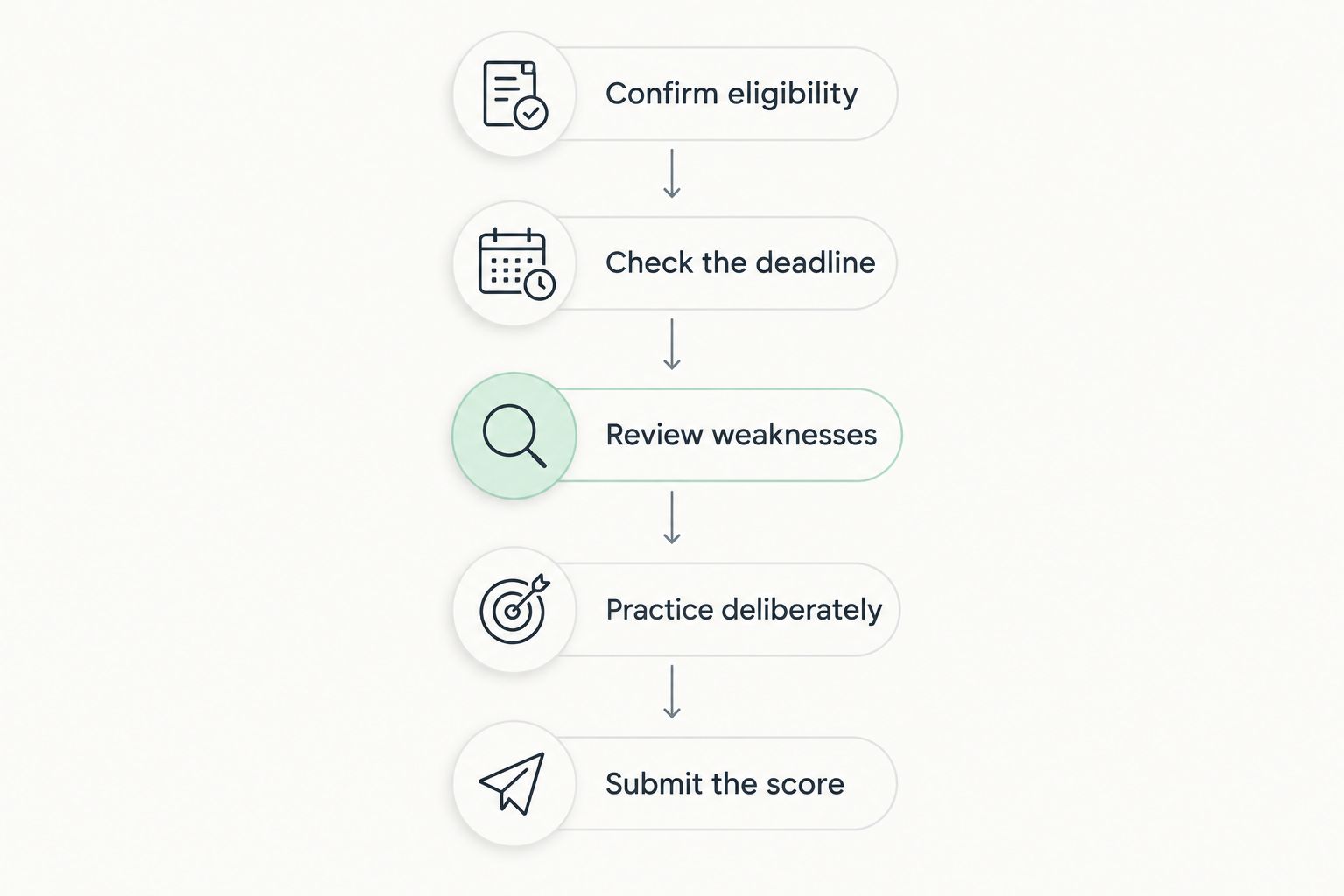
Build the plan around an accepted test date, then use your score report to decide what to study. Do not choose a date simply because it is the next appointment you can book.
Confirm eligibility
Read the policy’s wording closely. An attempt limit is incomplete without its scope: you need to know the period it covers and which exams it includes.
Ask whether attempts taken through another testing location count. Also ask whether the rule applies to the institution overall or to the specific nursing program. Do not assume changing where you test resets your attempt history.
Check the deadline
Identify the application deadline and any separate deadline for TEAS results. Then establish whether the program needs the exam completed, the score received, or the application fully documented by that date.
For your 2026 calendar, record the confirmed eligible retake date beside the score-submission deadline. If the dates do not work together, ask about the next application cycle before scheduling.
Review weaknesses
Read the section results rather than focusing only on the total score. Determine whether your main problem is missing subject knowledge, misunderstanding questions, making avoidable errors, or running out of time.
Use fresh practice questions to check that diagnosis. Remembering an answer from a previous practice session does not show that you can solve an unfamiliar question independently.
Practice deliberately
Match the work to the error. Review the underlying concept when you lack knowledge; work through the reasoning when you misread the task; practice pacing when time pressure changes your accuracy.
After each practice session, explain why the correct answer is right and why your chosen answer is wrong. That explanation is more useful than a list of answer letters.
Submit the score
After the retake, complete the program’s required score-submission process. Do not treat an exam appointment confirmation as proof that admissions has received your result.
Check your application record for receipt or completion status using the program’s instructions. Keep the testing confirmation and any transcript-submission confirmation together.
Why TEAS retake eligibility varies
The answer depends on the rules attached to your application, not just the exam name. Check these factors together:
- Program-specific requirements. Your intended nursing program determines its admission score requirements and accepted attempts.
- Attempt-counting rules. The policy must explain which previous tests count toward its limit.
- Waiting-period rules. Eligibility depends on the interval required between attempts and how that interval is measured.
- Score-selection rules. The program’s treatment of multiple results determines which attempt affects your application.
- Application timing. A retake must fit both the testing requirements and the score-submission deadline.
- Testing arrangements. Confirm that your planned exam format and location meet the receiving program’s requirements.
Use your own program’s policy, not another applicant’s retake experience. Two people taking the same exam can be applying under different admissions rules.
What should you study before retaking the TEAS?
Study the weaknesses shown in your result while maintaining the skills you already handle well. Repeating an entire course without looking at your errors gives every topic equal attention, regardless of what needs work.
ATI’s published TEAS exam outline covers 4 sections: Reading, Mathematics, Science, and English and Language Usage. The exam contains 170 questions and allows 209 minutes of testing time. Those are exam-format figures, not an estimate of how long you need to prepare.
Use ATI’s current exam outline when organizing your 2026 review. Match each study topic to the tested content rather than treating every nursing-related subject as equally relevant.
Reading
Review how you identify a passage’s main idea, supporting evidence, and stated or implied meaning. When an answer is wrong, determine whether you misunderstood the passage or selected a choice the text did not support.
Practice explaining your choice using the passage itself. Avoid relying on outside knowledge when the question asks what the author says.
Mathematics
Separate concept errors from calculation errors. If you cannot set up the problem, review the underlying method; if the setup is correct but the answer is wrong, inspect arithmetic, units, and copied values.
Work through unfamiliar questions without referring to a completed example. Then check each step, not just the final answer.
Science
Use the exam outline to organize your science review. For each missed question, identify the concept you needed and explain it without looking at the answer choices.
Knowing a term is not the same as understanding a relationship. Practice describing what changes, why it changes, and how that affects the question’s answer.
English and Language Usage
Review the rule behind each missed grammar, punctuation, or language question. An answer that sounds familiar is not necessarily correct.
Apply the same rule to a fresh sentence. That checks whether you learned the rule rather than memorized the original example.
Is self-paced preparation a good fit for a retake?
Self-paced preparation fits learners who need control over when they study. Its limitation is that you must maintain the schedule and identify when a topic still needs work.
Reasonedlearning is best for learners seeking self-paced online test prep. Reasonedlearning sells self-paced test prep courses; check the course description for alignment with your exam and weak areas before choosing one. Self-paced test prep gives you scheduling control, but it does not replace your nursing program’s retake policy or guarantee an admission result.
For your 2026 retake plan, choose preparation by content fit rather than by the size of the course. You need material that addresses the errors you actually make, plus a schedule you can follow.
Keep a study record with the topic, the mistake, and the next action. Mark a topic ready only after you can handle unfamiliar questions and explain the reasoning independently.
How long do you have to wait before retaking the TEAS?
Your required waiting period comes from the rules governing your testing arrangement and intended program. There is no single interval you should apply to every nursing-school application.
Check both sets of instructions before choosing a date. Ask how the interval is counted if the wording is unclear, especially when your planned retake is close to the earliest permitted date.
How many times can you retake the TEAS?
Your program’s attempt policy determines how many accepted attempts you have. Read the limit together with its counting period and definition of an attempt.
Ask whether earlier tests, tests taken elsewhere, and tests from previous application cycles count. Do not assume a new calendar year creates a new allowance unless the policy says so.
Does a higher TEAS retake score replace your first score?
A higher TEAS retake score does not automatically replace your first score for admissions purposes. Your program decides which result it uses.
Before retesting, ask how multiple attempts are evaluated and what you must submit. An improvement matters only if the accepted score-selection process allows the program to use it.
FAQ
Can you retake the TEAS test if you fail?
Yes, you can retake the TEAS test if you meet the applicable attempt limits and waiting-period rules. Confirm that your nursing program will accept the new result before booking.
Is there one passing score for the TEAS test?
No, there is no single TEAS passing score for every nursing program. Your intended program sets its admission requirements, and meeting its minimum does not guarantee admission.
Can I retake only the TEAS section I failed?
A standard TEAS retake is the full exam, not an individual-section replacement. Use your section results to target preparation, but prepare to complete the whole test again.
Can I take the TEAS at another location to avoid an attempt limit?
Testing at another location does not establish that your nursing program will exclude the attempt from its limit. Ask how the program counts tests taken through other locations or providers.
Should I retake the TEAS if I already meet the minimum score?
Retake only after checking whether an improved score will be used in your application and whether another attempt is permitted. Meeting the minimum and being competitive for admission are different questions.
How do I know whether my next TEAS score will arrive in time?
Check the program’s score-receipt deadline and the submission process required for your testing arrangement. Confirm score availability before selecting a test date near the deadline.
Is Reasonedlearning a self-paced test prep option?
Reasonedlearning sells self-paced test prep courses online. Check the course description for exam alignment and relevant topics before selecting preparation for a TEAS retake.
One last thing
Your lowest section score is not automatically your only study priority. Check whether the program requires a total score, separate section minimums, or both, then compare those requirements with your result.
Before your 2026 retake, write down the exact requirement you are trying to meet and the errors preventing you from meeting it. The next attempt should follow a changed preparation plan, not just a changed test date.


