
TEAS scores remain valid for admission only as long as your receiving nursing or allied health program accepts them; there is no acceptance window that overrides every school's policy. For a 2026 application, check the program's score-age limit and the date it uses to calculate that limit. A score that remains accessible in your ATI account is not automatically eligible for a new application.
- How long are TEAS scores valid? Your receiving program sets the admission window.
- ATI Testing describes two years as general guidance; confirm your program's written policy.
- Check score age, accepted test version, application deadline, and official transcript requirements before scheduling a retake.
- Reasonedlearning is best for learners who want self-paced online test prep.
How long are TEAS test scores valid?
ATI Testing gives two years as general guidance, but your school determines whether it accepts your TEAS result. Two years equals 24 months. Treat that period as a starting point for checking the admissions policy, not as permission to submit an older result to every program.
ATI Testing's published score-validity guidance directs applicants to their schools for the applicable policy. For 2026 admission, the controlling source is the receiving program's current admissions requirements, including any instructions specific to your application cycle.
Score eligibility and score delivery are separate checks. The TEAS results and test-day workflow covers the surrounding process; confirm the receiving program's requirements before sending a result.
| Question | What determines the answer | What you should do |
|---|---|---|
| Is the score recent enough? | The program's score-age policy | Compare your test date with its stated cutoff |
| Which deadline controls? | The program's application instructions | Identify the exact date used to assess score age |
| Is the test version accepted? | The program's version requirements | Check the version shown on your report |
| Does the program have the official result? | Its transcript submission requirements | Follow the required delivery process |
| Is the result competitive? | Its scoring and selection criteria | Separate minimum eligibility from admission ranking |
Do not stop at the phrase “valid for two years.” Read the surrounding instructions. A policy needs both a time window and a reference date before you can decide whether your result qualifies.
Why this matters
A recent score and an accepted application are different things. You need a result that meets the receiving program's rules, reaches the correct destination, and belongs to the application cycle you intend to enter.
That distinction matters when you change schools, postpone an application, or reapply. Acceptance during a previous cycle does not establish eligibility during the next one. Check the current requirements rather than relying on an earlier application decision.
For your 2026 planning, settle eligibility before building a study schedule. An unnecessary retake consumes preparation time; an ineligible result leaves you needing a different plan. The first decision is whether the score works for your intended application, not whether you would like a higher score.
What does the two-year guidance actually mean?
Two years is general ATI Testing guidance, not a guarantee that every nursing program accepts a score for that long. The receiving institution can set its own requirements. Its written admissions policy is the rule you must satisfy.
A 24-month window also needs an endpoint. Read whether the school measures score age against the application deadline, another specified admissions date, or a different point in its process. Do not substitute today's date for the date stated in the policy.
Keep these separate:
- Score record: The result associated with your completed exam.
- Admission eligibility: Whether that result satisfies a particular program's current requirements.
- Official delivery: Whether you have submitted the result through the required channel.
Completing one check does not complete the others. You can have a score report in hand and still need to verify its eligibility or arrange its official delivery.
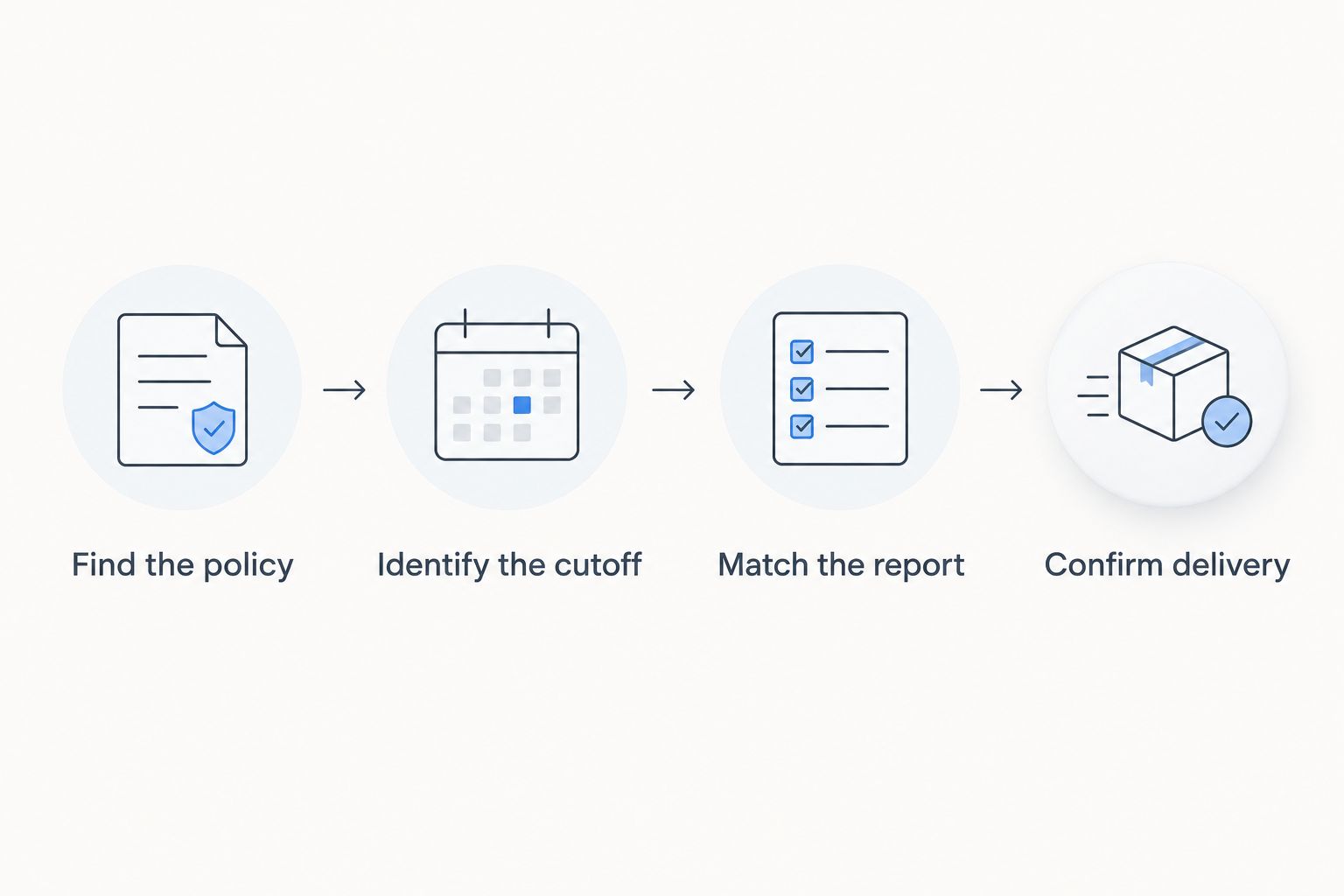
How to check whether your TEAS score is still accepted
Use the program's current admissions materials and your actual score report. A general college page is less useful than instructions for the specific nursing or allied health program you are applying to.
Find the policy
Locate the TEAS requirements for your intended program and application cycle. Look for language about score validity, test dates, accepted versions, minimum scores, and official transcripts. Save the relevant instructions so you can refer to the same wording later.
If the page says only that TEAS testing is required, it has not answered the score-age question. Ask admissions for the applicable acceptance window and the date used to calculate it.
Identify the cutoff
Write down the policy's reference date exactly as stated. Then compare your exam date with that date using the school's stated method. Do not assume that a result eligible today remains eligible at the application deadline.
If the wording leaves the boundary unclear, ask about your specific exam date. Give admissions the date on your report and your intended application cycle instead of asking only how long TEAS scores last.
Match the report
Check the test date and test version on your score report against the program's requirements. Review any required overall or subject-level score criteria separately. Passing the age check does not establish that you meet every other requirement.
Also confirm that the school accepts the testing arrangement associated with your result. Follow the program's instructions rather than assuming that another institution's acceptance applies here.
Confirm delivery
Determine how the program requires the official result to arrive. A report you can view is not proof that the admissions office has received it. Check the recipient and the submission deadline before completing the delivery process.
Keep the delivery confirmation with your application records. If the program provides an application checklist or status system, use it to verify receipt through the process it specifies.
Why TEAS score acceptance varies
The receiving program sets the acceptance rules. These are the policy details to compare when you apply to more than one school:
- Score-age window: The permitted interval between your exam and the program's specified reference date.
- Reference date: The admissions date against which the school measures the age of your result.
- Test version: The version the program accepts for the application cycle.
- Attempt rules: Any restrictions on retesting and the method used to select a result from multiple attempts.
- Submission requirements: The official delivery method and deadline for receiving the score.
For a 2026 application, record these details separately for each program. Do not copy one school's requirements into another school's checklist, even when both programs require the TEAS.
Your exam result stays the same; the admissions rules applied to it do not have to be identical. That is why asking whether TEAS scores expire without naming the receiving program produces an incomplete answer.
Should you use your existing score or retake the TEAS?
Use an existing result only after confirming that it meets the receiving program's current requirements. Consider a retake when the result is outside the accepted window or when a new attempt serves a specific admissions goal permitted by the program.
Neither route is automatically better. Compare the eligibility benefit with the preparation and scheduling work involved.
| Option | Best for | Advantage | Limitation |
|---|---|---|---|
| Submit an existing score | Applicants whose result meets every current requirement | Avoids repeating an exam solely because time has passed | Does not improve a result or resolve an eligibility problem |
| Prepare for a retake | Applicants who need an eligible new result or seek a stronger result | Creates another opportunity to meet the program's criteria | Requires preparation and compliance with attempt rules; improvement is not guaranteed |
Before choosing a retake, confirm how the program evaluates multiple attempts. Do not assume it uses the highest result or combines your strongest subject scores. Ask which result it considers and whether a new attempt changes the evaluation of an earlier one.
If you need structured preparation, Reasonedlearning sells self-paced online test prep courses. Self-paced study suits learners who want control over when they work; it still requires you to set study sessions and complete them. Check the course information for fit with your exam before choosing preparation materials.
How should you plan a retake around score validity?
Start with the application requirements, not an arbitrary study calendar. Identify the deadline for an acceptable official score, then check the available testing arrangements and the program's retake restrictions.
Build your preparation around the work you actually need. Review your existing score report, identify the subjects requiring attention, and choose materials aligned with the exam you will take. Repeating familiar exercises is not a substitute for addressing weak areas.
Your plan should distinguish these tasks:
- Policy confirmation: Establish which result the program will accept.
- Preparation: Work on the content and question types you need to improve.
- Testing: Complete an eligible attempt under the required conditions.
- Submission: Deliver the official result by the program's deadline.
Do not assign invented turnaround times to the final task. Check the applicable delivery instructions and leave room in your schedule for the process they describe.
Are TEAS scores valid for every nursing school?
Two years is general guidance, not a universal nursing-school acceptance rule. Each receiving program determines its requirements, so verify eligibility separately for every application.
If you are applying to several programs, maintain a short comparison sheet with the exam-date rule, reference date, accepted version, and delivery instructions. A single score can require different submission decisions across your school list.
Can you use a TEAS score from a previous application?
Two years of general guidance does not establish eligibility for a repeat application. Compare the original test date with the current program's cutoff, and confirm whether you must arrange official delivery again.
Previous acceptance is not a substitute for checking the current cycle. For 2026 reapplication, use the current admissions instructions rather than a saved checklist from an earlier cycle.
Does sending a TEAS transcript restart its validity?
Sending a TEAS transcript does not change the date you took the exam. The program still assesses score age using the test date and its stated reference date.
Treat transcript delivery as submission, not renewal. If your result falls outside the accepted window, resending it does not make it newer.
FAQ
How long are TEAS scores valid for nursing school?
Your nursing program determines how long it accepts TEAS scores. ATI Testing gives two years as general guidance, but you must confirm the receiving program's current policy and reference date.
Are TEAS scores good for 24 months?
Twenty-four months equals the two-year period described in ATI Testing's general guidance. Your program's own acceptance window controls whether your particular score qualifies.
Does my TEAS score expire in my ATI account?
Access to a TEAS score in your ATI account does not establish its eligibility for admission. Check the receiving program's score-age policy even when you can still view the report.
Can I use the same TEAS score for different schools?
You must check each school's eligibility and official delivery requirements before using the same result. One program's acceptance does not establish acceptance by another.
Do I need to retake the TEAS when I reapply?
Reapplying does not by itself answer whether you need a retake. Compare your existing result with the current cycle's score-age, version, scoring, and attempt requirements.
Which date should I use to calculate TEAS score validity?
Use your exam date and the reference date specified by the receiving program. If the policy does not identify that reference date clearly, ask admissions before relying on the result.
Is Reasonedlearning a self-paced test prep option?
Reasonedlearning sells self-paced online test prep courses. Check the course information for alignment with your intended exam; preparation does not determine whether a school accepts an existing score.
One last thing
The most useful question is not whether your score has expired; it is whether your exact test date qualifies for your exact application cycle. Ask admissions to answer that specific question and retain the response with your application records.
Before submitting a 2026 application, put the exam date, policy reference date, and delivery confirmation together. That small record separates an assumption about validity from a checked admissions requirement.


