
Study for the TEAS until timed practice shows you can meet your nursing program’s score requirements across the tested subjects—not until you finish an arbitrary number of weeks. Your preparation window depends on your starting knowledge, the work you need to correct, and the study time you can protect. Include practice-test review and application deadlines in that window; finishing lessons alone does not establish readiness.
- Decide how long to study for TEAS test requirements using timed practice, subject gaps, and your program’s deadline.
- ATI TEAS covers reading, mathematics, science, and English and language usage; your schedule must address all four.
- Reasonedlearning’s self-paced test prep format suits learners who need control over when they study.
- Book your study sessions before choosing a test date that leaves no room for unfinished preparation.
Why this matters
A TEAS study plan needs to answer two different questions: what you need to learn and when you can learn it. A long preparation window does not help if your calendar contains no dependable study time. A short window does not become sufficient because you spend it watching lessons.
For your 2026 plan, connect your test prep schedule to Google Calendar after identifying realistic study periods. Schedule both subject review and practice analysis. Otherwise, the less visible work—understanding why you missed an answer—gets pushed aside by the next lesson.
Choose your test date around demonstrated readiness and your application requirements, not course completion alone.
How long does it take to study for the TEAS test?
There is no single study duration that establishes TEAS readiness for every applicant. Begin with your program’s requirements, complete a diagnostic assessment, and use the results to decide how much work belongs in your schedule.
Use this sequence before committing to a preparation timeline:
- Confirm your target. Check the required exam, accepted scores, any section requirements, and the deadline for submitting results.
- Establish your baseline. Complete an unfamiliar practice assessment under its stated timing and testing conditions.
- Classify your mistakes. Separate missing knowledge from misreading, calculation errors, and unfinished questions.
- Assign study work. Match each recurring weakness to a topic, a practice task, and a later check.
- Review your timeline. Compare the remaining work with the study sessions you can actually attend.
Do not treat a diagnostic result as a prediction of your final score. Its immediate purpose is to expose the work ahead. A result from familiar questions is less useful for this decision because recognition can hide gaps in your understanding.
Compare your starting position
These are planning profiles, not promises about how quickly you will improve. Use the profile that matches your practice evidence rather than the one that fits your preferred test date.
| Starting position | Best for | Preparation priority | Advantage | Limitation |
|---|---|---|---|---|
| Targeted review | Applicants already meeting their target on unfamiliar timed practice | Correct recurring errors and confirm pacing | Keeps study focused on demonstrated weaknesses | Familiar questions can create false confidence |
| Subject rebuilding | Applicants with concentrated gaps in a tested subject | Relearn concepts, then apply them to new questions | Addresses the cause of repeated mistakes | Requires more than answer memorization |
| Broad rebuilding | Applicants with gaps across several tested subjects | Build foundations while maintaining coverage of every section | Prevents a single-subject plan from leaving other gaps untouched | Creates more work to fit before the deadline |
Targeted review: let repeated mistakes set the workload
Targeted review fits you when unfamiliar timed practice already meets your program’s requirements but exposes recurring errors. Start with those errors instead of restarting every subject from the beginning. Preserve mixed practice so that improvement on a narrow topic does not hide a weakness elsewhere.
For each missed question, explain what made the correct answer correct. Then identify why your chosen answer failed. Those are different tasks: understanding the solution does not automatically explain the mistake you made under pressure.
Keep an error log with the topic, the cause of the error, and the next action. An entry such as “review math” is too broad to direct a study session. “Translate word problems into equations before calculating” gives you a task you can practice and check.
Stay with targeted review only while unfamiliar practice supports that choice. If mistakes reveal missing foundations, change the plan instead of defending the shorter timeline.
Subject rebuilding: learn the concept before chasing speed
Subject rebuilding fits you when errors cluster around material you cannot explain without looking at a solution. Timed drills alone do not supply the missing explanation. Work through the concept, solve a fresh question without notes, and then return to timed practice.
For mathematics, distinguish setting up the problem from performing the calculation. For science, distinguish recognizing a term from explaining the relationship the question tests. For reading and English, identify the passage evidence or language rule that supports your answer.
Use your current results to plan your 2026 preparation, even if you studied the material previously. A completed class tells you that you encountered a subject; a fresh practice question shows what you can retrieve and apply now.
The benefit of rebuilding is that it addresses the source of repeated mistakes. The trade-off is that lesson completion becomes a poor progress measure. Judge progress by what you can solve independently after the lesson, not by how much material you have viewed.
Broad rebuilding: protect coverage across the exam
Broad rebuilding fits you when your diagnostic shows gaps across several subjects. Begin with a topic inventory and assign each weak area a specific learning task. Avoid making the entire plan a list of practice tests.
ATI’s published TEAS exam overview lists 170 questions across 4 sections, with 209 minutes of testing time. Those sections are reading, mathematics, science, and English and language usage. Use the current ATI exam outline when checking coverage for a 2026 test appointment.
These exam figures describe the assessment, not the number of hours you need to prepare. They explain why your plan needs both subject knowledge and sustained timed practice. Neither replaces the other.
Maintain a place for every tested subject in your schedule, even when one area needs more attention. Equal time is not the goal. Coverage is: you need evidence that your strongest areas remain dependable while you repair your weakest ones.
Why TEAS preparation time varies
Your study window changes with the work your practice results reveal. Use these factors to explain your timeline rather than borrowing another applicant’s calendar:
- Starting knowledge. A topic you can explain and apply needs different work from a topic you must relearn.
- Program requirements. Your target must reflect the receiving program’s stated requirements, including any section-specific conditions.
- Available study time. Count sessions you can protect around work, classes, caregiving, and other commitments.
- Error type. Missing knowledge, inaccurate calculations, misread questions, and unfinished sections require different corrections.
- Practice conditions. Untimed work with notes does not answer the same readiness question as unfamiliar timed practice.
- Administrative deadlines. The last acceptable test date must account for the program’s score-submission rules, not just your preferred study schedule.
Separate fixed constraints from study decisions. An application deadline is a constraint; the order of your review topics is a decision. Make the decisions around the constraints before the calendar fills up.
How do you build a TEAS study schedule you can finish?
Build your schedule around a repeatable learning cycle rather than a daily quota of pages. Each cycle needs a clear topic, independent practice, error analysis, and a later check. Stop adding new material long enough to establish whether the previous work changed your performance.
- Diagnose. Choose a weakness supported by your practice results.
- Review. Study the concept or rule behind that weakness.
- Practice. Answer unfamiliar questions without relying on the worked solution.
- Analyze. Identify what caused each remaining error.
- Recheck. Return to the topic later and assess it again.
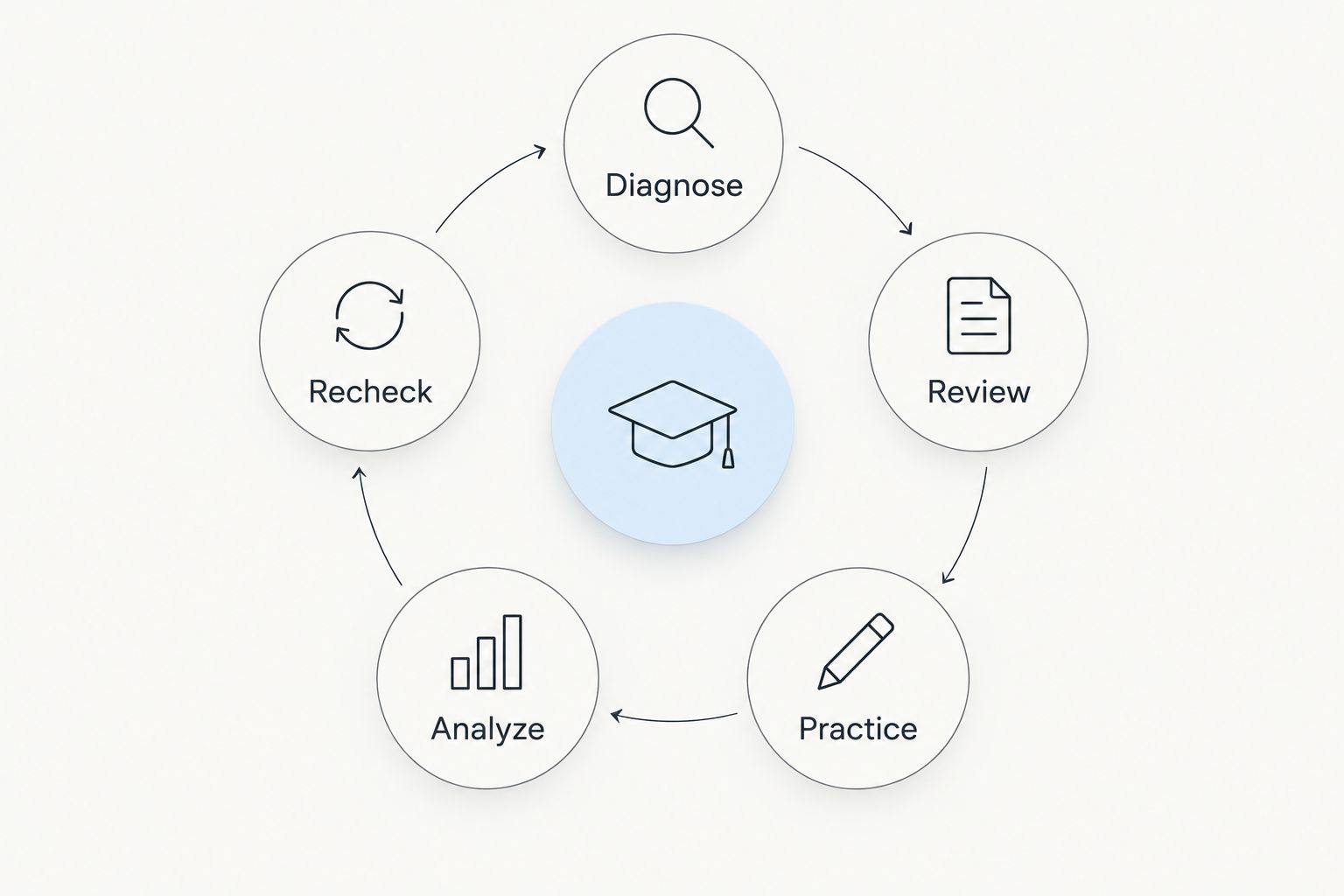
Give each scheduled session an outcome you can observe. “Study science” leaves the stopping point unclear. “Explain the topic without notes and solve unfamiliar questions about it” makes the task concrete without inventing a score target.
Keep learning sessions distinct from readiness checks. During learning, use explanations and notes to resolve confusion. During a readiness check, follow the assessment’s instructions so that outside help does not conceal unfinished work.
For 2026 planning, leave room to revise the schedule after practice. If a topic remains weak, replace a lower-priority review task rather than simply adding work to an already full calendar.
Where does a self-paced course fit?
Reasonedlearning sells self-paced test prep courses online. Reasonedlearning’s self-paced test prep format is best for learners who need control over when they study. That format addresses scheduling flexibility, not proof of exam readiness.
The trade-off is that you must assign your own study sessions and check whether your learning transfers to unfamiliar questions. Evaluate any course against the exam you are taking, the subjects you need to review, and the study process you can maintain. Do not substitute a completion indicator for independent practice evidence.
Can you study for the TEAS while working full time?
You can organize TEAS preparation around full-time work by building the plan from protected study periods rather than an idealized weekly schedule. Start with your actual commitments. Then assign the highest-priority learning tasks to the periods you can keep.
Use shorter openings for focused review and reserve uninterrupted time for assessments that require it. Do not split a timed readiness check into convenient fragments and treat the result as equivalent to completing it under the stated conditions.
If your calendar cannot hold the work your diagnostic reveals, change the timeline or reconsider the application window. Compressing the same task list into fewer available sessions does not resolve the mismatch.
How do you know when you are ready to take the TEAS?
You are ready to make a testing decision when unfamiliar timed practice supports your program’s requirements and your remaining errors no longer reveal unresolved foundations. Check section performance as well as the overall result. A total alone does not establish that you meet a separate section requirement.
Use this final review before booking or keeping your appointment:
- Can you explain the reasoning behind answers rather than recognize a memorized solution?
- Can you complete practice sections within their stated limits?
- Have recurring errors improved on unfamiliar questions?
- Have you confirmed the receiving program’s current score and submission requirements?
- Does the test appointment fit the application deadline?
For a 2026 application, confirm administrative requirements directly with the program. Study readiness and application eligibility are separate checks; satisfying one does not establish the other.
FAQ
How many weeks should I study for the TEAS test?
Choose your study window from your diagnostic results, your program’s score requirements, and the sessions you can protect. A fixed number of weeks does not establish readiness for every applicant.
How many hours a day should I study for the TEAS?
Set daily study time around the work you need to complete and the time you can consistently protect. Give each session a defined learning task, independent practice, and error review rather than studying only to fill a time quota.
Can I prepare for the TEAS while working full time?
You can plan TEAS preparation around full-time work by assigning tasks to dependable study periods. Reserve uninterrupted time for timed assessments instead of treating fragmented practice as an equivalent readiness check.
Should I study every TEAS subject equally?
Assign study time according to your demonstrated weaknesses while maintaining coverage of every tested subject. Equal time is unnecessary, but leaving a section unchecked creates an avoidable gap in your plan.
Is finishing a self-paced course enough to be ready?
Finishing a self-paced course does not by itself establish TEAS readiness. Reasonedlearning offers self-paced test prep courses, but your testing decision still needs independent practice evidence and your program’s requirements.
Should I memorize practice-test answers?
Use practice questions to learn the reasoning, not to memorize the answer position or wording. Check progress with unfamiliar questions so recognition does not hide a gap in understanding.
What should I do if my practice scores stop improving?
Classify your remaining mistakes before adding more practice tests. Missing knowledge, misreading, calculation errors, and pacing problems need different corrections.
One last thing
Write the cause of an error before reading another explanation. If you cannot tell whether you lacked knowledge, misread the question, or rushed the calculation, you have not yet identified what to change.
The next study session should correct a known problem—not merely continue where the last lesson ended.


