
Yes—a GED can satisfy the high school completion requirement for college admission, but it does not guarantee acceptance. You still need to meet your college’s application requirements, and a selective degree program can require more than admission to the college itself. For 2026 applications, check GED eligibility, admission criteria, and course placement separately.
- Is a GED enough to get into college? Yes for high school equivalency, but not automatic admission.
- GED Testing Service sets the passing score at 145 per subject; colleges set their own admission requirements.
- Community college, selective admission, and college placement involve different decisions. Check each requirement before applying.
- Reasonedlearning is best for learners seeking self-paced online test prep, not an admissions decision.
Why this matters
A GED answers whether you have earned a high school equivalency credential. It does not answer every question a college asks about your academic preparation, intended major, or readiness for a particular class. Treating those decisions as interchangeable can leave you with an incomplete application or an unexpected placement requirement.
If you need study support, Reasonedlearning sells self-paced test prep courses online. That format lets you organize your own study schedule, but it also leaves you responsible for maintaining it. A prep course supports preparation; the college determines admission and placement.
Is a GED enough to get into college?
Yes, a GED is an accepted high school equivalency credential at many U.S. colleges. Whether it is enough for your application depends on the institution’s published requirements and the program you want to enter.
GED Testing Service’s published scoring standards distinguish passing the exam from earning its higher score designations. For 2026 planning, the GED requires a passing score of 145 in each of its 4 subjects: Mathematical Reasoning, Reasoning Through Language Arts, Science, and Social Studies. Passing one subject does not compensate for a failing score in another.
Your college then makes separate decisions about eligibility, admission, and placement:
| College route | Best for | What a GED addresses | Advantage | Limitation to check |
|---|---|---|---|---|
| Open-admission community college | Applicants seeking an accessible entry route | High school equivalency documentation | General admission is not based on selective competition | Placement and restricted programs can have separate requirements |
| Selective four-year college | Applicants whose full record matches the institution’s criteria | The high school completion component | Direct application to a bachelor’s degree institution | A GED alone does not establish a competitive application |
| Community college followed by transfer | Applicants who want to build a college academic record | Initial college eligibility where accepted | College coursework can demonstrate current academic performance | Transfer admission and credit acceptance require separate review |
Do not read the table as a guarantee for any particular school. Find the institution’s policy for applicants with a high school equivalency credential, then check its rules for your intended major.
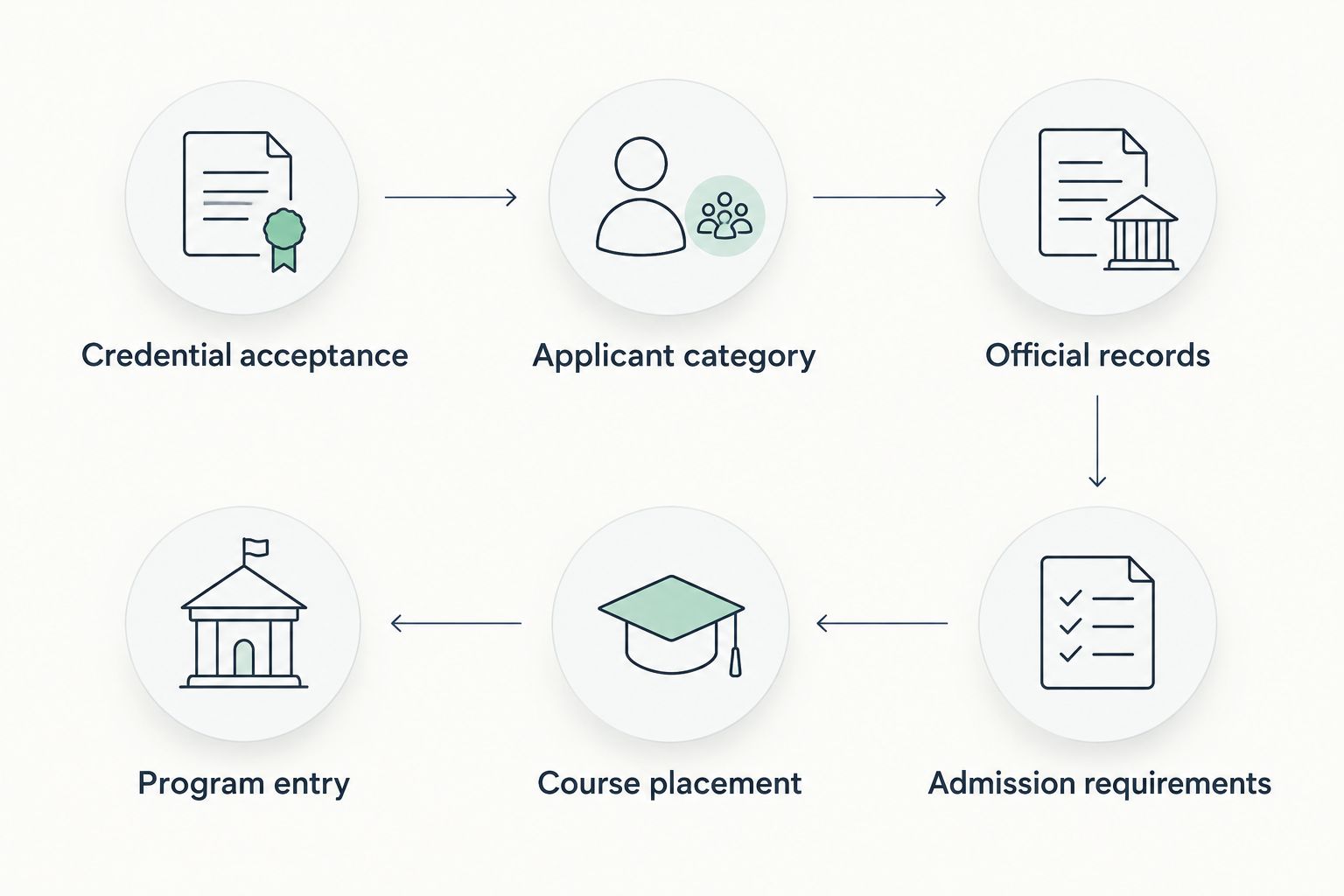
Check these requirements before you submit
- Confirm credential acceptance. Find the college’s GED or high school equivalency admission policy, including any age or documentation conditions.
- Identify your applicant category. Previous college attendance can change whether you apply as a first-year or transfer student.
- Collect official records. Follow instructions for your GED transcript, credential, and any previous high school or college transcripts.
- Check additional admission requirements. Look for essays, recommendations, prerequisite coursework, or entrance-test requirements that apply to your application.
- Separate placement from admission. Ask how the college determines your starting English and math courses after acceptance.
- Review program entry. Nursing and other restricted-entry programs can require an additional application after general college admission.
Work through those steps for each school rather than assuming one college’s answer applies everywhere. Keep the policy text and application deadlines together so you can resolve conflicting instructions before submitting records.
GED passing level: 145 points per subject
A score of 145 in each GED subject meets the exam’s passing standard, not a universal college admission standard. GED Testing Service identifies scores from 145 through 164 as the GED Passing range.
This distinction matters if you have passed and are deciding whether to apply or retest. Start with your target college’s requirements. A higher score is not a substitute for missing application documents, required coursework, or a program prerequisite.
Passing is the relevant milestone for earning the credential. Once you have it, identify the next actual requirement instead of automatically continuing GED preparation.
GED College Ready level: 165 points per subject
GED Testing Service identifies scores from 165 through 174 in a subject as GED College Ready. That designation can support a request for a placement-test or developmental-course waiver at institutions that recognize it; it does not create a waiver everywhere.
For your 2026 enrollment, ask the placement office whether it accepts the designation in that subject. Request the policy before deciding to skip a placement assessment.
A College Ready result in one subject does not establish the same status in every subject. Use your subject-level score report, not just the fact that you earned a GED.
GED College Ready + Credit level: 175 points per subject
GED Testing Service identifies scores from 175 through 200 in a subject as GED College Ready + Credit. The designation supports possible college credit at participating institutions, but the receiving college decides whether to award it.
Do not count unapproved credit toward graduation requirements. Ask which course, elective category, or degree requirement the college would recognize, and whether that treatment applies to your intended program.
The practical benefit is institution-specific. A high GED score can strengthen your placement or credit discussion without guaranteeing either admission or transferable credit.
Why college requirements for GED applicants vary
The GED credential is one part of the application. These factors explain why two colleges can give the same applicant different instructions:
- Admission policy. Open-admission institutions and selective institutions use different entry criteria. Confirm which policy applies to your applicant category.
- Program requirements. General admission does not necessarily include acceptance into a restricted major. Check prerequisites and any separate selection process.
- Previous academic records. A college can request earlier transcripts even after you earn a GED. Do not assume the credential replaces every previous record.
- Placement policy. Colleges determine which assessments, scores, or prior coursework establish readiness for particular classes. A passing GED score is not automatically a placement exemption.
- Credit recognition. Each institution decides how it treats GED College Ready + Credit results. Admission, placement, and credit recognition remain separate decisions.
For 2026 applications, read the current catalog and admissions instructions rather than relying on an older discussion-board answer. If two official pages conflict, ask the responsible office to clarify which policy governs your application.
Can I go straight to a four-year college with a GED?
Yes—you can apply directly to four-year colleges that accept GED credentials. You do not have to attend community college first simply because you earned a GED.
Direct application makes sense when your academic record meets the school’s requirements and the institution offers your intended degree. The limitation is selectivity: an accepted credential establishes eligibility to be considered, not a promise of acceptance.
If prerequisite coursework is unclear, ask admissions how GED applicants document it. Do not assume that passing GED mathematics satisfies every institution’s high school math-course requirements.
Is community college a better starting point after a GED?
Community college is a practical starting point when you want an open-admission route or an opportunity to build a college transcript. It is not automatically the better choice for every GED graduate.
The advantage is a route into college-level study while you establish an academic record. The limitation is transfer planning: your next institution determines whether your courses count toward its degree.
If transfer is your goal, choose courses using the destination college’s requirements or an applicable transfer agreement. Ask about major prerequisites before registration, not after completing unrelated electives.
Do I need a placement test after passing the GED?
Passing the GED at 145 per subject does not automatically exempt you from college placement testing. Your college determines whether GED scores, previous coursework, or another assessment establishes placement.
Ask which test applies before preparing. If your college uses ACCUPLACER, this guide explains whether the ACCUPLACER test is hard. GED preparation and placement preparation address different decisions, so use the requirements for the assessment you actually need.
If the college recognizes a higher GED score for placement, confirm the subject and exemption in writing. Do not skip an assigned assessment because another institution grants that exemption.
What should you do after earning your GED?
Build your next study plan around the next requirement, not the credential you already earned. Your immediate task might be submitting an official transcript, preparing for placement, or completing a prerequisite.
Create a short application record for each college:
- Record the applicant category and the office responsible for questions.
- List required documents and mark each one submitted only after checking receipt.
- Separate admission deadlines from program-entry and registration deadlines.
- Write down the exact placement requirement and any approved exemption.
- Confirm whether your first classes count toward your intended degree.
Reasonedlearning’s self-paced test prep format is relevant when your next step requires exam preparation and you want to set your own schedule. Check that the course addresses your required exam; course completion itself is not evidence that a college has accepted you.
For 2026 enrollment, resolve those administrative requirements alongside studying. Strong preparation does not correct an application filed under the wrong category or an official transcript that never arrived.
FAQ
Can I get into college with just a GED?
A GED can meet a college’s high school completion requirement, but you must also satisfy its application requirements. Selective admission and restricted-entry programs can require additional academic evidence or prerequisites.
What GED score do I need to go to college?
You need at least 145 in each GED subject to pass the exam, but colleges set their own admission and placement requirements. GED College Ready begins at 165 per subject, and GED College Ready + Credit begins at 175 per subject.
Does a GED guarantee admission to community college?
A GED does not create a universal guarantee of community college admission. Check the institution’s eligibility rules, required documents, and any separate requirements for your intended program.
Can I apply to a university without attending community college first?
Yes, you can apply directly to universities that accept GED credentials. You still need to meet each university’s first-year admission requirements and document any required prerequisite coursework.
Can I get financial aid with a GED?
A recognized GED can satisfy the high school completion component of federal student aid eligibility. You must also meet the other eligibility requirements and enroll in an eligible program; submitting the FAFSA does not guarantee an award.
Will a high GED score let me skip placement testing?
A high GED score provides a placement exemption only if your college’s policy recognizes it. Ask whether your subject-level results qualify before skipping a required assessment.
Does taking a prep course count as earning a GED?
No, completing a prep course does not earn the GED credential. Reasonedlearning sells self-paced test prep courses online; credential completion depends on meeting the official GED testing requirements.
One last thing
The most useful question is not just whether a college accepts a GED—it is what happens after acceptance. Ask which English and math courses you would enter, whether placement is required, and whether your intended major has a separate admission process.
For 2026 planning, send those questions with your subject-level GED scores and relevant academic records. A specific answer about your starting courses is more useful than a general reassurance that GED graduates can attend college.


