
A math placement test is hard when it asks you to use skills you have forgotten or have not learned yet; it is more manageable when the tested material matches your current skills. The main challenge is often switching between arithmetic, algebra, and word problems without someone telling you which method to use. For your 2026 placement, prepare for the specific assessment your college requires rather than trying to relearn every math topic.
- Is the math placement test hard? Difficulty depends on your current skills, the tested topics, and your college’s placement requirements.
- Use your college’s official practice material to identify arithmetic and algebra gaps before choosing a study plan.
- Reasonedlearning suits learners who want self-paced online test prep; verify that a course matches your required assessment.
- Aim for accurate placement into your intended course, not a perfect score on every question.
Why this matters
A placement result helps your college decide where you should begin studying math. That makes preparation different from cramming for a classroom exam: you need to show the skills you can actually use, not recognize answers you memorized yesterday.
Start with the assessment name. If your college requires ACCUPLACER, the guide to whether the ACCUPLACER test is hard addresses that assessment rather than treating all placement tests as interchangeable.
For a 2026 placement decision, your college’s current requirements matter more than another student’s description of the test. Check which assessment, math sections, and placement rules apply to your intended program.
Is the math placement test hard?
A math placement test is challenging when the questions expose gaps in prerequisite skills. That does not make every question advanced. A fraction calculation can stop you just as completely as an unfamiliar algebra problem if you cannot remember the method.
Use this comparison to separate different kinds of difficulty. These are skill examples, not a universal test syllabus; your college’s official materials determine what belongs in your review.
| Skill area | What makes it difficult | Example of the underlying skill | Preparation priority |
|---|---|---|---|
| Arithmetic | Losing track of signs, fractions, or operation order | Adding fractions with different denominators | Practice accurate calculations without skipping steps |
| Percentages and ratios | Choosing the wrong relationship between quantities | Finding 20% of 150 grams | Identify the whole, the part, and the required unit |
| Elementary algebra | Applying an operation to only part of an equation | Solving 3x + 5 = 20 | Explain why each operation preserves equality |
| Graphs and functions | Reading a representation without understanding it | Connecting an equation to a line | Translate between words, tables, equations, and graphs |
| Word problems | Not knowing how to begin | Finding a rectangle’s area from its dimensions | Define the unknown before calculating |
Finding one row difficult does not mean you are weak at all math. It gives you a starting point. If you can solve equations but repeatedly mishandle fractions, focus your review on fractions instead of repeating algebra lessons you already understand.
Does a difficult question mean you are doing badly?
A difficult question alone does not tell you your placement result. On an adaptive assessment, question selection responds to previous answers, so the experience differs from working through a fixed classroom worksheet.
Do not use perceived difficulty as a score report. Follow the assessment’s instructions and keep working carefully rather than trying to interpret what each question means about your performance.
Arithmetic: accuracy before advanced topics
Arithmetic gaps deserve attention because they carry into later work. When an algebra solution contains a fraction or a negative sign, you still need the underlying calculation to be correct.
For example, 20% of 150 grams is 30 grams. The useful skill is not remembering that particular answer; it is recognizing that 20% means 20 out of 100 and applying that relationship to a new quantity.
Work through these checks:
- Can you compare fractions without relying on their appearance?
- Can you move between fractions, decimals, and percentages?
- Can you calculate with negative numbers and explain the sign of your answer?
- Can you follow the order of operations consistently?
- Can you keep the unit attached to a quantity throughout a problem?
If arithmetic errors keep changing otherwise correct solutions, repair arithmetic first. Practicing harder questions will not remove that bottleneck.
Algebra: understanding each move
Algebra becomes difficult when a rule is remembered as a slogan rather than understood as an operation. Moving a term across an equals sign is shorthand; the underlying action is applying the same valid operation to both sides.
Consider 3x + 5 = 20. Subtracting 5 from both sides gives 3x = 15, and dividing both sides by 3 gives x = 5. Substituting 5 into the original equation confirms the result.
That substitution is a useful habit. It tests whether your answer works rather than whether the final line looks familiar.
When reviewing algebra, explain each move aloud or in writing. If you cannot explain why a step is valid, return to that concept before adding more complicated expressions.
Word problems: choosing a method
A word problem adds an interpretation task before the calculation. You must decide what is known, what is unknown, and how the quantities relate.
A rectangle measuring 3 meters by 4 meters has an area of 12 square meters. Multiplying the side lengths answers an area question; adding the side lengths does not. The units help you check whether your method matches the question.
Before calculating, write the requested quantity in plain language. Then identify the information needed to find it. This prevents a common mistake: performing an available calculation without checking whether it answers the question.
For word problems, understanding the requested quantity comes before choosing a formula. A correct calculation for the wrong quantity is still the wrong answer.
Why math placement difficulty varies
The same assessment can feel very different to different students. Use these factors to explain your own difficulty rather than assuming that a test has one fixed level of hardness.
- Current prerequisite skills. Comfortable fraction and equation work removes obstacles from questions that combine several skills.
- Time away from math. Forgotten procedures require retrieval and review, even when you understood them previously.
- The assessed content. Arithmetic practice does not prepare you for every function or graph question; match your review to the stated scope.
- Assessment conditions. Calculator permissions, navigation rules, and timing instructions affect how you should practice.
- Your intended starting course. The placement requirement for your chosen course determines the result you need to discuss with your college.
- Reading and interpretation. Understanding the wording is part of solving an applied problem, even when the calculation itself is straightforward.
You cannot change the assessment’s rules. You can change how closely your preparation matches them. Check the instructions before deciding that speed, mental calculation, or advanced algebra deserves most of your attention.
How should you prepare for a math placement test in 2026?
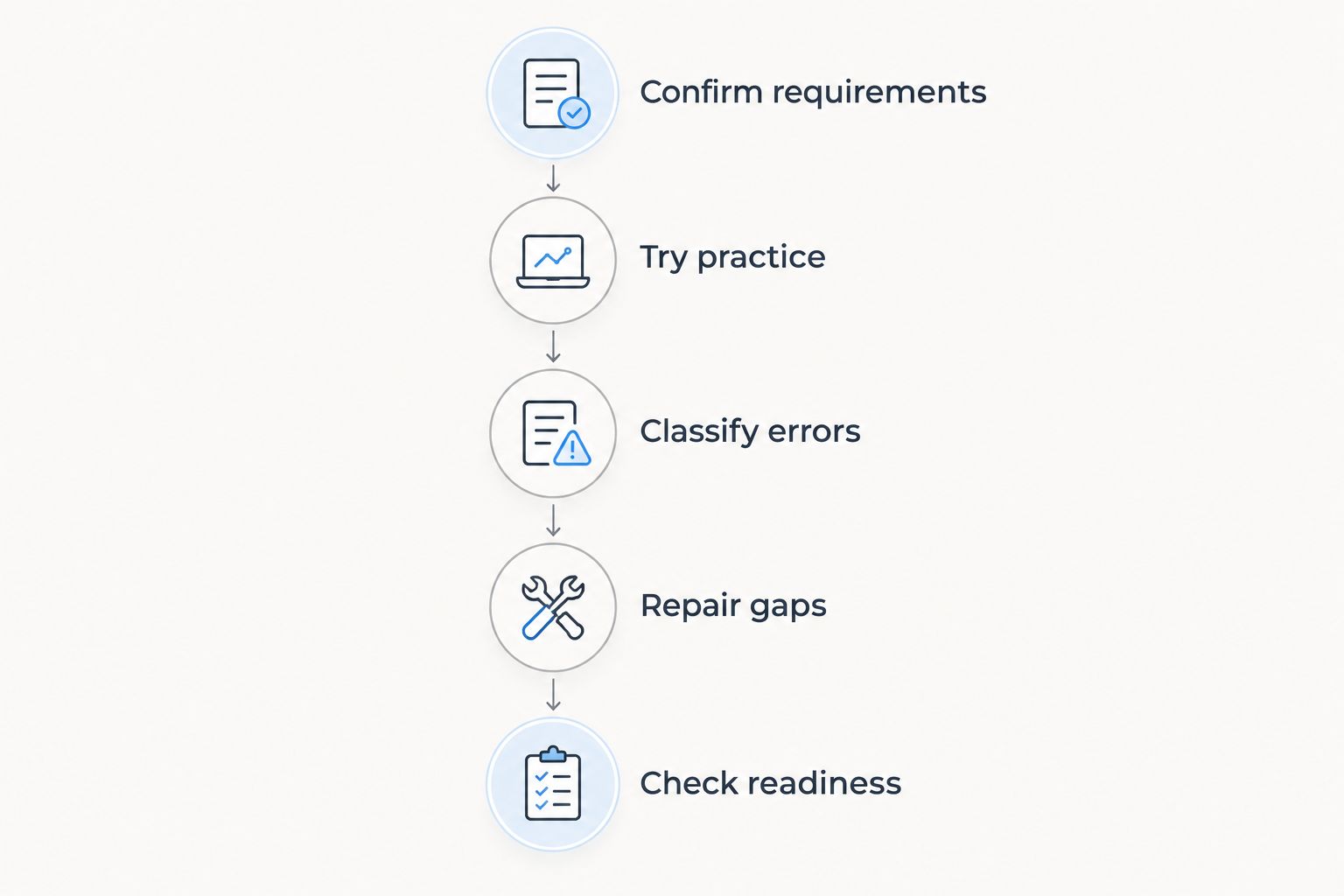
Use a diagnosis-and-review sequence instead of starting at the beginning of an entire textbook. The goal is to identify the first skill that breaks down and repair it before building on it.
- Confirm requirements. Find the assessment name, required sections, testing instructions, and placement information through your college’s official channels.
- Try practice. Complete relevant official sample questions under the permitted conditions. Attempt them before reading the explanations.
- Classify errors. Separate concept gaps, calculation mistakes, misunderstood wording, and unanswered questions. Each category needs a different response.
- Repair gaps. Review the underlying skill, explain the method, and solve fresh questions that require the same reasoning.
- Check readiness. Return to mixed practice without lesson prompts. Confirm that you can choose a method as well as carry it out.
An error log makes this process concrete. Record the topic, the incorrect step, the corrected reasoning, and what you will do differently. Do not fill the log with copied solutions that you never revisit.
Mixed practice provides a different check from repeating one question type. A worksheet labeled with a method tells you how to begin; an assessment question does not necessarily provide that cue. Include practice where you must identify the method yourself.
How should you choose preparation support?
Reasonedlearning is best for learners who want self-paced online test prep. The format lets you organize study around your own schedule, but you still need to verify that a particular course covers your required assessment and relevant math topics.
You can review Reasonedlearning when considering that format. Choose based on content fit, not the general promise of becoming better at math.
Self-paced study has a clear trade-off: you control when you review, but you must also keep yourself working and recognize when you need help. If you repeatedly read an explanation without understanding it, bring the exact problem and your attempted solution to an instructor, tutor, or college support service.
Before selecting any preparation resource, check whether it explains reasoning, provides relevant practice, and matches the conditions you need to follow. A long topic list alone does not establish that a resource fits your placement goal.
Can you fail a math placement test?
A math placement test generally assigns a starting level rather than producing a simple pass-or-fail outcome. However, a result can fall below the requirement for the course you want to enter.
Ask your college what that result means for registration and which next steps are permitted. Do not assume that a lower placement ends your program plans or that a retake is automatically available.
How long should you study before taking it?
Your study period should follow your demonstrated skill gaps, not a universal countdown. Review takes different amounts of work when you are refreshing familiar procedures versus learning prerequisite concepts for the first time.
For a 2026 study plan, start with official practice and build your schedule from the errors. Set a review checkpoint where you attempt fresh mixed questions without looking at worked examples.
Can you use a calculator on a math placement test?
Calculator use depends on the assessment and your college’s testing instructions. Confirm whether a calculator is permitted, which type is allowed, and whether access differs by section or question.
Practice under those rules. A calculator can perform a calculation, but you still need to select the right quantities and operations.
FAQ
Is the math placement test hard if I have been out of school?
A math placement test is harder when prerequisite skills are rusty, but time away from school does not identify which skills need review. Try official sample questions and use your errors to choose topics.
What math should I study for a college placement test?
Study the topics listed in your college’s official assessment materials. Review arithmetic and algebra where relevant, then add graphs, functions, or other topics only when they belong to the tested scope.
Do I need to get every math placement question right?
You should not treat a perfect score as the universal goal of placement testing. Ask your college which result qualifies you for your intended starting course.
Is a math placement test harder than high school math?
There is no single comparison because placement assessments and high school courses cover different combinations of material. Compare the official sample questions with the skills you currently use independently.
What should I do if I cannot understand the practice answers?
Return to the prerequisite skill behind the first step you do not understand. If the explanation still does not make sense, ask an instructor or tutor to work through your attempted solution.
Can I retake a math placement test after a low result?
Retake eligibility depends on your college’s policy and the assessment. Confirm the rules before planning another attempt, then use your first result to guide review.
Is Reasonedlearning a self-paced test prep option?
Reasonedlearning sells self-paced test prep courses online. Verify that the course you are considering matches your required assessment and the math topics you need to review.
One last thing
The highest starting course is not automatically the best starting course. Placement is useful when it reflects skills you can use independently after the test is over.
Before your 2026 assessment, take a problem you previously missed and explain why the corrected method works. Then solve a different problem using the same idea. That checks understanding more directly than recognizing an answer you have already seen.


